


| Newspaper Articles |

|
Newspaper Articles |
 |
 |
21st May 1938, Page: 358, Column: 1
Tunnelling In Hard Rock
By Thomas Bryson, A.R.T.C., M.I.Min.E,
From a paper read before the West Cumberland Mining Engineering Society at Workington Technical College. Concluded from page 338.
Blasting Rounds.
Whatever may be the particular arrangement of shot-holes, and the order and manner of firing the charges, consideration must always be given to the need for presenting the greatest possible degree of freedom to each shot that is fired in the round. As a rule the first series of shots to be fired comprises the "sumpers" the second, the "easers" and the third, the "trimmers." In the case in which a ditch is to be formed at one side of the tunnel, additional "lifters" may have to be drilled and fired.
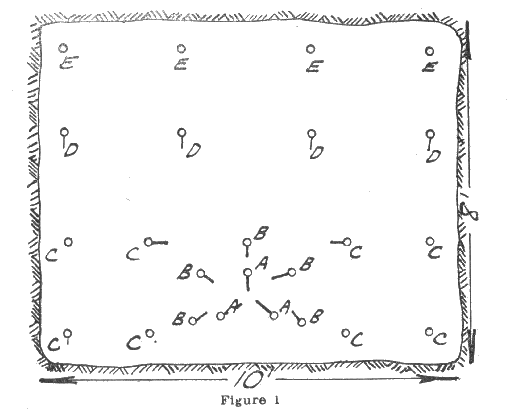
In driving a cross-measures drift 10' x 8' at Rockingham Colliery (see COLLIERY GUARDIAN, 10-12-37) three preparatory sumpers 4' 6" deep were followed by five sumpers proper, and these were bored to a depth of 7 or 8 feet. The easers and trimmers were all drilled to a depth of 7 feet, the inner holes being slightly inclined to the centre, and the outer ones parallel to the roof and sides of the road. The firing took place in series in the following order: A, 3; B, 5; C, 8; D, 8; and E, 4. That arrangement (see FIGURE 1) was decided upon as the best means of ensuring that the debris would be piled towards the roof in a suitable position for removal by scraper loader. The whole time occupied in drilling and blasting a round was from 3 to 3½ hours.
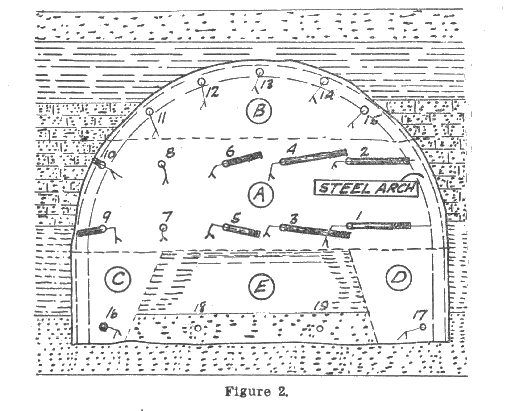
A variant of the foregoing arrangement (FIGURE 2) was adopted in the case of a tunnel 13' x 10' in which nineteen shot-holes were normally drilled in the order indicated in the illustration. In this case it was necessary that the lagged steel arches should be kept close to the face, and on that account, in addition to other reasons of safety and health, it was decided to fire the shots singly, tbe debris being cleared up after the firing of the 10th, 15th, 16th, 17th, and 19th charges. This arrangement had the advantages (a) that miss-fires could not fail to be detected at once, (b) that the dust arising from blasting could be allayed by spraying after each shot, (c) that no heavy accumulation of poisonous gases could take place, (d) that the removal of debris was fairly regular throughout the shift, which was of importance in view of the fact that it was being stowed in adjacent workings, and finally because it admitted of the permanent roof supports being set up at the earliest possible moment. Throughout a length of 350 yards in each of two parallel tunnels the average weekly advance was about 25 yards with an average pull of 4' 6" per round.
The blasting round (FIGURE 3) employed at the Trepca Mines was a standard one, based on the principle of an ordinary wedge cut. The quadrants of the front elevation enclose the holes that were drilled by each machine. The two top machines drilled six and seven holes each, and the lower machines five and six holes each. This arrangement was made because it took longer to drill the lower holes where the operators occupied cramped positions. The use of delay-action detonators enabled the whole of the shots to be ignited by a single discharge of the firing battery, the delay detonators being arranged so that the wedge was blasted first, being followed in turn by the lifters, the rippers, and the final trimmers. The top holes were blasted last, so that the debris was piled against the face, with consequent benefit to the removal of the rock.
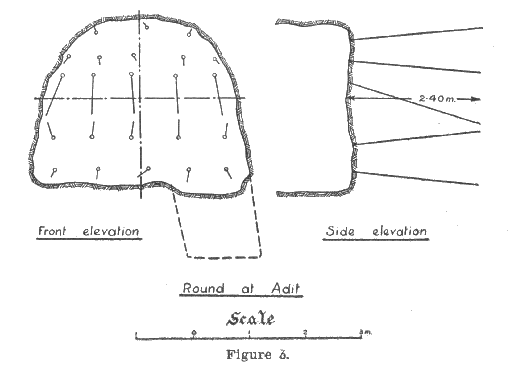
The ditch on one side of the tunnel was normally dug out to a depth of about one yard and a like width by means of paving breakers, and as the digging of the ditch followed up the tunnel at a distance of 150 yards from the face the debris was filled into trucks by hand, the debris from blasting at the face being removed by mechanised shovelling.
Removing the Debris.
Experience of tunnelling confirms me in the belief that the most arduous task is the removal of the debris, especially when it must be shovelled into tubs. The use of hand shovelling may be justified in driving small tunnels, but as a means of dealing with the debris resulting from a large blast it does not appear to be consistent with the idea of organised routine as required for rapid advancement. Much obviously depends on the grade of the tunnel and the dip in relation to the advancing face. Whilst it is not always possible to avoid the employment of manual labour for the filling of debris, it seems desirable, on the ground of expedition, to reduce the effort required of fillers to a minimum. Belt conveyors may be used for the rapid transportation of debris, even in dipping tunnels, but there is no doubt that their use in rising tunnels is more likely to prove beneficial to those who are employed to load them. A level, or slightly rising tunnel, provides a useful field for the application of conveyors, and it is here that the adaptability of the shaking conveyor may be a recommendation for its use in conjunction with a belt conveyor. Being easily lengthened, the shaker can be kept close to the debris, and being comparatively low the effort required of fitters is reduced to a minimum. With such an arrangement of conveyors three fillers can fill out in one shift the rock produced in pulling one round of a 13' x 9' tunnel in which the holes are bored to a depth of 4' 6". In the absence of mechanical transportation of that kind a much greater effort would be required of three fitters to shovel the dirt direct into tubs.
Mechanical methods of filling and transportation are much to be desired when rapid advance is specially important. The Halkyn tunnel (IRON AND COAL TRADES REVIEW, 10-12-37) which is 10' x 8', is at present nearly 7 miles in length, and it has been driven at an average rate of 166 feet per week. In July, 1933, in 31 days, the tunnel was driven a distance of 1,086 feet, the average time for a cycle of operations being 5 hours 26 minutes, the best time cycle being 3 hours 45 minutes. There, the debris was removed by a Sullivan scraper loader.
In driving a tunnel of similar dimensions at Rockingham Colliery, the Sullivan scraper loading outfit was also used with advantage. This loader consists of a structural steel frame, 18 feet long, 5 feet wide, and 5 feet 9 inches high, running on cast steel roller bearing wheels, and on which is mounted a 7½ h.p. compressed air double drum haulage. The haulage is capable of carrying 100 yards of 3/8" flexible steel rope, and it operates a scraper by means of a main sheave mounted at the rear end of the frame, and a tail sheave mounted at the face of the tunnel.
The construction of the Holman scrapeloader is similar. The haulage motor is connected to a double-drum haulage which is situated above the hinged apron. Of special interest to students of mining engineering is the epicyclic gear which is introduced for the purpose of reducing the speed by a compact gear. A longitudinal section of the gear shows the spur wheel to be keyed to the shaft, upon which the drums are loosely mounted. Two sun wheels are keyed to the same shaft and they mesh with three or four planet wheels which are also in mesh with the teeth on the inner surface on the brake wheel. When the toggle lever is out of action the housing of the sun-and-planet wheels is free to rotate and the planet wheels to idle, but when the brake is tightened the rotation of the housing ceases and the planet wheels begin to run round the sun wheel and carry the drum now in gear with them. The spindles of the planet wheels are fitted across the cheeks of the drums. Each drum is similarly fitted.
The tail sheave is suspended by a bolt which is fastened into one of three holes bored in the face of the tunnel according to the situation of the debris to be loaded out. When the empty scrape has been hauled into the face the direction of travel of the haulage rope is reversed, and the scrape is hauled out towards the loader into which it passes by way of the apron and inclined chute. On reaching the opening in the overhanging end of the framework the debris in the scrape is discharged into the truck underneath.
Scrapes are of different shapes, but the Hoe scrape with scalloped cutting edge is most suitable for dealing with rock in tunnels, provided the rock has been reduced in blasting to a suitable degree of fragmentation.
The Ojuela drainage tunnel in Mexico had a total length of 5,412 feet and was 8 feet wide and 9 feet high. it was driven through interbedded limestone and shale, each round of shots being bored to a depth of 5 feet. The average time cycle, blast to blast, was 5 hours 37 minutes, and the best time cycle 3 hours 35 minutes. The maximum day's footage was 43, and the maximum monthly footage 1,001, the average monthly footage being 714. In this case the debris was handled by a Nordberg-Butler shovel, similar to that used at Trepca drainage tunnel. As soon after blasting as was permitted by the clearing away of the smoke, the miners returned to the tunnel and started cleaning up the flyrock. Having done that the shovel was moved into position and clamped down to the track. An empty truck was run up behind the shovel and as soon as that was filled it was withdrawn and another truck put in its place. The trucks were filled in sets of twenty-six, which were then hauled out of the dump by means of an electric storage battery locomotive which weighed 14,000 lb. and could haul a load of 38 tons up a grade of 1 in 200. The average number of trucks filled per round of blasting was about forty, and the time taken to fill one was about four minutes.
Allaying Dust.
Having regard to the devastating effect of silicosis on miners employed regularly in driving tunnels in hard rock containing free silica, those employed in drilling, shot-firing, and filling should be provided with suitable respirators. Wet drilling should be preferred to dry drilling, where possible, and liberal use should be made of the mist projector after firing to allay dust and assist in the removal of poisonous gases. When it is found advantageous to employ dry drilling the dust projected from the shot-holes may be drenched, or trapped by such means as a Hay dust trap, We in the northern coalfields are fortunate in respect to the incidence of silicosis, because, by reason of the fact that the coal measures do not contain rocks high in free silica, few miners have fallen victims to the disease, in the five-year period 1932-6 the number of certificates issued by the Silicosis Board to workmen in England, Scotland and North Wales was 96 out of 488,567 employees, whereas in the Southern group comprising South Wales, Monmouthshire, Forest of Dean, Somerset, and Kent, certificates were issued to 1,207 workmen out of a total of 127,273 employees. These are the quoted figures given in the contribution on "Silicosis in the British Coalfields" by Dr. W. E. Cooke of the Royal Infirmary, Wigan, in the April issue of TUBERCLE.
 |
 |
| Names mentioned in this article | |
 |
 |
| Name | Age | Occupation | Notes |
|---|---|---|---|
| Bryson, Thomas |
 |
 |
| Related Articles | |
|
|
| Pub. Date | Article (Newspaper) |
|---|---|
| 07 May 1938 | Tunnelling In Hard Rock (The Science and Art of Mining) |
| 21 May 1938 | Tunnelling In Hard Rock (The Science and Art of Mining) |



 Contains public sector information licensed under the

