


| Newspaper Articles |

|
Newspaper Articles |
 |
 |
7th May 1938, Page: 337, Column: 1
Tunnelling In Hard Rock
By Thomas Bryson, A.R.T.C., M.I.Min.E.
From a paper read before the West Cumberland Mining Engineering Society at Workington Technical College.
Tunnelling through hard rock is rendered necessary by a variety of circumstances. When shafts are sunk to win a number of seams consideration of the relative advantages of winding and hauling may lead to the decision that the shafts should be sunk to a certain level in proximity to one of the seams, and that tunnels should afterwards be driven to reach other seams to provide a ready means of hauling or conveying the coal won in those seams to the bottom of the shafts. Such an arrangement admits of the centralisation of the winding arrangements with respect to the workings in the various seams and the realisation of the economic advantage of haulage over winding from different levels. See FIGURE 1.
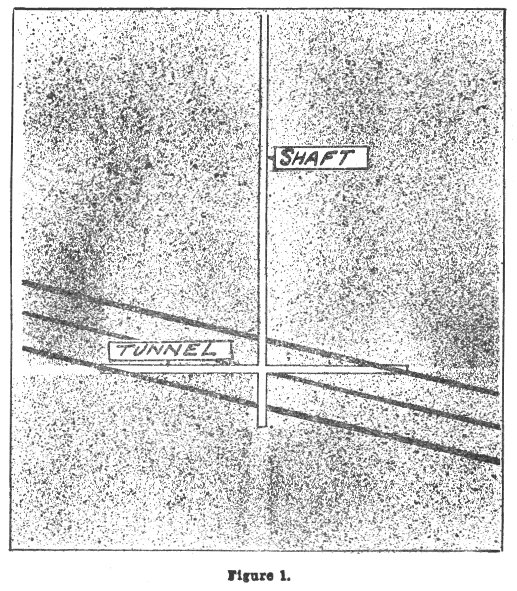
The earth movements which took place after the carboniferous rocks had been deposited in Britain resulted in the denudation of uplifted ridges and the formation of the separate coalfields. Parts of the earth's crust were subjected to considerable tension on the flanks of the ridges and faults were formed, the vertical displacement of some being very great. The occurrence of faults in coal seams necessitates the driving of bard headings across the measures, so that the winning of seams may be continuous over the whole area of the royalty.
Washouts sometimes occur in carboniferous strata, and when these are encountered the recovery of the severed portions of the seams being worked is effected by driving headings through the barren ground in the position formerly occupied by the coal.
In some of the British coalfields igneous rocks are found intruded into the measures as dykes or sills. The tunnels driven through such igneous rocks to connect the severed portions of seams are generally more costly than cross-measure drifts, because of the greater hardness of igneous rocks, and if the rocks are siliceous particular care may have to be taken to prevent the inhalation of free silica. Experience of crushed main roadways in deep mines, and the liability of some coals to spontaneous combustion, may lead to the formation of arterial roadways in hard rock to avoid the destructive effect of weight on the weaker strata enclosing the coal seams and to prevent underground fires.
The shape of the cross-section of cross-measure drifts is influenced by the hardness of the rocks and their depth from the surface. If the sides of drifts are self-supporting the rectangular form may be adopted, but if the excavation is to be lined because of the weakness of the rocks to withstand heavy pressure the section may be made suitable for the use of steel arches as supports. When there is need for the provision of space for the passage of water along the tunnel a ditch may be formed on one side of it, and when the floor is weak the section may be circular.
Tunnelling Routine.
In normal circumstances the various operations performed in excavating the rock in a tunnel are drilling, blasting, removing the debris, and lining the excavation. Some of us can remember the time when such a cycle of operations simply meant a dull round of laborious hand drilling and shovelling dirt. The arduous nature of the work in those days called fur the employment of brawn rather than brain, but now economic considerations generally demand the use of engineering skill in shortening the period required for the completion of the cycle of operations.
During the driving of a tunnel the capital invested in the necessary equipment is tied up, and as interest and depreciation charges increase in proportion with time it is important that the work should be executed in the shortest possible period of time. If the capital available is small and it is decided that the cost of tunnelling should be charged to current cost account, the speed of tunnelling will of necessity be limited and may not be economical because of the reduced speed at which the face of the tunnel advances.
Speed is not achieved by making men perform an increasing amount of manual work, but by the execution of a carefully thought-out scheme of mechanisation by workers who have acquired familiarity with the machines employed in drilling and removing the debris, and are intelligent enough to realise that blasting is necessary not only for the dislodgment of rock but for its proper fragmentation. The chief essential for rapid and economical tunnelling is an effective method of removing the debris resulting from blasting, therefore sufficient thought should be given to blasting practice to ensure that the rock is reduced to a size suitable for rapid handling.
Nowadays, percussive drills, used in conjunction with multiple drill carriages, and loading devices of the scraper and shovel types, march through the rock in orderly procession in accordance with a set plan, secure in the knowledge that metallurgical science has provided steels capable of rutting the hardest rock at a speed unheard of in the old hand-drilling days.
Development of Tunnelling Methods.
In Victorian days stonemen were quite accustomed to the use of the hammer and jumper as a means of drilling holes in shafts and tunnels, and it is quite likely that in earlier mining times holes were bored by the use of churner alone. With the advance of engineering skill and metallurgical science such elementary methods of drilling shot-holes have been almost entirely abandoned in favour of the twisted steel and ratchet machine or a percussive drill of some kind.
A natural development of the twisted-drill machine was the driving of it by mechanical means. A portable electric motor placed near the drill operated it through a flexible shaft and bevelled gearing. Even in those early days it had been discovered that the percussive action of a reciprocating steel was much superior to the rotary grinding action of the twisted drill, and consequently it was sought to take advantage of the electrical method of transmitting power by designing a machine in which a strong helical spring was extended by a cam and, on being released, delivered a blow on the rock sufficient to cut it. The drill was rotated by a rifled bar and the machine was mounted on an extensible column, both outstanding features of modern drilling machines. The method of feeding the machine as the drilling proceeds is similar to that of the modern machine used in drifting through hard rock.
It was soon found that the percussive action which was so much to be desired in drilling in hard rock could best be produced by the use of compressed air, and machines were then made similar to the jackhammers and drifters now so familiar to us. The Burleigh rock drill had its own drill carriage in those early days.
Modern Drilling Arrangements.
When the measures being tunnelled consist of alternate beds of sandstone and shale, drilling may be done with expedition by means of hammer drills held by the drillers. Bottom holes are bored as the drillers stand on the floor, but when top holes are being bored the work is simplified by the erection of a platform on which the drillers stand.
The work of drilling is less arduous when the hammer drill is mounted on a column and the feed is arranged to be automatic. When it is inconvenient to have the drill mounted on a column it may be set with the end of the feed barrel against the floor. Still another alternative method of supporting a drill is to make use of a standard similar to that of the Elliott coal-boring machine
Hard measures require the use of the drifter type of drill as a means of quickly boring holes in hard rock without undue fatigue to the driller. When electricity is used as the general medium of transmitting power throughout a colliery it is found expedient to place the air compressor near to the tunnel so that the greatest efficiency and convenience may be obtained in providing percussive drills with the necessary power air. The drilling of a round of shot-holes is speeded up by the use of two machines, mounted on a column provided with two foot-screws for greater stability than is afforded by one foot-screw. Two machines may be mounted on a horizontal bar when the tunnel is of rectangular section, and that is a very convenient position for the support when much water issues from the face of the tunnel, as it does in the drainage tunnel at Halkyn.
The drilling equipment used in driving the drainage tunnel at the mines of the Trepca Mines, Limited, Jugo-Slavia, comprised a drill carriage on which were mounted four Ingersoll-Rand N. 75 drifters. This enabled an average round of twenty-three holes to be bored to a depth of 6 feet 9 inches in the average time of 2 hours 9 minutes, including the time spent in setting up the drills. The time occupied at a Lancashire colliery in drilling twenty holes, starting with 2" bits and finishing with 1 5/8" hits at a depth of 6 feet, was 9 hours 7 minutes. In this case one drifter drill was used on a column set 2 feet to the right, and then to the left, of a 13' x 10' arched tunnel.
[To be concluded.]
 |
 |
| Names mentioned in this article | |
 |
 |
| Name | Age | Occupation | Notes |
|---|---|---|---|
| Bryson, Thomas |
 |
 |
| Related Articles | |
|
|
| Pub. Date | Article (Newspaper) |
|---|---|
| 07 May 1938 | Tunnelling In Hard Rock (The Science and Art of Mining) |
| 21 May 1938 | Tunnelling In Hard Rock (The Science and Art of Mining) |



 Contains public sector information licensed under the

