


| Newspaper Articles |

|
Newspaper Articles |
 |
 |
18th February 1938, Page: 331, Column: 1
Notes from the Coal Fields
South Wales and Monmouthshire
[Local Correspondence.]
The trade report for the port of Newport, for the month of January 1938 shows that both exports and imports were less than in December 1937, but considerably higher than in January of last year. In comparison with December the decline in shipments was due to sharp falls in the coal cargoes to France, due to the depreciation of the value of the franc, and to Italy where financial stringency has restricted sales. The falling-off in imports is due mainly to a seasonal decline in arrivals of ore from Newfoundland. These will be resumed in a few months. The clearances of coal for foreign destinations totalled 202,000 tons, compared with 217,000 tons in December, and 173,000 tons in January last year. The following is the comparative table :—
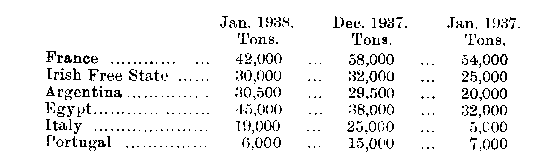
There were shipments also to Tunis (4,800 tons), Denmark (3,500 tons), Gibraltar (3,000 tons), Malta (4,300 tons) and Uruguay (7,700 tons). The total dock shipments of coal coastwise and foreign for the four weeks ended January 30 amounted to 269,000 tons; 10,000 tons less than in December, but 43,000 tons more than a year ago. Collieries have continued fairly well occupied, home demand remaining brisk, and in the foreign market Egypt's increased demands compensated to some extent for the decline in shipments to France. Patent fuel shipments amounted to 7,400 tons, compared with 11,000 tons in December and 7,400 tons in January 1937. France was the only customer in each case. Apart from galvanised sheets and tin-plates, for which demand has slackened, most iron and steel works are still in arrears with their orders. Stocks of raw material are showing a tendency to increase, and there is an inclination on the part of customers (possibly only a passing phase) to hold their hand before placing fresh orders in the hope of prices easing. Shipments of iron and steel and general cargo totalled 13,600 tons compared with 14,900 tons in December and 12,600 tons a year ago. Imports of iron ore consisted of 11,900 tons from Sweden, compared with 13,000 tons from Sweden and 16,200 tons from Newfoundland in December and nil in January 1937. Imports of iron and steel totalled 35,100 tons, against 34,200 tons in December and 9,500 tons a year ago. The United States for the first time for many years was the main source of supply, sending 12,900 tons compared with 7,200 tons in December and nil a year ago. Canada's contribution was 9,700 tons, compared with 7,800 tons and nil. France sent 6,700 tons, against 8,200 tons and 7,700 tons, whilst Belgium sent 5,900 tons, against 8,700 tons and 1,900 tons. Imports of pit wood were rather more than in December and more than double those in January 1937. France sent 4,100 cu. fm. and Portugal 625 fm., compared with 3,117 and 1,233 fm. respectively in December and 1,425 and 747 fm. in January last year.
The South Wales branch of the Association of Mining Electrical Engineers, held its annual dinner at the Queen's Hotel, Cardiff, on Saturday, February 12. under the chairmanship of its branch president, Mr. J. Vaughan Harries, who was supported by Mr. J. A. B. Horsley, O.B.E. (H.M. electrical inspector of mines), president of the association for the present session. Guests included Mr. Iestyn R. Williams, joint secretary, Mon. and South Wales Coalowners' Association ; Mr. Levi Phillips, general manager, Ocean Coal Co., Ltd. ; Major E. Ivor David, president, South Wales Institute of Engineers ; Mr. H. F. Reeman, vice-chairman, South Wales branch, Institution of Mechanical Engineers : Mr. Martin Price, secretary, South Wales Institute of Engineers ; and Mr. C. T. Allan, assistant manager, the South Wales Electric Power Co. Mr. Iestyn Williams, proposing the toast of "The Association," said he imagined that during recent years the association had been losing members rather than attracting young blood. There has been and still is a moving away from the mining industry of those men who are so urgently needed. There has been a lot of thought given to the vexed question of the recruitment of the personnel needed. Much consideration had been given to the development of scholarship schemes for the higher and lower officials, and even apprenticeship schemes for the development of craftsmen within the industry. We have yet to find the real reason why mining is not so attractive as it should be. Mr. Williams said it might be the aftermath of a period of depression, and it must not be forgotten that that period of depression was itself the aftermath of much strife and disorder. As secretary of the Mon. and South Wales Coal Owners' Association he perhaps had to deal with more subjects than anywhere else in the country for the reason that the activities of the mining industry in South Wales were so diversified. Mr. Williams referred to the pension scheme for miners and superannuation schemes for all officials employed at collieries, and the efforts made, to bring these to fruition. In referring to the development of the mechanical side of the industry, Mr. Williams said the important thing to do was to see that this development was made to be a blessing and not a curse to the great community who depend upon mining for a livelihood. So far as South Wales was concerned, we could look back over the past two years and say we have an atmosphere within the industry which is in no small measure due to the outlook of colliery officials. He invited the Association of Mining Electrical Engineers to approach the coal owners at any time to discuss their problems. Mr. J. A. B. Horsley, replying for the association, said it was a matter for congratulation that the toast of "The Association" had been proposed by a representative of the Coal-owners' Association. Electricity as a power in mines has certain well-established rivals — steam and compressed air. A third competitor was now likely to enter the field — the diesel locomotive. This was used to a great extent in Germany and to a lesser extent in France and Belgium. The increasing use of electricity in mines depended not only on its ability to give efficient and economic service, but upon its freedom from danger. Regarding the superannuation schemes mentioned by Mr. Williams, he wondered whether colliery electricians were to be classed as "officials." Mr. Horsley referred to the evidence given by Major Ivor David before the Royal Commission on Safety in Coal Mines in 1936, when he said that the greater part of the electricians in South Wales were working on shift and on the minimum subsistence wage. Mr. Horsley referred also to Mr. Williams' invitation to the association to approach the coal owners. The offer was very fair, and he hoped that grievances would be brought to light by virtue of that invitation. Mr. Levi Phillips, proposing the toast "Electrical Industries," mentioned that the president of the branch — Mr. Vaughan Harries — was an old employee of his company, and he congratulated him on the honour he had attained. Mr. Phillips spoke of the problem of coal face mechanisation. He reminded his listeners that the chief question was not a matter of perfection of manufacture, but more of subsequent maintenance, and this depended more on the mining electrical engineer than on anyone else. Major E. Ivor David, replying for "Electrical Industries," confirmed what Mr. Horsley had said about his (Major David's) evidence given before the Royal Commission in 1936. He said his statement was only made after taking all possible steps to confirm it. He referred to the prosperity which the industry had enjoyed, especially in the heavy sections. He wondered why manufacturers of motors did not open up in South Wales, where they already had two cable factories and one manufacturing switchgear. One of the reasons appeared to be the marked tendency locally to go anywhere in the country for local needs, except in the locality. Mr. Joseph Jones proposed the toast "Kindred Associations and Guests," and Mr. H. F. Reeman responded. Mr. D. J. Thomas proposed the toast "The Chairman," and this was carried with musical honours, the chairman replying suitably.
The 15th annual dinner of the Bristol Channel District Association of Chartered Shipbrokers was held at Cardiff, last Friday evening, under the chairmanship of Mr. H. H. Davenport. Replying to the toast of "Coal and Shipping," Mr. Norman J. McNeil, president of the Cardiff Chamber of Commerce, said both industries were related and both had to meet foreign subsidised competition and the many varied restrictions operating against the natural flow of trade in the world to-day. At the moment, particularly with regard to shipping, there was a setback which he trusted was temporary, as the maintenance of the shipping industry on a reasonably profitable basis was of vital importance, not only to South Wales, but to the whole nation. Although the production and export of coal was far below that of former years, it was some satisfaction to know that the figures for last year showed a decided improvement upon the previous year, but the increase had been on a lower scale than was obtained by their competitors abroad. South Wales had increased its coal output last year by, roughly, 13 per cent. and exports by 23¼ per cent., but they wanted more, and that brought them up to a stiff problem. Lower prices would soon put the industry in the swamp; wages would be reduced and cause unrest amongst the miners, and no more coal would be sold in the end. A subsidy would be helpful in certain directions, but the Government did not appear to be impressed with the idea. A levy had not been enthusiastically received by the inland coal producers or by home consumers. This might be a short-sighted view, as any further falling off in the coal export trade would have far-reaching effects, and probably, in the long run, prove more costly than the addition of a few pence per ton on the price of coal. An international agreement would be advantageous and, in order to get a fair and reasonable arrangement, it would be necessary to fortify the industry with the promise of a Government subsidy. They could not allow their coal export trade to be whittled away. Something must be done. He felt that a fair scheme would be bound to give them a greater share of the export trade, and would ensure the maintenance of reasonable prices. Sir Julian Foley, C.B., Under-Secretary of the Board of Trade, said that one method of increasing coal exports was by improving the quality, and much in that respect had been done in South Wales. Exposed to the fierce competition of foreign countries, our hopes of success lay in maintaining the quality of coal.
The Monmouthshire and South Wales Coal Owners' Association is offering £120 in prizes in the mining section of the arts, crafts, and science competitions at the National Eisteddfod to be held at Cardiff this year. In addition to this the Powell Duffryn Associated Collieries, Ltd., have donated 50 guineas as the prize for an essay on safety in mines, with special reference to modern equipment. The company is to retain the winning essay and apply any suggestions it contains in so far as is practicable in South Wales. The adjudicators in this special competition are Mr. Douglas A. Hann, Mr. Hubert McVicar, and Prof. David Jones. The Powell Duffryn Co. have also contributed 150 guineas towards the general fund of the Eisteddfod. In addition to the prizes for practical work, the Coal Owners' Association is offering a special prize of £30 for "exile choirs," i.e. choirs consisting chiefly of Welsh miners who have left the coal field for employment elsewhere. The practical competitions comprise rope splicing, fitting of cap to rope, erection of timbers, erection of steel arches, shotfiring, dressing of colliery horses, making and fitting horse shoes, dismantling, fitting and erecting different types of conveyors, and fitting an electrical joint box. In theoretical work a prize of five guineas is offered for the best design of a haulage as specified, a prize of 10 guineas for the best plan and lay-out of an underground district for machine mining, and a prize of £20 for the best handbook detailing a course of instruction suitable for safety-classes for boys. The prize for rope splicing has been awarded by Mr. D. Morgan Rees, J.P., of the Whitchurch wire rope works.
 |
 |
| Names mentioned in this article | |
 |
 |
| Name | Age | Occupation | Notes |
|---|---|---|---|
| Allan, C. T. | Assistant Manager | ||
| Davenport, H. H. | |||
| David, E. Ivor, Major | President | Whos Who Page | |
| Foley, Julian, Sir | Under-Secretary | ||
| Hann, Douglas Alfred | Adjudicator | Whos Who Page | |
| Harries, J. Vaughan | Branch President | ||
| Horsley, James Arthur Bennett | H.M. Electrical Inspector of Mines | Whos Who Page | |
| Jones, David, Prof. | Adjudicator | ||
| Jones, Joseph | |||
| McNeil, Norman J. | |||
| McVicar, Hubert | Adjudicator | Whos Who Page | |
| Phillips, Levi | General Manager | Whos Who Page | |
| Price, Martin | Secretary | Whos Who Page | |
| Reeman, H. F. | Vice-chairman | ||
| Rees, D. Morgan | |||
| Thomas, D. J. | |||
| Williams, Iestyn | Joint Secretary | Whos Who Page |




 Contains public sector information licensed under the

