


| Newspaper Articles |

|
Newspaper Articles |
 |
 |
15th January 1938, Page: 214, Column: 1
Haulage Drawgear Failures
The Safety in Mines Research Board have been investigating the question of haulage accidents underground, many of which are due to runaways. One aspect of the problem is concerned with the quality and the condition of the materials used for colliery haulage drawgear, and in this investigation over 250 samples of broken or defective gear (chains, drawbars, shackles and couplings) have been considered, the results being embodied in S.M.R.B. Paper No. 100 on "The Metallurgical Examination of Colliery Haulage Drawgear" by J. H. Andrew, R. Jeffrey, and W. A. Johnson (Price 1s. 6d. net, H.M. Stationery Office). The purpose of this Paper is to make available to colliery officials the latest findings; ropes are not dealt with. There are 51 illustrations in the Paper, and the following is a summary of the work :—
It is shown that drawgear failures are associated with (1) the quality of the materials used, (2) the manner of their fabrication and (3) the circumstances of their use. The practical points emerging are :—
1. That material of standard quality only should be used. Where welding is not involved the use of mild steel containing 15 per cent. of manganese is recommended.
2. (a) That the welding in drawgear should be reduced to a minimum. By the use of shackles and pins and weldless couplings, welds can, for instance, be entirely eliminated.
(b) Great care is necessary in welding to avoid welds of subnormal strength due to the inclusion of slag or voids in the scarf.
(c) The side welding of links over inch in diameter is desirable; whilst not so easy as end welding it produces stronger links if correctly carried out.
(d) The plane of the piling in wrought-iron gear should be correctly related to the direction of loading.
(e) After any forging operations all drawgear should be annealed or normalised.
3. (a) Because of the surface hardness which develops as a result of service and which, in the case of wrought-iron, may cause brittleness, all such material should be heat-treated at frequent practicable intervals. In the case of mild steel drawgear heat-treatment on this account is not necessary. (b) To remove the effects of over-strain (deformation) both wrought-iron and mild steel drawgear should be heat-treated. (c) The best temperatures for heat-treatments are :—
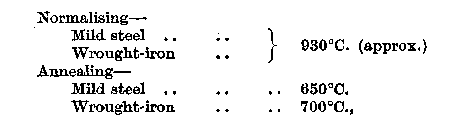
and the use of correct temperatures is important. The temperature and conditions are best controlled by using special furnaces fitted with pyrometers, and in such circumstances normalising heat treatment is preferable.
Apart from its good mechanical properties emphasis is placed upon the use of 1.5 per cent. manganese mild steel because after heavy over-strain it retains an unusually high resistance to impact which renders any heat treatment virtually unnecessary, whilst heat treatment over a wide range of temperature produces equally satisfactory results.
These investigations generally draw attention to the necessity for material of high quality for haulage drawgear: this together with good design, would go far to eliminate many failures.
Heat Treatment.
In the presentation of the results of investigations the authors of Paper No. 100 observe that, whilst investigations have shown that the quality of the materials used is a matter of prime importance in service, the greatest number of material failures. having been associated with or promoted by the use of initially deficient material, the practical application of heat treatment as a remedial measure against the effect of cold work appears in a number of instances to have been detrimental rather than beneficial. It has, for instance, been sometimes found that the effect of heat treatment has produced, in mild steel and wrought-iron, regions of coarse ferrite crystals and boundary cementite (carbide of iron). Such a structure is brittle and this boundary migration is due to unsuitable methods or temperatures employed in this process.
From the standpoint of tensile strength the structural condition of mild steel and wrought-iron in the work-hardened, annealed or normalised conditions is generally only reflected in less or greater ductility and this only slightly affects the yield point and breaking strength. But the notched-bar impact test, which gives a measure of impact strength, is invaluable for determining whether a material has received correct heat treatment. A material which is quite tough when submitted to uniform stress may exhibit brittleness when the stress is intensified locally by change of section or due to the presence of a hard surface or intergranular constituent. The Izod-impact test has therefore been used as a criterion in these considerations.
The simplest forms of heat treatment are as follows : (a) Low temperature annealing or "annealing" This involves heating to a suitable temperature-at which the material is soaked — followed by a slow cooling. The temperatures frequently employed for this treatment are 650°C. and 700°C. for mild steel and wrought-iron respectively. (b) Normalising: This consists of heating the material to the requisite temperature, soaking and allowing it to cool in still air. A temperature of about 930°C. is suitable for both wrought-iron and mild steel.
Colliery heat treatment is usually carried out in one of three ways: (i) In the blacksmith's fire; (ii) In a wood fire built around and over the material; (iii) In specially constructed furnaces heated by gas, oil, coal or coke.
Ideally, material should be heated uniformly to the correct temperature, out of contact with free air or the fuel, and cooled uniformly. Clearly this condition can only be met in a specially constructed furnace, the temperature being controlled by means of pyrometers.
Tests with pyrometers of the annealing temperatures obtained in a number of wood fires of the kind frequently employed at collieries for the heat treatment of chains and other gear have shown wide variations of the maximum temperature attained in different parts of the fire. These maxima varied in one case from 600° to 1,000 °C. and in several others over a range of 300°C. The general effect of such variations is to produce in the material regions which may have a deficient structure.
On scientific grounds normalising is preferable to annealing, but the use of the higher temperature necessitates that it should be more carefully conducted: a special furnace to minimise scaling and to avoid burning is particularly desirable. For these reasons low-temperature annealing is more commonly practised.
 |
 |
| Names mentioned in this article | |
 |
 |
| Name | Age | Occupation | Notes |
|---|---|---|---|
| Andrew, J. H. | S.M.R.B. | ||
| Jeffrey, R. | S.M.R.B. | ||
| Johnson, W. A. | S.M.R.B. |
 |
 |
| Related Articles | |
|
|
| Pub. Date | Article (Newspaper) |
|---|---|
| 15 Aug 1925 | Ignition Of Fire-Damp (The Science and Art of Mining) |
| 15 Aug 1925 | Research Board's Report (The Science and Art of Mining) |
| 21 Nov 1925 | Electrical Exploders For Shot-Firing (The Science and Art of Mining) |
| 21 Nov 1925 | Stone Dust (The Science and Art of Mining) |
| 06 Dec 1925 | Coal Dust Explosions (The Science and Art of Mining) |
| 02 Jan 1926 | Falls Of Ground, Support of Workings in Mines Committee Reports (The Science and Art of Mining) |
| 16 Jan 1926 | Limits Of Inflammability Of Firedamp And Air (The Science and Art of Mining) |
| 16 Jan 1926 | Gauge For Measuring Pressures (The Science and Art of Mining) |
| 30 Jan 1926 | The Composition Of Coal (The Science and Art of Mining) |
| 27 Mar 1926 | Pressure Wave Of Explosives (The Science and Art of Mining) |
| 10 Apr 1926 | Limits Of Inflammability (The Science and Art of Mining) |
| 24 Apr 1926 | Electric Ignition Of Firedamp (The Science and Art of Mining) |
| 31 Jul 1926 | Rock Drill Dust (The Science and Art of Mining) |
| 31 Jul 1926 | News (The Science and Art of Mining) |
| 04 Aug 1926 | Ignition Of Firedamp (The Science and Art of Mining) |
| 28 Aug 1926 | Coal Dust (The Science and Art of Mining) |
| 25 Sep 1926 | Firedamp Explosions (The Science and Art of Mining) |
| 09 Oct 1926 | Spontaneous Combustion (The Science and Art of Mining) |
| 12 Feb 1927 | News and Notes (The Science and Art of Mining) |
| 26 Feb 1927 | Safety In Mines Research Board (The Science and Art of Mining) |
| 12 Mar 1927 | Methods Of Working And Support (The Science and Art of Mining) |
| 23 Apr 1927 | Inflammability Of Coal Dusts (The Science and Art of Mining) |
| 23 Apr 1927 | News and Notes (The Science and Art of Mining) |
| 07 May 1927 | News and Notes (The Science and Art of Mining) |
| 18 Jun 1927 | Safety In Mines, Research Station at Buxton (The Science and Art of Mining) |
| 02 Jul 1927 | Buxton Research Station (The Science and Art of Mining) |
| 30 Jul 1927 | News and Notes (The Science and Art of Mining) |
| 13 Aug 1927 | Safety In Mines Research (The Science and Art of Mining) |
| 11 Feb 1928 | Flame Caps (The Science and Art of Mining) |
| 11 Feb 1928 | Lighting Power Of Safety-Lamps (The Science and Art of Mining) |
| 25 Feb 1928 | Mining Electrical Research (The Science and Art of Mining) |
| 19 Jun 1928 | Mine Explosions, Results Of Research Work (The Times) |
| 30 Jun 1928 | Safety In Mines Research Board, Report for 1927 (The Science and Art of Mining) |
| 30 Jun 1928 | Firedamp Explosions (The Science and Art of Mining) |
| 20 Oct 1928 | Safety In Mines Research (The Science and Art of Mining) |
| 01 Dec 1928 | "Sparks" And Ignition Of Firedamp (The Science and Art of Mining) |
| 15 Dec 1928 | Explosibility Of Coal Dusts (The Science and Art of Mining) |
| 29 Dec 1928 | Pyritic Oxidation (The Science and Art of Mining) |
| 26 Jan 1929 | Explosions Within Closed Vessels (The Science and Art of Mining) |
| 21 Sep 1929 | Popular Lectures For Miners (The Science and Art of Mining) |
| 31 May 1930 | Steel Pit Props (The Science and Art of Mining) |
| 06 Sep 1930 | Northern Engineers Meet (The Science and Art of Mining) |
| 20 Sep 1930 | Support Of Underground Workings (The Science and Art of Mining) |
| 05 Mar 1932 | The Combustion Of Coal Dust (The Science and Art of Mining) |
| 23 Dec 1933 | Preventing Ignitions Of Firedamp, Impact of Picks Against Rocks (The Science and Art of Mining) |
| 09 Jun 1934 | Firedamp Explosions: The Projection Of Flame, The Effect of Branch Galleries and of Bends (The Science and Art of Mining) |
| 21 Jul 1934 | Props — Lids — Bars, Research Committee's Pamphlet (The Science and Art of Mining) |
| 21 Jul 1934 | Simultaneous Shot-Firing (The Science and Art of Mining) |
| 08 Dec 1934 | Wave Sent Out By Explosives (The Science and Art of Mining) |
| 31 Aug 1935 | Safety In Mines Research, Board's Annual Report (The Science and Art of Mining) |
| 14 Sep 1935 | Ignition Of Firedamp By Compression (The Science and Art of Mining) |
| 29 Feb 1936 | Colliery Winding Ropes (The Science and Art of Mining) |
| 12 Sep 1936 | Safety In Mines Research, Board's Annual Report (The Science and Art of Mining) |
| 26 Sep 1936 | Research Work (The Science and Art of Mining) |
| 24 Oct 1936 | Roof Supports (The Science and Art of Mining) |
| 30 Jan 1937 | Pamphlet On Protective Equipment (The Science and Art of Mining) |
| 11 Sep 1937 | Safety In Mines Research, Board's Annual Report (The Science and Art of Mining) |
| 25 Sep 1937 | Protective Equipment (The Science and Art of Mining) |
| 25 Sep 1937 | Coal Measure Rocks (The Science and Art of Mining) |
| 15 Jan 1938 | Haulage Drawgear Failures (The Science and Art of Mining) |
| 15 Jan 1938 | Examination Of Colliery Ropes (The Science and Art of Mining) |
| 08 Oct 1938 | Safety In Mines Research, Board's Annual Report (The Science and Art of Mining) |
| 05 Nov 1938 | Wire Ropes, Careful Examination Emphasised (The Science and Art of Mining) |
| 03 Dec 1938 | Analysis Of Mine Dusts (The Science and Art of Mining) |
| 14 Jan 1939 | Fibre Cores For Winding Ropes (The Science and Art of Mining) |
| 12 Aug 1939 | Safety In Mines Research, Board's Annual Report (The Science and Art of Mining) |
| 26 Aug 1939 | Falls Of Ground, District Investigations (The Science and Art of Mining) |
| 26 Aug 1939 | Haulage Problems (The Science and Art of Mining) |
| 07 Oct 1939 | Noise In Coal Mines (The Science and Art of Mining) |
| 07 Oct 1939 | Wire Ropes, Examples of Deterioration (The Science and Art of Mining) |
| 07 Oct 1939 | Dust Production And Suppression (The Science and Art of Mining) |
| 21 Oct 1939 | Inflammability Of Coal Dusts (The Science and Art of Mining) |
| 21 Oct 1939 | Detection Of Heatings (The Science and Art of Mining) |
| 18 Nov 1939 | Ignition By Sparks From Picks (The Science and Art of Mining) |
| 16 Dec 1939 | Falls In Broken Workings (The Science and Art of Mining) |
| 16 Dec 1939 | Flameproof Releases (The Science and Art of Mining) |
| 13 Jan 1940 | Back-Stays In Mines (The Science and Art of Mining) |
| 09 Aug 1941 | Safety In Mines Research, Eighteenth Annual Report (The Science and Art of Mining) |
| 23 Aug 1941 | Safety In Mines Research — II, Eighteenth Annual Report (The Science and Art of Mining) |
| 06 Sep 1941 | Safety In Mines Research — III, Eighteenth Annual Report (The Science and Art of Mining) |
| 20 Sep 1941 | Research Pointers (The Science and Art of Mining) |
| 21 Feb 1942 | Safety In Mines Research, Nineteenth Annual Report (The Science and Art of Mining) |
| 30 May 1942 | Coal Dust Explosions (The Science and Art of Mining) |
| 06 Feb 1943 | Safety In Mines Research, Twentieth Annual Report (The Science and Art of Mining) |
| 20 Feb 1943 | Safety In Mines Research — II (The Science and Art of Mining) |
| 06 Mar 1943 | Safety In Mines Research — III (The Science and Art of Mining) |



 Contains public sector information licensed under the

