


| Newspaper Articles |

|
Newspaper Articles |
 |
 |
24th December 1937, Page: 1211, Column: 1
Notes from the Coal Fields
South Wales and Monmouthshire
[Local Correspondence.]
It was announced last week that a factory for the manufacture of galvanised hollow-ware and sheet metal work will be erected at Caerphilly, Glamorgan, early in the new year. This new factory is the outcome of the efforts of Mr. H. M. Crankshaw, chairman and managing director of Ludlow Bros, (1913), Ltd., and associated companies, controlling seven factories in the Midlands. Work has already begun in preparing the site, and the construction of the factory will be begun before the end of January.
Mr. E. Julian Pode, secretary to British (Guest Keen Baldwins) Iron and Steel Co., Ltd., speaking at the second annual dinner of the South Wales and Monmouthshire Association of the Institution of Civil Engineers in Cardiff, last week, said the steel output for November 1937 was a record, and even so the demand for finished steel was met only by large imports. As far as South Wales was concerned, he saw no reason to take other than an optimistic attitude. His company was engaged on considerable developments for enlarging the output of steel in their works in Cardiff. They felt sanguine that those developments would be fruitful in increasing their business.
Speaking at the annual general meeting of British Benzol and Coal Distillation, Ltd., in London, last week, Major-Gen. Sir Neill Malcolm, K.C.B., D.S.O. (chairman of the company), said the last 12 mouths had been the most important in the company's still short history. A year ago shareholders sanctioned a scheme for the reorganisation of the capital structure, in connection with which a debenture was floated in August of this year. Owing to improved conditions of trading they found they needed no more than £100,000 instead of £125,000, which they originally thought to be necessary. The Severn Valley Gas Corporation, Messrs. Woodall Duckham, and Messrs. Instones took up between them £37,500, and of the balance of £62,500 the shareholders subscribed at once for £42,000, a most remarkable result. By those two measures, the reorganisation and the debenture issue, the finance of the company had been put on what he believed to be a thoroughly satisfactory basis. By the end of this year, eight years of their 15-year contract with the Bedwas Colliery would have run out and they were considering the revision of their agreements both with the colliery and with Messrs. Instones. Even during the past year they had had to pay rather more than the contract price of 11s. per ton, and in turn some of their customers had paid them prices for coke in excess of the contract price which they were legally entitled to enforce. To secure their supplies of raw material they were making plans for purchasing their coal on a sliding scale dependent on the price they obtained for their coke. It meant that they would pay considerably more for their coal, but only so long as they obtained a correspondingly higher price for their coke. In consideration of this enhanced price the colliery would extend the contract for the supply of raw material, always subject to Government control. With the contracts which they already had for next year their trading results, even with the higher price of coal, should be at least equal to those for the 12 months ended on October 31 last. Shareholders would be glad to know that they began to supply gas to Newport on December 8, and they had now supplied over 7,000,000 cu. ft. to that town. As to the future, their coal from January 1 would cost more, but their coke prices would be better than at present and would compensate them for the dearness of their raw material.
Newport's trade report for the month of November, 1937, shows that clearances of coal cargoes amounted to 179,000 tons, 24,000 tons less than in October, but 23,000 tons more than in November of last year. The following is the comparative table :—
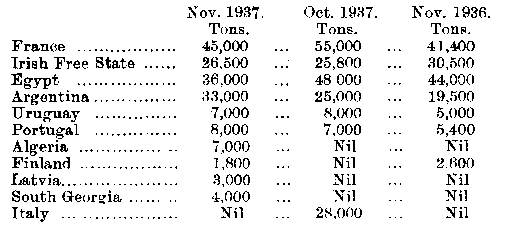
Dock shipments foreign and coastwise for the four weeks ended November 29 totalled 263,000 tons, compared with 273,000 tons in the previous four weeks and 242,000 tons a year ago. Coal output has remained at a slightly higher level than in the corresponding period of last year, and home demand continues good, but there has been a distinct decline in foreign inquiries which will, if it continues, affect shipments. Few collieries are working to capacity, but if South Wales and Monmouthshire coals can be sold at competitive prices there is still a brisk demand abroad to be met, which foreign coal fields are trying hard to meet. Patent fuel shipments went entirely to France and amounted to 10,750 tons, compared with 9,140 tons (all to France) in October and only 3,350 tons in November 1936, of which 2,850 tons went to France and 500 tons to Venezuela. Iron ore imports totalled 43,000 tons, compared with 20,000 tons in October and nil a year ago. Newfoundland sent 24,000 tons and Sweden 19,000 tons. The production of pig iron at Ebbw Vale is going on normally and regular imports of ore can be expected for some considerable time to come. Of semi-manufactured steel imports the total of 34,500 tons was by far the highest total this year. In October only 14,500 tons were received, and the previous highest total for this year was 20,000 tons in July. In November 1936 the total was 13,600 tons. The tonnages received from each main source of supply were : Canada 16,100 tons, France 8,200 and Belgium 9,600 tons. Exports of iron and steel and general cargo went mainly to seven main markets chiefly within the Empire. The total of 13,400 tons compares favourably with 11,200 tons a month ago and 8,500 tons a year ago, but the highest levels were reached in the months of February, March, April and June, and shipments have been sluggish since. Shipments to Australia amounted to 4,300 tons New Zealand took 2,400 tons, Egypt and East Africa 1,800 tons. There were shipments also to South America 700 tons, India 550 tons, Holland 300 tons, and South Georgia 300 tons. There is no apparent falling off in orders for home markets but the stabilisation of prices over 1938, while it has given satisfaction in some quarters, has aroused expectations of a reduction in prices as a result of the large decline in production in the United States. Monmouthshire works have shared in the continued prosperity of the iron and steel trades and well filled order books and lengthy periods for deliveries are still the order of the day though the time required is now somewhat shorter than a few months ago. Pitwood imports have been low, 2,300 cu. fm. compared with 2,600 a month ago and 800 a year ago. Portugal sent 960 fm., and France 1,300 fm. Other timber imports consisted of one cargo of 730 standards from Sweden.
Mr. D. O. Evans, M.P. for Cardiganshire, speaking at the annual meeting and prize distribution in connection with the Cardiff Technical College at the city hall, Cardiff, on December 14, said that the problem of unemployment and the attraction of new industries was more complicated than many imagined. The important fact was that industry and commerce were directed and carried on by private enterprise. The State extracted for public purposes a substantial and increasing portion of industrial gain, and in return industry rightly claimed that the aim of Government industrial policy should be to establish conditions best calculated to keep industry flourishing. It appeared, therefore, that proposals for the location or redistribution of industry should be such as could be effected within the ambit of the present economic system. Mr. Evans said he did not believe that coal had seen its day, for there was growing evidence of its enormous untapped potentialities as a source of fuel, power, and chemical products. The terrible plight of the coal field might serve a good purpose. It showed the glaring need for a diversity of industries and employment.
 |
 |
| Names mentioned in this article | |
 |
 |
| Name | Age | Occupation | Notes |
|---|---|---|---|
| Crankshaw, H. M. | Chairman | ||
| Evans, D. O. | M.P. | ||
| Malcolm, Neill, Major-Gen. Sir | Chairman | ||
| Pode, E. Julian | Company Secretary |




 Contains public sector information licensed under the

