


| Newspaper Articles |

|
Newspaper Articles |
 |
 |
3rd December 1937, Page: 1069, Column: 1
Notes from the Coal Fields
South Wales and Monmouthshire
[Local Correspondence.]
A factory for the manufacture of activated carbon is to be built on the Government-aided trading estate at Treforest for British Activon Industries, Ltd., and production will begin early in the New Year by a special process developed by Prof. C. L. Mantell, who is recognised as the leading authority on the subject. Construction on the new factory, which will be the eleventh to be placed at Treforest, is to be accelerated, for orders have already been taken for delivery in April. Work will be provided at first for between 100 and 200 unemployed people who will be taught the various phases of the process, and it is expected that many more workers will be required later.
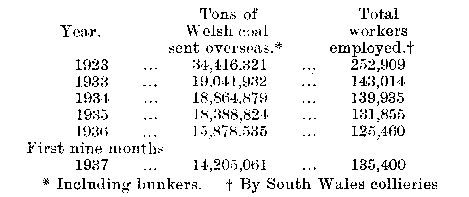
The board of Powell Duffryn Associated Collieries, Ltd., have had their attention drawn to the debate on the Coal Bill, and as their company's name is specifically referred to in Hansard, they have issued a reply to statements which have been made and from which erroneous conclusions may be drawn. The reply says that in the Official Report of Parliamentary Proceedings for Monday, November 22, 1937, there appears the following excerpt from a speech made on the Coal Bill : "On February 26, 1935, the Hon. Member for East Rhondda (Mr. Mainwaring) put a question to the Secretary for Mines as to the number of pits closed in South Wales by the merger known as Powell Duffryn Associated Collieries. He was told that while there were 27 companies in 1920 there was only one in 1931. There were 121 pits working in 1920, and after the merger in 1934 only 68. That means that, as the result of that one merger, or amalgamation, no fewer than 53 pits were closed. The number of men employed in them in 1920 was 98,800. In 1934 the number was 39,300, a reduction as the result of the amalgamation in that merger alone of 59,500 men." The implication of this passage, and other statements forming its context, is that the formation of Powell Duffryn Associated Collieries caused a substantial reduction in the number of workers, and that mergers carried out under private ownership reduce the capacity of the enlarged undertaking to engage labour. The company's board are anxious to correct what in their opinion is an incorrect statement of facts and to dispel from the public mind certain obviously fallacious conclusions which may have been drawn. The board are unaware why 1920 was chosen as a basis of comparison. In 1920 a representative price for Best Admiralty coal was £5 17s. 6d. per ton f.o.b. Cardiff, as the effect of the war shortage on commodity prices had not disappeared; in 1934 the price was 19s. 6d. In 1920, with the industry under Government control, the number of persons employed in the South Wales coal field totalled 271,000, a figure which was 38,000 above that for 1913, when the area achieved its maximum output. Of the companies whose interests were acquired by the Powell Duffryn concern, thirteen, owning together 64 collieries and employing 43,454 men in 1920, were actually in the hands of receivers at the time of the acquisition. Between 1920 and the time of their acquisition there had been a reduction of 21,650, or nearly one-half, in the workmen employed by them. Obviously, therefore, change of ownership was not responsible for the decline in employment at these particular collieries. The fall in employment has been less severe in collieries since they became part of the Powell Duffryn organisation than in the rest of the coal field. The hon member, as reported, stated that 53 pits had been closed "as the result of that one merger or amalgamation." The expression "pit" appears to be used to include anything from a small level employing 15 to 20 men to a large colliery employing several thousands. Employment in the industry is not necessarily governed by the number of working pits. The board of Powell Duffryn Associated Collieries realise that the closing down of a colliery causes serious social disturbance, as well as rendering idle the capital invested in that colliery, if such capital is not in fact entirely lost. The prosperity of the South Wales coal industry, continues the company's statement, is dependent on its export trade in unprotected markets. The Powell Duffryn Co. must in common with other South Wales producers face competition with prices which are quoted by coal fields of other countries. In Germany there is a direct Government subsidy varying between 6s. and 10s. per ton, apart from other forms of indirect assistance, which enable exporters to quote prices for business which have little relation to costs of production. It is not surprising, therefore, that the export tonnage of South Wales has dropped, and that ability to give employment has declined. The capacity of a colliery undertaking to employ men is directly governed by the demand for coal, and the board draw attention to the following table :—
Ebbw Vale Council has instructed its representative at the conference of county rating authorities to be held at Newport to-day (Friday) to press for an immediate revaluation of all colliery properties in the county. This decision was taken on Monday after Mr. Edgar Harries, chairman of the West Monmouthshire Rating Authority, had stated that when trade conditions were bad the colliery owners secured assessment relief. It was agreed among the parties at the time that if conditions did get better the valuation should be reviewed. He had stressed this point at a meeting of the West Monmouthshire Assessment Committee a week ago, but the county rating officer suggested that the matter should be left over until the general revaluation next year. This meant that the new valuation would not come into operation until 1939 and by that time there might be another slump.
Works at the south shaft of the Coedely Collieries of the Welsh Navigation Co., Tonyrefail, was suspended last Friday as the result of a remarkable mishap. The last two trams were being wound on the afternoon shift the previous day preparatory to the night shift descending, but when the winding rope was brought to the top it was found that the cage had been left suspended in mid-shaft with two large trams of rubbish in it.
An inquest was held at Neath on Wednesday, November 17, on L. Phillips, aged 41, who died at Penrhiwtyn Infirmary, Neath, on November 5, as the result of an explosion at the Dillwyn Colliery, Seven Sisters. D. Harris, a collier, said he was working 20 yd. away from Phillips, when he was blown off his feet by the force of an explosion. Phillips came towards him. He was suffering badly from burns, and told him his foot slipped on a loose rail, making a spark which caused the explosion. He had never known Phillips to smoke underground. J. Phillips, a fireman, said the men were searched before going below. He never suspected Phillips of smoking at work. R. Morris, manager of the colliery, said he could not believe Phillip's statement that the explosion was caused by a spark from his foot. He examined the district the day before the explosion and found no trace of gas. He had also been unable to find traces of cigarettes or matches following the accident. The jury returned a verdict of "Accidental death," adding that there was no evidence that Phillips had been smoking.
 |
 |
| Names mentioned in this article | |
 |
 |
| Name | Age | Occupation | Notes |
|---|---|---|---|
| Harries, Edgar | Chairman, Rating Authority | ||
| Harris, D. | Miner | ||
| Mainwaring, — | M.P. | ||
| Mantell, C. L., Prof. | |||
| Morris, R. | Colliery Manager | ||
| Phillips, J. | Fireman | ||
| Phillips, L. | 41 | Miner | Deceased |
|
|
| Links to Collieries/Mines mentioned in this article | |
|
|
 | Dillwyn Colliery |




 Contains public sector information licensed under the

