


| Newspaper Articles |

|
Newspaper Articles |
 |
 |
25th September 1937, Page: 84, Column: 1
Coal Measure Rocks
When the work of the Safety in Mines Research Board on mining engineering problems was intensified some years ago, a general scheme of research on falls of ground was initiated, which, broadly speaking, can be divided into three groups-Coal Measure Strata, Their Behaviour when Undermined, and Supports.
Most of the reports hitherto published on this work have dealt with the second and third of these groups, and the Board has now published in Paper No. 98 a general account of some of the basic work which has been done with regard to the coal measure strata.
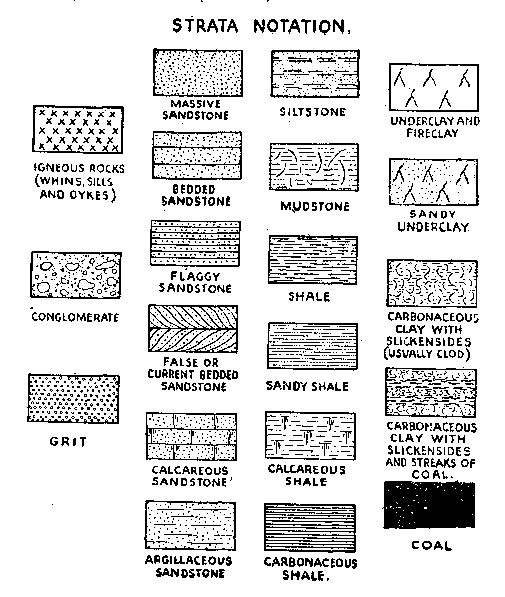
This Paper by H. M. Hudspeth and D. W. Phillips entitled "Coal Measure Rocks: Part I. — Classification, Nomenclature and Relative Strengths " (H.M. Stationery Office, is. net), discusses briefly the more important rock structures bearing on the strengths of rocks and on roof control. It describes a classification of the rocks, based on grain size, into five standard groups as well as a further classification according to some structural, textural or constitutional feature. The general petrological characters of the chief rock types are dealt with and also their relative strengths and bending capacities. The nomenclature used to describe the rocks in the different coalfields of this country as well as a description of each term is given and the paper ends with an appendix on strata notation sufficiently comprehensive to illustrate the rocks met with during coal mining.
In some general remarks on rocks and rock structure the Authors say :—
Geologically, the term rock is used to describe any natural aggregate of material which makes up the crust of the earth, and, incidentally, includes coal; it is applied to hard materials like granite or sandstone and to soft materials like clays. There are two main groups of rocks, Igneous and Sedimentary, the former having provided, except in the case of coal, the material from which the latter were formed. The products of disintegration were in most cases water-borne before being deposited as sediment, hence the term Sedimentary Rocks. In some cases these rocks have again been disintegrated and re-deposited.
Originally loose, the sediments became hard and compact rocks by cementation and/or by consolidation under the weight of overlying sediments, the former process having been more prominent in the formation of limestones and arenaceous or sandy rocks, and the latter in those of the argillaceous, or clayey variety. The cementing material may be calcite, silica, or iron compounds, in most cases deposited between the grains from percolating solutions, or by the growth of new minerals formed by the decomposition of felspar in situ.
Igneous rocks and limestones are rarely involved in the problem of roof control. Coal has distinct characteristics as compared with other coal measure rocks and is separately considered.
Though the sedimentary rocks of which the coal measures are almost wholly comprised were laid down in water, the physical conditions of deposition were sufficiently varied to result in the formation of rocks having, wide textural differences, depending largely on the size of their constituent grains. They grade in this respect from such coarse rocks as conglomerates downwards through sandstones, siltstones, mudstones and shales to the finest grained clays. Though these rocks have the same origin they differ in mineralogical constitution to the extent that the finer grained contain less quartz and more of the argillaceous minerals.
When the rocks are considered as a whole the textural differences are readily appreciated, but even in the case of one type of rock, e.g., sandstone, there are many different textures in consequence of minor variations in the size and in the arrangement of the constituent grains. These textures are related to the strength and elastic properties of the rocks.
Besides differing in texture, these rocks exhibit structural features, other than folding and faulting, which affect their behaviour when undermined. One of the most prominent is stratification, the structure dividing the sediments into beds, layers or strata. it is sometimes called the bedding, and is indicated by differences in composition, texture, hardness of colour of the rocks in the various beds — features that are often well exhibited in cross-measure drifts. The plane of junction between any two beds is called a bedding plane, and this is often plane of discontinuity along which the beds can move relatively to each other. When the rocks are undermined, separation may take place at such a plane. Less abrupt changes in character take place along the beds. A good example of this is the gradual change in the character of the roof of the Top Hard Seam in the Nottinghamshire and Derbyshire Coalfield from a sandstone in the West, to stone bind (siltstone) and shale in the North-East.
Another important structural feature is lamination, which is a further sub-division of the rocks into very thin layers. The existence of lamination is closely associated with the mineral constitution of the rock, and is often due to the presence of flattened particles like mica arranged in layers, usually parallel to the bedding. This results in the rock being fissile, or easily split, along these layers. It mostly occurs in the finer grained rocks, though the sandstone roof of the Harvey and Hutton Seams in certain parts of the North of England Coalfield, which is called a leafy post, is a fairly well laminated rock full of micaceous layers. Siltstones which exhibit lamination are the linseys of the Lancashire Coalfield ; similar examples are found in other coalfields and are described as stone binds or rock binds. In these rocks the fissility is mostly due to the intercalation of thin layers of argillaceous material. Lamination is most perfect in shales, and is well exhibited after this kind of rock has been subjected to weathering, as for instance on pit rubbish heaps, where pieces of shale that can easily be split by hand into extremely thin layers can often be found.
False bedding is a structure exhibiting a subsidiary stratification or lamination inclined to the main lines of stratification. It is also known as cross, current, or oblique bedding and is very characteristic of sandy rocks.
There exist also planes of divisions (joints) cutting normally across the bedding planes or nearly so. These occur mostly in sandstones and are planes along which the rocks are already separated, or have been re-cemented by the deposition (in the joint) of a cementing material, usually a carbonate somewhat similar to ankerite or cleat spar [a calcium — iron — magnesium carbonate]. Though only two sets of joints usually occur and these cross each other at an angle approaching a right angle, in some cases there may be three or even four sets.
Coal seams — and some carbonaceous clays in their immediate vicinity — are usually traversed by parallel sets of very closely spaced planes of division to which the term cleat is applied. There is nearly always a main cleat, which has a North-Westerly trend in all the British coalfields, and a subsidiary cleat more or less at right angles to it, though there are some local variations where the conditions are reversed. Along the cleat planes there is often a deposit of ankerite.
Some coal seams, especially those of the South Wales Coalfield, also exhibit planes of division which are different from cleat and to which the term "slips" is applied. Those of South Wales are usually from 1 to 2 feet apart, sometimes more. Their direction is roughly N.-S. and they generally hade downwards to the West at angles varying from 25° to 45°.
The weaker varieties of argillaceous rocks — the clods and the clunches — often exhibit smooth well polished or striated surfaces which enhance their weakness and reduce their ability to resist disintegration when undermined. Similar smooth shiny surfaces found in the vicinity of faults are usually described as slickensides.
Following an examination of rock types the Authors summarise by saying that the rocks involved in the investigations on Roof Control are mostly of sedimentary origin. When considered as a whole textural differences can be easily observed macroscopically, hut microscopic examination reveals differences even in any one kind of rock. They also exhibit structural features such as bedding, lamination, joints, cleat and slips. The different textures and structures are associated with the relative strength and elastic properties of the rocks and affect their behaviour when undermined.
The rocks, other than coal, can be classified according to grain size in descending order into sandstones, siltstones and mudstones, shales and clays; the three last are of similar grain size but differ in structural features. Mudstones are not laminated while the shales are; the clays are also unlaminated and are less coherent Than mudstones and shales. A further classification can be made according to some feature possessed by the rocks, e.g. sandstones may be coarse, medium, or fine grained and they may have different kinds of cement; siltstones may he sandy or clayey, banded or non-banded; mudstones and shales may be silty, calcareous or carbonaceous. These factors affect the strengths of the rocks.
Present nomenclature is very wide and varied and it is difficult to make comparisons of rocks by means of the many local terms used. It is suggested that, with the addition of suitable adjectives to denote any particular feature possessed by the rocks, the five terms, used in the classification based on grain size, can be substituted for those now used.
In an appendix it is pointed out that when showing sections of strata it is often necessary to illustrate many different types of rocks, and in order that they can be appreciated at a glance it is essential that each type be denoted by a distinctive symbol. Student readers will be interested in the accompanying illustration which is reproduced to indicate the appropriate symbols for use when illustrating rocks met with during coal mining.
 |
 |
| Names mentioned in this article | |
 |
 |
| Name | Age | Occupation | Notes |
|---|---|---|---|
| Hudspeth, Henry Moore | S.M.R.B. | Whos Who Page | |
| Phillips, David Watkin | S.M.R.B. |
 |
 |
| Related Articles | |
|
|
| Pub. Date | Article (Newspaper) |
|---|---|
| 15 Aug 1925 | Ignition Of Fire-Damp (The Science and Art of Mining) |
| 15 Aug 1925 | Research Board's Report (The Science and Art of Mining) |
| 21 Nov 1925 | Electrical Exploders For Shot-Firing (The Science and Art of Mining) |
| 21 Nov 1925 | Stone Dust (The Science and Art of Mining) |
| 06 Dec 1925 | Coal Dust Explosions (The Science and Art of Mining) |
| 02 Jan 1926 | Falls Of Ground, Support of Workings in Mines Committee Reports (The Science and Art of Mining) |
| 16 Jan 1926 | Limits Of Inflammability Of Firedamp And Air (The Science and Art of Mining) |
| 16 Jan 1926 | Gauge For Measuring Pressures (The Science and Art of Mining) |
| 30 Jan 1926 | The Composition Of Coal (The Science and Art of Mining) |
| 27 Mar 1926 | Pressure Wave Of Explosives (The Science and Art of Mining) |
| 10 Apr 1926 | Limits Of Inflammability (The Science and Art of Mining) |
| 24 Apr 1926 | Electric Ignition Of Firedamp (The Science and Art of Mining) |
| 31 Jul 1926 | Rock Drill Dust (The Science and Art of Mining) |
| 31 Jul 1926 | News (The Science and Art of Mining) |
| 04 Aug 1926 | Ignition Of Firedamp (The Science and Art of Mining) |
| 28 Aug 1926 | Coal Dust (The Science and Art of Mining) |
| 25 Sep 1926 | Firedamp Explosions (The Science and Art of Mining) |
| 09 Oct 1926 | Spontaneous Combustion (The Science and Art of Mining) |
| 12 Feb 1927 | News and Notes (The Science and Art of Mining) |
| 26 Feb 1927 | Safety In Mines Research Board (The Science and Art of Mining) |
| 12 Mar 1927 | Methods Of Working And Support (The Science and Art of Mining) |
| 23 Apr 1927 | Inflammability Of Coal Dusts (The Science and Art of Mining) |
| 23 Apr 1927 | News and Notes (The Science and Art of Mining) |
| 07 May 1927 | News and Notes (The Science and Art of Mining) |
| 18 Jun 1927 | Safety In Mines, Research Station at Buxton (The Science and Art of Mining) |
| 02 Jul 1927 | Buxton Research Station (The Science and Art of Mining) |
| 30 Jul 1927 | News and Notes (The Science and Art of Mining) |
| 13 Aug 1927 | Safety In Mines Research (The Science and Art of Mining) |
| 11 Feb 1928 | Flame Caps (The Science and Art of Mining) |
| 11 Feb 1928 | Lighting Power Of Safety-Lamps (The Science and Art of Mining) |
| 25 Feb 1928 | Mining Electrical Research (The Science and Art of Mining) |
| 19 Jun 1928 | Mine Explosions, Results Of Research Work (The Times) |
| 30 Jun 1928 | Safety In Mines Research Board, Report for 1927 (The Science and Art of Mining) |
| 30 Jun 1928 | Firedamp Explosions (The Science and Art of Mining) |
| 20 Oct 1928 | Safety In Mines Research (The Science and Art of Mining) |
| 01 Dec 1928 | "Sparks" And Ignition Of Firedamp (The Science and Art of Mining) |
| 15 Dec 1928 | Explosibility Of Coal Dusts (The Science and Art of Mining) |
| 29 Dec 1928 | Pyritic Oxidation (The Science and Art of Mining) |
| 26 Jan 1929 | Explosions Within Closed Vessels (The Science and Art of Mining) |
| 21 Sep 1929 | Popular Lectures For Miners (The Science and Art of Mining) |
| 31 May 1930 | Steel Pit Props (The Science and Art of Mining) |
| 06 Sep 1930 | Northern Engineers Meet (The Science and Art of Mining) |
| 20 Sep 1930 | Support Of Underground Workings (The Science and Art of Mining) |
| 05 Mar 1932 | The Combustion Of Coal Dust (The Science and Art of Mining) |
| 23 Dec 1933 | Preventing Ignitions Of Firedamp, Impact of Picks Against Rocks (The Science and Art of Mining) |
| 09 Jun 1934 | Firedamp Explosions: The Projection Of Flame, The Effect of Branch Galleries and of Bends (The Science and Art of Mining) |
| 21 Jul 1934 | Props — Lids — Bars, Research Committee's Pamphlet (The Science and Art of Mining) |
| 21 Jul 1934 | Simultaneous Shot-Firing (The Science and Art of Mining) |
| 08 Dec 1934 | Wave Sent Out By Explosives (The Science and Art of Mining) |
| 31 Aug 1935 | Safety In Mines Research, Board's Annual Report (The Science and Art of Mining) |
| 14 Sep 1935 | Ignition Of Firedamp By Compression (The Science and Art of Mining) |
| 29 Feb 1936 | Colliery Winding Ropes (The Science and Art of Mining) |
| 12 Sep 1936 | Safety In Mines Research, Board's Annual Report (The Science and Art of Mining) |
| 26 Sep 1936 | Research Work (The Science and Art of Mining) |
| 24 Oct 1936 | Roof Supports (The Science and Art of Mining) |
| 30 Jan 1937 | Pamphlet On Protective Equipment (The Science and Art of Mining) |
| 11 Sep 1937 | Safety In Mines Research, Board's Annual Report (The Science and Art of Mining) |
| 25 Sep 1937 | Protective Equipment (The Science and Art of Mining) |
| 25 Sep 1937 | Coal Measure Rocks (The Science and Art of Mining) |
| 15 Jan 1938 | Haulage Drawgear Failures (The Science and Art of Mining) |
| 15 Jan 1938 | Examination Of Colliery Ropes (The Science and Art of Mining) |
| 08 Oct 1938 | Safety In Mines Research, Board's Annual Report (The Science and Art of Mining) |
| 05 Nov 1938 | Wire Ropes, Careful Examination Emphasised (The Science and Art of Mining) |
| 03 Dec 1938 | Analysis Of Mine Dusts (The Science and Art of Mining) |
| 14 Jan 1939 | Fibre Cores For Winding Ropes (The Science and Art of Mining) |
| 12 Aug 1939 | Safety In Mines Research, Board's Annual Report (The Science and Art of Mining) |
| 26 Aug 1939 | Falls Of Ground, District Investigations (The Science and Art of Mining) |
| 26 Aug 1939 | Haulage Problems (The Science and Art of Mining) |
| 07 Oct 1939 | Noise In Coal Mines (The Science and Art of Mining) |
| 07 Oct 1939 | Wire Ropes, Examples of Deterioration (The Science and Art of Mining) |
| 07 Oct 1939 | Dust Production And Suppression (The Science and Art of Mining) |
| 21 Oct 1939 | Inflammability Of Coal Dusts (The Science and Art of Mining) |
| 21 Oct 1939 | Detection Of Heatings (The Science and Art of Mining) |
| 18 Nov 1939 | Ignition By Sparks From Picks (The Science and Art of Mining) |
| 16 Dec 1939 | Falls In Broken Workings (The Science and Art of Mining) |
| 16 Dec 1939 | Flameproof Releases (The Science and Art of Mining) |
| 13 Jan 1940 | Back-Stays In Mines (The Science and Art of Mining) |
| 09 Aug 1941 | Safety In Mines Research, Eighteenth Annual Report (The Science and Art of Mining) |
| 23 Aug 1941 | Safety In Mines Research — II, Eighteenth Annual Report (The Science and Art of Mining) |
| 06 Sep 1941 | Safety In Mines Research — III, Eighteenth Annual Report (The Science and Art of Mining) |
| 20 Sep 1941 | Research Pointers (The Science and Art of Mining) |
| 21 Feb 1942 | Safety In Mines Research, Nineteenth Annual Report (The Science and Art of Mining) |
| 30 May 1942 | Coal Dust Explosions (The Science and Art of Mining) |
| 06 Feb 1943 | Safety In Mines Research, Twentieth Annual Report (The Science and Art of Mining) |
| 20 Feb 1943 | Safety In Mines Research — II (The Science and Art of Mining) |
| 06 Mar 1943 | Safety In Mines Research — III (The Science and Art of Mining) |



 Contains public sector information licensed under the

