


| Newspaper Articles |

|
Newspaper Articles |
 |
 |
25th September 1937, Page: 82, Column: 2
Electricity At Mines
Substantial H.P. Increase in 1936
Mr. J. A. B. Horsley, H.M. Electrical Inspector of Mines, in his Report for the year 1936 (H.M. Stationery Office, 2s. net) shows that during the year there was an increase of 77,092 horsepower of motors installed, distributed territorially approximately thus: Scotland 21,448 H.P.; Northern 15,975 H.P.; South Wales 10,000 H.P.; Yorkshire and the North Midland 8,000 H.P. each; North Western 7,102 H.P.; Midland and Southern 6,361 H.P.
Electrical power was in use at 1,332 of the 2,080 mines at work. Above ground the H.P. of motors installed was 978,331 whilst below ground it amounted to 1,109,093, giving a total of 2,087,424 H.P. There were 23,043 motors in use above ground and 27,325 below ground, giving a total of 50,368 motors.
Direct current rose from 326,153 to 344,693 H.P., and alternating current from 1,684,179 to 1,742,731 H.P., the A.C. representing 83.5 per cent. of the total. Ten years ago the percentage was 79.8. Decreases in direct current were recorded in the Northern and Yorkshire Divisions, with increases elsewhere. Increases in alternating current were recorded in all the Divisions except Cardiff and Forest of Dean.
In the use of electricity the Northern Division leads with 490,747 H.P., the other Divisions in order of importance being Cardiff and Forest of Dean 358,865 H.P. ; Scotland 342,005 H.P. Yorkshire 287,880 H.P. ; North Midland 218,078 H.P. ; North Western 154,830 H.P. ; Midland and Southern 117,774 H.P. Swansea 117,245 H.P.
An examination of the purposes to which electrical equipment was applied at mines shows increases in all departments except sub-head "other machinery," which comes under portable machinery. As this decrease was only 48 H.P., it may almost be said to be negligible. The aggregate H.P. in use under each of the main headings is shown below for 1935 and 1936 :—
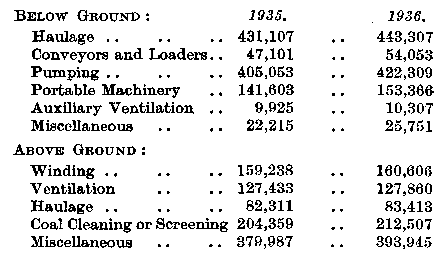
Under "Portable Machinery" coal-cutting machines represented 138,164 H.P. in 1935 and 149,975 H.P. in 1936, the increase for this purpose being 11,811 H.P. As would be expected, haulage and pumping make the heaviest calls on the use of electricity underground. On the surface it is largely employed for miscellaneous purposes, whilst for coal cleaning or screening the demand is a growing one.
General Comments on Accidents.
Owing to the ignition of firedamp at Wharncliffe Woodmoor Colliery the deaths record was less favourable than in 1935. Persons injured, on the other hand, numbered 54 as compared with 79. In some general remarks on the fatal accidents the Inspector says :—
During 1936 there were nine accidents (involving the loss of 12 lives) definitely attributable to the use of electricity, and one explosion of firedamp and coal dust where the balance of the evidence indicated that electricity was the probable cause. Six of these were instances of electric shock, with one person killed in each instance and, in addition, one person injured in one of them. There were three ignitions of firedamp in which six lives were lost and two persons were injured ; and one, viz., that at Wharncliffe Woodmoor Colliery, in which 58 lives were lost.
Five of the electric shock accidents occurred below ground and one on the surface,
The three minor explosions were due, respectively, to a coal-cutting machine used in a defective mechanical condition, a fault in a trailing cable and to an open type squirrel-cage motor used In a defective electrical condition.
The serious explosion at Wharncliffe Woodmoor Colliery is attributed to the switching-on of a small loader motor during a routine examination by an electrician, after he had removed the cover from the commutator.
The six purely electrical accidents may be summarised thus : drilling into a live armoured shaft cable; opening a live terminal box on a switch; climbing into live lines on a transmission line mast; and three instances involving trailing cables.
All of these accidents could have been avoided either by greater care on the part of the individual or by more effective supervision.
As regards non-fatal accidents Mr. Horsley states that during 1936 there were 46 accidents involving injury, more or less serious, to 51 persons and 13 reportable dangerous occurrences that did not result in personal injury. There were also three persons injured in two of the fatal accidents. Included in the totals were two ignitions of firedamp and 12 instances reported as outbreaks of fire underground. Of the total number, 14 occurred on the surface and 45 underground.
The Inspector describes in his report (a) Electric shock or arc burns when working upon high voltage circuits or apparatus, 11 instances; (b) Ignition of firedamp, two instances; (c) Outbreak of fire, underground, 12 instances.
Regarding those in category (a), he says it is true that only slight personal injury resulted in each instance, but the circumstances point to the lack of adequate instruction, or effective control and supervision of the electricians whose mistakes, or rashness, contributed to the accidents.
With respect to the two ignitions of firedamp, in category (b), he remarks that the first occurred in the presence of a deputy and resulted from a serious injury to a flexible cable that ought to have been discovered before the current was turned on, while the second was brought about by a short-circuit in a plug when the flexible cable was being drawn up the face, by the machineman, with the gate-end switch turned on.
Fortunately there were only two persons injured in the first and none in the second.
The reported outbreaks of fire underground. in category (c). make a formidable list, but in fact, he adds, many of these were of little consequence and no personal injury resulted from any of them. The apparatus involved was of the following descriptions: Liquid controller, oil-immersed resistance, connections in battery of locomotive, one instance of each; Flexible cable, four instances Armoured cable, five instances.
Regarding fire risks with cables, the Cable Makers' Association has undertaken, at Mr. Horsley's suggestion, to investigate this risk experimentally, particularly with respect to the value of non-inflammable coverings of such cables.
Machine Mining Increases.
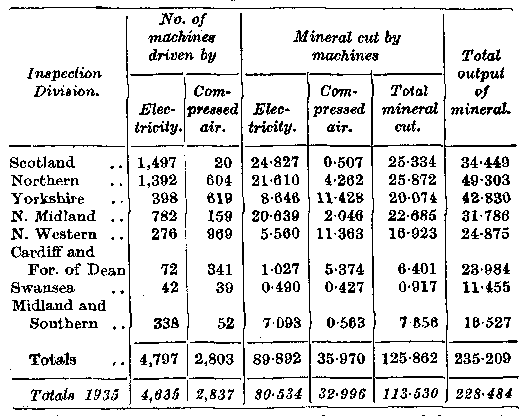
There has been an increase in the number of electrically-driven coal-cutting machines of 162 during 1936, following an increase of 184 in the preceding year. There was an increase of 9 1/3 million tons in the quantity of mineral cut by electrical machines, out of a total increase of 12½ million tons of mineral got by machine mining. The greatest increase in the number of machines driven by electricity occurred in the Northern Division with 64 machines, but the greatest increase in the quantity of mineral cut by electrical machines was recorded in the North Midland Division with 3.108 million tons.
The output figures in the appended tables are in million tons :—
In 1936 there was also an increase in the number of electrically driven conveyors and loaders of 493, compared with an increase of 527 in the preceding year.
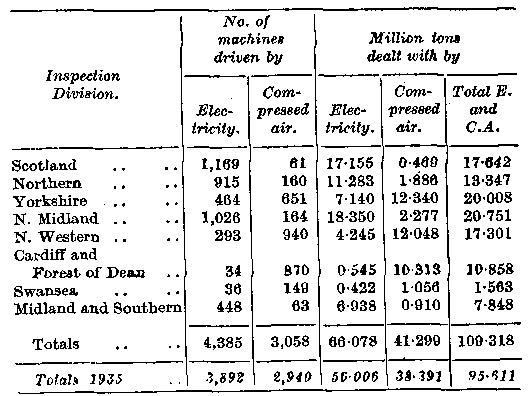
Tables show an increase of ten million tons of coal conveyed wholly by electrically-driven machines, out of a total increase of 13¾ million tens of coal conveyed by mechanical means.
It appears that there were increases in the number of electrically driven machines in every Division. The more notable increases occurred in North Midland with 101 machines and Northern with 96 machines. Yorkshire and Scotland Divisions follow with 83 and 82 machines, respectively, while the North Western Division added 73 machines.
 |
 |
| Names mentioned in this article | |
 |
 |
| Name | Age | Occupation | Notes |
|---|---|---|---|
| Horsley, James Arthur Bennett | H.M. Electrical Inspector of Mines | Whos Who Page |




 Contains public sector information licensed under the

