


| Newspaper Articles |

|
Newspaper Articles |
 |
 |
5th June 1937, Page: 376, Column: 2
Some Aspects Of Mine Illumination
By Thomas Bryson, A.R.T.C., M.I.Min.E., M.I.M.S.
From paper read at a joint meeting of the Past and Present Mining Students' Association (Wigan Mining and Technical College) and the Lancashire branch of the Institute of Mine Surveyors. The Author is president of the Institute. Concluded from page 353.
Illumination.
Light, from whatever source it may come, is transmitted by wave motion in the ether. Daylight, as distinct from sunlight, enables man to see with greatest comfort, but as the human eye is a very adaptable mechanism considerable variations of light intensity are received by it in comparative comfort. As darkness falls the pupil of the eye expands to allow a greater amount of light to pass to the retina, and in strong sunlight the iris contracts to exclude the glare-of the sun from the retina. No light that can be used underground will give more than a mere fraction of the illumination derived from the sun, and yet the eye may without serious discomfort adapt itself to the diminished light. Remembering that daylight is diffused and sunlight a glare against which we endeavour to protect ourselves by partially closing the eyes, we can choose a diffused light for underground illumination and avoid the danger of glare. The brightness of the filament of a miner's electric lamp may be many times the brightness of a flame lamp of the same candle-power, but enclosure in an opalescent or prismatic well-glass diffuses the light and discomfort is avoided. One of the qualities of a metallic reflector, however, is that it produces glare by specular reflection, and that is undoubtedly hurtful to the eyes. The constant strain of muscular effort exerted in an attempt to protect the eyes against glare leads inevitably to astigmatism and nystagmus. The greatest stress is produced when the glare of a lamp impinges on the eyes whilst the vision is concentrated on the work to be done, and the least stress is experienced when the full intensity of the lighting power of the lamp is brought to bear on the work being done.
The soft yellow light of flame lamps in which there is no reflection may, or may not, be less injurious to the eyes than the diffused white light of the electric hand lamp, but it is tolerably certain that the greatly enhanced light of the electric cap lamp, directed to the same point as holds the wearer's attention, is far less likely to lead to the dreaded discomfort of nystagmus. Macula vision becomes less of an effort when a cap lamp of any kind is worn, so that the advantage of using a cap lamp is two-fold: better light is available and it requires less effort on the part of the wearer.
The efficiency of any system of lighting, however, is not entirely dependent on the character of the source of light. Light falling on a dull black surface may be wholly absorbed in the surface; light falling on coal may be reflected to the extent of one-tenth, whereas if it falls on a whitewashed wall 70 per cent. of the light may be reflected. The periodical application of stone dust tends to improve the lighting of places treated in that way, and whitewashing of permanent roadways contributes a great deal more to the efficient lighting of underground workings. To what extent can the advantage of whitewashing be carried into the face of the workings ?
Illumination Units.
The brightness of an illuminated surface is expressed in foot-candles, the foot-candle being defined as the intensity of illumination produced by the light falling from a source of one candle-power on a surface at a distance of one foot from the source.
The unit of light intensity is the candle, and it is defined as the light emitted horizontally by the flame of a sperm candle weighing one-sixth of a pound and burning at the rate of 120 grams per hour, or it is one-tenth of the light given by a Harcourt pentane lamp when the flame is adjusted to a standard height.
A lumen is the amount of light falling on a surface of 1 square foot, every point of which is at a distance of 1 foot from a point source of light of one candle-power. Since the surface of a sphere is 4[pi]R², the lumens emitted by a lamp are obtained by multiplying the mean spherical candle-power by 4[pi].
Inverse Square Law.
When an electric torch is held horizontally at a distance of 21" from a vertical surface a circle of 6 inches in diameter is illuminated; when the distance is. increased to one foot the diameter of the illuminated circle is 42"; and the illuminated circles have areas in proportion to the square of the diameter. Since the amount of light emitted by the source is the same in both eases, the intensity of illumination of the larger surface is one-fourth of the intensity of illumination of the smaller one. It therefore follows that the intensity of illumination varies inversely as the square of the distance from the source of light to the illuminated surface, or foot-candles candle-power / distance in feet, squared. For example, if an electric cap lamp gives a candle-power of 16 and it is placed at a distance of 3 feet from the illuminated surface, the intensity of illumination on the surface = 16 ÷ 3² = 16 ÷ 9 = 1.8 foot-candles nearly. Were a flame or electric hand lamp of 4 c.p. placed at the same distance from the surface, the intensity of illumination would be 4 ÷ 3² = 4 ÷ 9 = 0.44 foot-candle.
When the light falls obliquely on the illuminated surface, the intensity of illumination falls off in proportion to the cosine of the angle between inclined surface and the plane at right angles to the incident light. In accordance, therefore, with the cosine law of Lambert, the inverse square law takes the form:
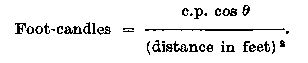
An understanding of the inverse square law and Lambert's cosine law enables us to appreciate the variations of intensity of light falling from any given source of light, but the former is important also as a means of comparing the lighting power of different sources of light, one of which may be a standard source.
Photometry.
As the intensity of illumination varies inversely as the square of the distance from the source to the surface, it may also be stated that the candle-powers of lamps are directly proportional to the square of their distances from equally illuminated surfaces, thus :—

This is the principle upon which photometric measurements are based, and these may be made by means of Rumford, Bunsen, Flicker, or Lummer-Brodhun photometers.
In the case of the Rumford photometer designed by the late Dr. Haldane the lamp to be tested is compared with a standard candle which is placed at a distance of one foot from the screen upon which the shadows of a wooden pillar are received. The safety-lamp is moved along a scale until the shadows cast by the candle and the lamp are of equal intensities; then the candle-power of the lamp is read direct from the scale along which it was moved.
When the Bunsen grease-spot photometer is used the standard source of light and the lamp being tested are placed on opposite sides of a translucent paper screen, with a grease spot in the middle of it, the grease spot being in the same horizontal line as the lights being compared. When the photometer has been moved towards one source or the other, the grease spot disappears because of the equal illumination of both of its sides. The distances from the screen to the standard source and the lamp are measured to enable the candle-power of the lamp to be calculated as follows :—
Distance of standard from screen, 20"; candle-power of standard, 2.68; distance of lamp from the screen, 26.5".
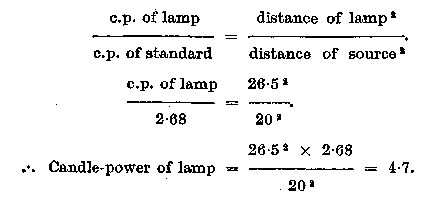
In the case of the Flicker photometer the comparison is made by placing between the standard source of light and the lamp specially shaped disc made of plaster of Paris, the disc being caused to rotate at a suitable speed by means of clockwork. When there is inequality in the illumination of the opposite sides of the disc the latter appears to flicker when viewed through an eyepiece placed in the central plane of the disc. The photometer head is then moved to one side or other along the bench untll the rotating disc ceases to flicker. Distances from the sources of light to the central plane of the disc are measured and the illuminating power of the lamp calculated. Probably the best results are obtained with this photometer when a flame safety-lamp is compared with the pentane standard and an electric lamp with an electric bulb of known candle-power.
The Lummer-Brodhun photometer consists of a screen of plaster of Paris which is placed in a box containing glass prisms so arranged that the opposite sides of the screen can be seen at once through the eyepiece attached 'to the case. Again, the photometer is adjusted until the screen appears to be equally illuminated on both sides, after which the candle-power of the lamp being tested is calculated.
The accuracy of photometric determinations made in this way is influenced by the difference in colour of the lights being compared and 'by the soundness or otherwise of the judgment of the person making the comparison.
Swinging Arm Photometer.
The mean intensity of illumination over the horizontal angle of distribution (m.h.c.p.) must not now be less than 15 candle-power, and lamps will not be regarded as having a suitable distribution of light unless the intensity of light is not less than one candle-power anywhere within a minimum area, which for cap lamps is a solid angle of 100° and for all other types of lamps is contained within a horizontal angle of 180° and a vertical angle of 50°. The swinging-arm photometer was a natural development arising from the foregoing requirement. It is constructed to enable the candle-power to be determined in all directions horizontally round the lamp and within a limited vertical range in all directions round it. The personal element is displaced by a photo cell which is attached to the swinging arm in a position determined with reference to a standard source of light placed at the centre of the turntable. The terminals of the cell are connected to a micro-ammeter with a foot-candles scale and/or a candle-power scale, and when light falls on the light-sensitive disc of the cell a discharge of electrons passes to the adjacent ring and a difference of potential is set up between the terminals. The edges of the turntable and the vertical disc are divided into divisions of 10°, and therefore observations can be made to enable diagrams of horizontal and vertical light distribution to be drawn and the mean intensities to be determined. Calibration of the instrument is effected by reference to a standard electric bulb.
Cube Photometer.
A safety-lamp after burning continuously for nine hours must give such light that the mean spherical candle-power (m.s.c.p.) is not less than 0.4 for cap lamps and 0.75 for all other types of lamp. Having regard to the impossibility of putting a pit lamp at the centre of a spherical photometer, and recognising the feasibility of standardising a cube photometer with an electric bulb of a certain mean spherical candle-power, the cube photometer has been constructed to enable the m.s.c.p. of lamps to be determined accurately and expeditiously. A Weston photo-cell is set flush in the wall of the cube, and its terminals are connected to a Tinsley galvanometer having a deflection of 13 mm. per micro-ampere. The galvanometer is calibrated with the photometer by means of electric bulbs of known mean spherical candle-powers.
The lamp to be tested is placed on an adjustable platform in the cube, and the platform is adjusted to place the source of light at the centre of the cube. Direct passage of light to the cell is prevented by a disc placed between the lamp and the cell. The door is closed and the reading of the light spot on the scale is taken to admit of the m.s.c.p. being calculated. The scale reading divided by 1.75 gives the m.s.c.p. of any lamp tested.
It appears incumbent upon colliery companies to provide themselves with at least one of these photometers to enable the depreciation of lamps in service to be recorded. After an initial determination of mean horizontal, vertical, and spherical candle-powers, it is only necessary that the m.s.c.p. should actually be determined as a means of finding the other values.
 |
 |
| Names mentioned in this article | |
 |
 |
| Name | Age | Occupation | Notes |
|---|---|---|---|
| Bryson, Thomas |
 |
 |
| Related Articles | |
|
|
| Pub. Date | Article (Newspaper) |
|---|---|
| 08 May 1937 | Some Aspects Of Mine Illumination (The Science and Art of Mining) |
| 22 May 1937 | Some Aspects Of Mine Illumination (The Science and Art of Mining) |
| 05 Jun 1937 | Some Aspects Of Mine Illumination (The Science and Art of Mining) |



 Contains public sector information licensed under the

