


| Newspaper Articles |

|
Newspaper Articles |
 |
 |
15th August 1936, Page: 35, Column: 1
Coal Jigging
Clean Water v. Dirty Water
From the paper on "Notes on Coal Jigging," by Dr. A. Hirst of the Mining Department of the University of Birmingham, read at the general meeting of the Institution of Mining Engineers, we give the following extracts :—
By adopting suitable methods of clarification the water in a jig may be kept crystal clear. When this is done a brilliant washed coal which drains very readily is usually obtained. It may be found, however, that in spite of its brilliant appearance the ash-content of the washed coal is no lower than, if as low as, when using dirty water; moreover, there is often a considerably increased loss of fine coal in the dirt when using very clean water. There appear to be, therefore, some advantages in the use of dirty water. One perfectly certain advantage is the increased density of the washing medium. One possible, but not certain, advantage is that some kinds of dirty water may act as a lubricant and reduce the contact forces between particles.
Without delving into theoretical matters, common sense indicates that the maximum advantage of dirty water will be realised when (a) the density is a maximum so long as the medium does not become unduly viscous; (b) the particles in suspension are sufficiently small to flow freely through the interstices of the bed; and (c) a separation at a low gravity is required.
As the presence of coal-particles in suspension increases the viscosity without greatly increasing the density of the medium, coal-particles are preferably excluded in favour of clay or shale. Unless the particles in suspension are very small the advantages of dirty water will probably be greater when treating de-dusted or sized coal than when treating raw coal, since in the former case the interstitial spaces are larger.
A Laboratory Experiment. — A quantity of coal was prepared, sized ¾-1/10 in,, and having the following float-and-sink analysis :—
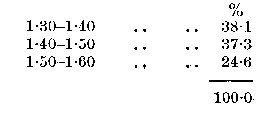
A bed 4 in. thick was jigged by hand until stratification was complete and a given weight, corresponding to a layer in. thick, was scraped off and tested at a density of 1.40. Two series of tests were made. In the first, the jigging was done in water density 1.0 ; in the second, in a suspension of finely ground soft shale, the density of the suspension being 1.l.
Using water, the 1.4 sinks in the top layer were on the average over 20 per cent. ; with the clay suspension the sinks were reduced on the average to under 10 per cent. Although such tests are not directly representative of the conditions of practical jigging, the improved separation with the clay suspension is very marked.
Practical Control of the Condition of Washery Water. — One hears and reads that certain methods of treatment keep the solid content of the washery water to x per cent., which value gives the best washing. This is all right up to a point, but the considerations dealt with suggest that some suspended solids — extremely finely divided soft shale or clay — are useful, whereas others — coal or large particles of shale — are not particularly useful, and when present inhibit the possibility of obtaining the maximum advantage from the useful varieties. Leaving for the moment the question of brilliant washed coal and ready drainage, in so far as the jigging process itself is concerned it is probable that an excellent medium would be a suspension of semi-colloidal soft shale or clay with a density of about 11.
Considerations Involved in Maintaining a Washing Medium of Semi-colloidal Soft Shale or Clay. — The suspension is supposed to be produced in the first place by the action of the jig and its associated equipment on soft shale mixed with the raw coal, though it may become necessary to consider the deliberate introduction of semi-colloidal material. The considerations involved in maintaining the desired suspension are, for the sake of convenience, tabulated as follows :—
1. Coal and larger particles of shale should be separated out. As such particles settle fairly readily this might possibly be achieved in the conical tank, or it may be necessary to employ differential flocculation.
2. To obtain a brilliant washed coal, if this is possible, plenty of spray water will be required. This may also be necessary in order to conserve the semi-colloidal material.
3. To avoid dilution of the washing medium, the spray water exclusive of the "make-up" will probably have to be provided by clarifying a proportion of the water in the system.
4. The point in the circuit where water is bled off for clarification should be chosen with a view to obtaining an easily clarified product.
5. When a suspension of the right kind of solids is obtained, the solid content must be maintained at the proportion which is found to give the best results.
6. If part of the system is clarified by flocculation with chemical reagents, it will probably be desirable to take precautions to avoid flocculation of the washery water as a whole in order to avoid increasing its viscosity.
 |
 |
| Names mentioned in this article | |
 |
 |
| Name | Age | Occupation | Notes |
|---|---|---|---|
| Hirst, A., Dr. |




 Contains public sector information licensed under the

