


| Newspaper Articles |

|
Newspaper Articles |
 |
 |
15th February 1936, Page: 251, Column: 1
Coal For Mechanical Stokers
From a study of the relationship between ash and boiler efficiency, said Mr. H. L. Pirie, M.I.Mech.E., in his paper on "Coal for Mechanical Stokers" before the Institution of Mining Engineers on the 30th January, it would appear that the lower the ash, the higher the efficiency to be expected. This conclusion can he applied to coals which are hand-fired without serious error, but it must he noted that some varieties of coal, irrespective of ash-content, are entirely unsuitable for burning on certain standard types of mechanical stoker.
Characteristics of Coals.
Dealing with the characteristics of coals, he remarked that in effecting a "marriage" between a coal and the appliance on which it is to be burned it becomes necessary to study the characteristics of the former, and it is convenient to classify coals according to their behaviour under the influence of heat.
Coking Coals. — Coking coals may be defined as those which coke and swell appreciably. Such coals, where the tars fuse at a temperature below that at which they are driven off as gas and percolate the fuel-bed so that it coheres strongly, require that the coke as it is formed be broken to enable air to pass through, as they readily burn only when the exposed surface is increased by fracture. Coals of this nature are, it is submitted, best burned in conjunction with stokers in which provision is made for the agitation of the fuel-bed.
Caking Coals. — These coals cake but do not swell (or if they do, the swelling takes the form of a frothy weak spongy mass), and are probably the most satisfactory for the vast majority of mechanical stokers. A coking coal is necessarily a caking coal, but the reverse is not the case. When "slacks" are used, it is advisable that they should be of a slightly caking nature, otherwise there will generally be undue ash pit loss. Certain slacks have a low caking index, are free-burning, and are therefore not considered suitable for stokers where bars moving relative to the fuel-bed are used, as they riddle excessively and interfere with the maintenance of the requisite fuel-bed thickness.
Free-burning Coals. — Free-burning coals are those which neither coke nor cake but retain their shape throughout the burning period.
With regard to coal cleaning Mr. Pirie explained that whether dry or wet cleaning should be practised must be decided by each individual colliery, regard being paid primarily to the nature of the coal seam — whether it is dirty or contains a low percentage of adventitious ash. If the former, doubtless washing will be resorted to, but other factors must he taken into consideration, such as the gravity of the "middlings" and the extent of intergrowth.
Grouping Mechanical Stokers.
Discussing mechanical stokers he said these may be grouped under the following heads (a) Stokers for water-tube boilers which naturally fall into two main classes: (i) Progressive, in which the grate surface is movable and travels at the same speed as the coal which lies undisturbed thereon, e.g., the chain-grate type; (ii) Non-progressive, in which the grate is usually fixed and the coal travels over its surface by gravity or otherwise, e.g., the retort type,
(b) For use with narrow flue internally-fired boilers such as the Lancashire: (i) Coking, which imitates the coking method of hand-firing; (ii) Sprinkler, which imitates the sprinkling method of hand-firing; (iii) Underfeed, the principle of which is obvious from its name; (iv) The ram type.
(c) For use with central-heating boilers: (i) Underfeed type (ii) Gas-producer type; (iii) Overfeed type; (iv) Progressive type.
Suitable Coals for Stokers.
The relative suitability of coals for stokers of any type is largely dependent on the rate of combustion (lb. per square foot per hour) which is to be employed. The upper limit of the rate of combustion with any stoker and with any fuel is reached when the air velocity through the fuel bed becomes such that an excessive quantity of grit is entrained by the flue gases. Some coals, particularly those of the coking and caking type, will withstand higher air velocities than others. It follows that there are fewer coals which can be burned at high fuel-burning rates than at low fuel-burning rates. Accordingly, a good deal of conflicting information in existence to-day about the relative suitability of coals for specific stokers arises from the fact that the variable of combustion rate per square foot is generally omitted from consideration.
Summarising, it may be said that suitable coals for the types of stoker enumerated are: (a) (i) Caking or free-burning types. When the coal fluxes its ash at furnace temperatures, this type of stoker gives good results. Peas or smalls are the sizes usually specified. (a) (ii) Coking, caking or free-burning type. The caking or coking types being more particularly suited for installations having higher rates of combustion.
Modern stokers of progressive and non-progressive types will burn slacks or sized coals from nuts to 1/8 in. smalls. Generally, it is not economic to burn small slacks remote from their source of origin, but as it is possible to get reasonably good results from many so-called "low-grade" coals Mr. Pirie does not see why they should be sold so much below their cost of production, which is often the case.
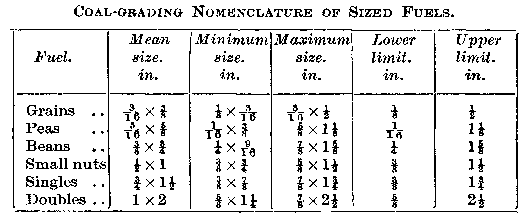
The inference is not to be drawn that all makes of stoker in the respective classes will necessarily burn the coals recommended, but at least one make from each class is capable of so doing. As well as giving trade names, the Author quoted actual sizes. This precaution is necessary because the variation in the sizes of coals marketed under the same nomenclature is considerable, as will be seen from an inspection of the Table :—
Powdered Fuel Firing.
After discussing blending, evaluation of coals, coal purchase and combustion of anthracite duff Mr. Pirie remarked that no paper on coal for mechanical stokers would be complete unless some reference were made to powdered-fuel firing. In his view, whether for Lancashire or water-tube boilers, this method of firing should be considered at least by all collieries which clean their coals. The de-dusting or extraction of fines, provided the coal is initially sufficiently dry, facilitates washing or cleaning, and the aspirated dust can be submitted to grinding, which will render it serviceable for boiler work. This dust is high in ash, but the emission of fly ash at collieries, which are not as a rule situated in a residential neighbourhood, need not receive too close scrutiny.
He would hesitate to recommend the use of powdered fuel for larger boiler plants situated in the midst of dense centres of population. Grit and ash emission can, of course, be overcome by the installation of washers or precipitators, but these cost money and it is a moot point whether they will pay an adequate return on the capital expended. He considers it essential that very low ash coal should be purchased if it is to be used in any quantity in a residential neighbourhood.
Many collieries have adopted powdered-fuel firing both for water-tube and Lancashire boilers, while anthracite duff has been decided upon for Swansea's Tir John North Power-station. Anthracite was obviously the fuel to use at that station, and as it was found that powdered fuel would be more suitable than mechanical stokers in that instance, the plant was designed to suit the fuel most readily available.
 |
 |
| Names mentioned in this article | |
 |
 |
| Name | Age | Occupation | Notes |
|---|---|---|---|
| Pirie, H. L. |




 Contains public sector information licensed under the

