


| Newspaper Articles |

|
Newspaper Articles |
 |
 |
15th February 1936, Page: 250, Column: 1
Energy Output When Loading
Effect of Height
At the annual general meeting of the Institution of Mining Engineers on the 30th January Professor K. Neville Moss, O.B.E., M.Sc., presented a paper on "The Effect of Height of Roof and of Tubs upon the Energy Output of the Miner when Loading." Tests were undertaken having for their object to provide data which would give comparisons between the energy outputs of miners loading under different heights of roof and into tubs of different height, and it was necessary to conduct them in a laboratory. It is obvious that conditions of loading must be kept uniform so that the muscular energy expended during movements of the body, in between actual coal-lifting operations, would be the same, or as nearly as possible the same, in all experiments.
The height to which the concrete blocks, shovelfuls of coal, or baskets of coal in sacks, were raised was observed by the same man in every test. For this purpose a scale reading was erected behind the loader. The observer placed himself in such a position that his eyes were on a level with a point above the platform to which the miner lifted the coal and in line with the scale, so that the height could be read as accurately as possible. It was observed throughout the experiments that a miner engaged in loading never wastes energy by lifting the coal too high, though there is a tendency for him to throw the coal from the shovel or basket into the tub so that it rises a little higher than his shovel.
The time taken to load 10 cwt. of material was recorded in seconds. The heights to which the concrete blocks and the shovels full of coal were raised were separately recorded so that the work done in lifting could be determined as accurately as possible. The actual work-output was only that of lifting the concrete blocks and coal plus shovel and did not include raking the sacks into the basket, driving the shovel into the heap of slack, or in other incidental forms of work which go to make up the full task of loading. In any case, however, the total energy expended during loading is determinable with a reasonable degree of accuracy, and since the positions of the blocks, slack, and sacks were the same in each test, the portions of the work of loading which cannot be estimated were kept practically constant.
Tables were submitted by Professor Moss giving personal data about the ten men undergoing the tests, the loading of coal on to a conveyor, and into tubs, and he assumed as reasonable that the total work-output in loading 10 cwt. of coal is not more than twice the recorded actual work-output in lifting the coal, and is in fact not likely to be more than 150 per cent. on the average. The volume of air breathed during a loading operation was recorded and all the air expired was collected and sampled. Thus all the data were available for determining the total oxygen consumption during each loading test.
The Author directed attention to the records of the tests showing the inefficiency of a miner's work especially when working in a cramped condition, and to the mechanical efficiency of the men, that is, the relationship between energy output less the basal resting rate, the actual work-output in lifting the coal being low, varying on an average from 1.5 per cent. for loading on to a conveyor under a 3-ft. roof to 6.1 per cent. when loading into a 3½-ft. tub under a 6-ft. roof. He averred that it is remarkable at first sight that the mechanical efficiency of the body when loading a 42-in, tub under a 5-ft. roof is three times greater than when loading on to a 10-in, conveyor. His previous work has shown that loading is the hardest type of work at the coal face, and its proved inefficiency points at once to the need for mechanical appliances to do this type of work. Also, loading on to conveyers is less efficient than loading into tubs.
In order to obtain the working efficiency of miners loading rhythmically, Professor Moss explained, some of the men lifted 10 cwt. of coal in sacks over a rail varying in height from 10 to 42 in. This was done by standing or kneeling in a fixed position, stooping down to pick up the sacks one at a time, and lifting them over the rail in such a way that the operations were performed rhythmically, thereby working with maximum efficiency. The -results of these experiments show that the mechanical efficiency of the body when loading rhythmically is 8.4 per cent. when loading a 10-in, conveyor under a 3-ft. roof and 16.3 per cent. when loading a 3½-ft. tub under a 6-ft. roof.
The following table was presented by the Professor in further reply to the discussion of the paper on "A Time Study of Coalface Workers" :—
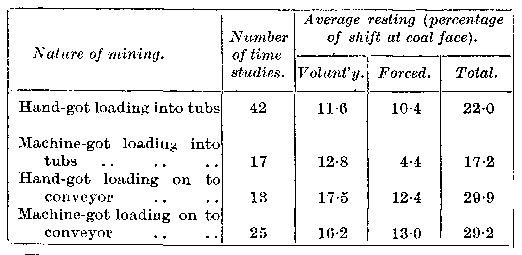
These data, he said, support the facts contained in his present paper in that one can attribute the increased voluntary resting time when loading on to conveyers to increased fatigue due to what we now know to be harder work. It appears from the total 0 2 consumption, he concluded, that conveyors should be raised from 2 to 3 ft. above floor-level to improve the efficiency of loading and reduce the energy output of the men to as low a figure as possible. One point is abundantly clear, he finally said; a miner should work in a position as erect as possible, for the more he stoops the less efficient, in a mechanical sense, his work will be.
 |
 |
| Names mentioned in this article | |
 |
 |
| Name | Age | Occupation | Notes |
|---|---|---|---|
| Moss, Kenneth Neville, Prof. | Whos Who Page |




 Contains public sector information licensed under the

