


| Newspaper Articles |

|
Newspaper Articles |
 |
 |
8th December 1934, Page: 170, Column: 1
Fuel Research Board's Report
Object of Coal Survey.
The Department of Scientific and Industrial Research has issued the Annual Report of its Fuel Research Board for the year ended 31st March, 1934 (3s. net, H.M. Stationery Office). The Board points out that the last year has seen many developments affecting either the direct combustion of raw coal or its conversion into other forms of fuel. All these have been closely followed by the Board in order to enable it to adjust its programme to the immediate needs of industry and to ensure that the necessary fundamental investigations are undertaken in preparation for the future.
Sir Harold Hartley, C.B.E., the chairman of the Board, says the object of the coal survey is to examine the coal seams as they occur belowground, tracing the variations in properties from floor to roof and from place to place. Samples taken at the pithead are also examined and show the properties of the coal as it is marketed. The data obtained in the coal survey are co-ordinated with the results of investigations on typical coals carried out in the large-scale carbonisation plants, etc., at the Fuel Research Station. The laboratory examination has, in some cases, indicated how the coal can be improved by modifying the method of working the seam in the mine. It provides information as to the correlation of the coal seams in different areas, a problem which is frequently of considerable practical importance. It indicates where coal possessing particular properties can he obtained and suggests means of improving the quality of the coal for a particular purpose by cleaning or blending. As the work progresses it is satisfactory to find the colliery owners making use of the information gained in the Survey, not only in connection with the utilisation of the coal, but in deciding questions as to the desirability of opening up or closing down certain seams.
Mechanically Cleaned Coal.
Recalling that in the early days the only surface cleaning consisted in hand-picking the larger lumps of dirt from the coal, Dr. F. S. Sinnatt, the Director, points out that now over 77 million tons of small coal per annum are mechanically cleaned in Great Britain, which is a very large proportion of the small coal produced. Clean coal is now obtainable in smaller and more convenient sizes, and a number of factors are combining to reduce the demand for large coal and increase it for small coal. Among these are the increase in the mechanically fired furnaces as compared with band-fired, the utilisation of graded small coal by the gas industry, and the diminished storage accommodation in the modern house or flat, together with the advantages associated with the sale of coal in bags. The householder is no longer favouring large coal; he finds it preferable to buy the coal in suitable sizes, and thus avoid not only the trouble of breaking it up, but the consequent wastage due to the formation of coal dust. The change in the demand for large and graded coal has come somewhat rapidly and is being felt in several of the coalfields it applies to both domestic and industrial demands at home as well as to export coal. The result is that a new problem has arisen, namely, how to break down the large coal to the sizes most in demand without the undue formation of dust.
This problem is related to two others — (a) coal grinding for the production of pulverised fuel and (b) anti-breakage. It is essential for economical working to prevent, as far as possible, breakage to smaller sizes than those required, and to minimise breakage once the coal has been graded.
Connected with the problems of grading are those of cleaning the coal, and of these the cleaning of the smaller sizes and the purification of the washery water appear to be those in which the greatest improvements are possible. It is to these that the greatest attention is being paid at the Fuel-Research Station. The importance of keeping the washery water clean does not always appear to be realised, particularly in relation to the smaller sizes of coal. If the washery coal contains an undue proportion of very fine coal and dirt, this is deposited on the washed coal and spoils its appearance even when it does not greatly affect its properties. A more important effect results in the case of the smaller sizes where the presence of very fine material — particularly if of a clay-like nature — prevents the ready drainage of the washed coal, which thus retains an undue proportion of moisture.
Pressure Flotation.
In the section dealing with the purification of coal the Report says possible new modification of the flotation process is being studied on a laboratory scale. In this process the dry coal is subjected to a slight pressure of air or other gas (20-60 lb. per square inch has been used) water is then added and the pressure released. In some cases oil is added as a flotation agent, but one feature of "pressure flotation" is that the yield of clean coal obtained without the use of flotation agent is generally considerably greater than that obtainable by other processes.
Some indication of the cleaning achieved by pressure flotation is given by the following results, obtained on a small scale with coal crushed to pass through a 1/16-inch sieve and subjected to an air pressure of 60 lb. per square inch :—
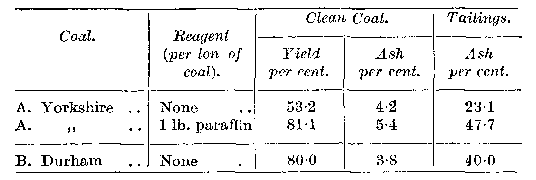
In the case of coal B the maximum yield obtainable by vacuum flotation without reagent was 30 per cent.
In pressure flotation the air bubbles are obtained by the expansion of air previously compressed into the pores of the coal, and it is believed that the attachment of such bubbles to the coal is stronger than is the case when bubbles created in the water are caused to adhere to the coal.
A process for the dry cleaning of coal by a new type of air jig has been developed at the Coal Survey Laboratory at Sheffield and tested with a small plant dealing with about of a ton of coal an hour. A larger plant has now been erected at the Fuel Research Station, designed to deal with about 1½ tons of coal an hour and intended to take coal up to inch size. The coal so far used for the experiments consists of a dry slack passing a ½-inch round hole screen and containing about 27 per cent. of "free dirt" sinking in a liquid of 1.45 sp. gr. No difficulty has been experienced in obtaining a clean coal containing 5—7 per cent. of "free dirt," and stratification in the cell has usually been such that the dirt layers contain 1—4 per cent. of free coal. The modifications have mainly been concerned with the efficient extract ion of the dirt. formed in the cell, and, although it is confidently expected that the present cell can be made satisfactory in this respect, the accumulated data will enable a greatly improved cell to be designed.
Coal Carbonisation.
The carbonisation of coal is being studied on a works scale at the Fuel Research Station in three types of retort, namely, in a setting of eight horizontal retorts as used in ordinary gasworks practice, in two narrow brick retorts designed for continuous working and intended for the production of free-burning smokeless domestic fuel, and thirdly in a setting of two vertical chamber ovens.
In the horizontal retorts experiments were made at the suggestion of the Manager of the Cardiff Gas Company, a former member of the Fuel Research Board, on the introduction of steam into the retorts during the last period of the carbonising process. These have indicated that in this way an increase of 10 therms per ton of coal carbonised — over 11 per cent. of the average number of therms produced — can be obtained. The report contains records of successful trials of this method by the Gas Light and Coke Company and by gas undertakings at Cardiff, Wandsworth and Mitcham.
The narrow brick retorts designed at the Fuel Research Station are being continuously used to test the life of this type of retort and to study on a full scale the suitability for low temperature carbonisation of different varieties of coal suggested by the Survey Committee. In the selection of the coal the economic position has had its influence as well as the nature of the coal itself.
The chamber ovens are being used to study the effect of blending various types of coal on the coke produced. "This problem," the report states, "is of considerable importance in view of the approaching depletion of the best coking coals in some districts, and it is necessary to obtain information which will enable seams of lower coking power to be utilised." The materials which have been carbonised may be grouped under the following headings :—
(1) Caking coal alone. (2) Caking coal with increasing additions of non-caking coal. (3) Caking coal with increasing additions of low temperature coke breeze. (4) The optimum proportion of caking coal, as decided by the results of (2) and (3), blended with varying proportions of both non-caking coal and low temperature coke breeze. (5) Similar to (4) but with a different proportion of caking coal.
Working according to this programme 35 blends have so far been carbonised and the cokes produced examined. The investigation is not yet sufficiently advanced to allow of definite conclusions being drawn. Nevertheless, results of considerable interest have emerged, and cokes suitable for use in the domestic open grate have been produced. These cokes, which contain about 5 per cent. of volatile matter, are dense and robust and fairly uniform in character, ignite with reasonable ease and give satisfactory rates of heat radiation when tested in the open grate by means of the empirical test used at the Fuel Research Station to assess the suitability of domestic cokes. A small particle size of coal is essential if a true blend is to be obtained.
Oil from Coal.
The report summarises the position during 1033 regarding the extraction of motor spirit and fuel oils in this country as follows :—
The lighter fractions of tar, together with the spirit "scrubbed from the gas produced by carbonisation, provide an excellent motor spirit, and are the source of the 40 million gallons, or so, of benzol produced in this country. The creosotes obtained by the distillation of tars from gas retorts and coke ovens can be, and are being, used as fuel oils. The medium fractions of tars produced by carbonising at lower temperatures are even more suitable as fuel oils. In this connection it is of interest to record that during the year 1933 one home-defence squadron of the Royal Air Force flew solely on motor spirit produced from coal, and in view of the satisfactory results a contract has been placed to cover the requirements of seven squadrons. Also, during the same period, about 2,000 tons of oil produced from coal were supplied to the Royal Navy; trials of this fuel have been carried out both at the Admiralty Experimental Station and on service afloat.
The most valuable fuel produced from tar is, in present conditions, the motor spirit, but when obtained by the usual methods it only amounts to about 3 gallons per ton of coal carbonised. It has been shown that practically the whole of a tar produced at "low" temperatures, and considerable proportions of other tars, can be converted into first-class motor spirit by treating the tar with hydrogen under pressure. A study of this process forms an important branch of research at the Fuel Research Station. The fundamental aspects of the process are being investigated on a small scale plant while the erection of a semi-commercial scale plant is nearing completion. It has been designed for a maximum of 400 atmospheres although it is intended to start at 200 atmospheres. The converter is constructed of British nickel-chromium-molybdenum steel. Its internal dimensions are 16 in. in diameter by 13 ft. long and the walls are 3 in. thick. A maximum wall temperature of 250°C. has been allowed for.
Pulverised Fuel.
In the chapter on pulverised fuel it is ascertained that the experiments with this fuel are being directed mainly to a study of the principles underlying its combustion with the object of developing methods by which coal can be burned in this form in boilers with small combustion spaces, such as Lancashire or marine-type boilers. No difficulty is experienced in burning coal containing, say, 25 per cent. volatile matter, or over, and several commercial types of burner are available for this purpose. Difficulties arise, however, when the coal contains less than 20 per cent, volatile matter, as is the case with many of the excellent "steam" coals available, especially in South Wales and Scotland, containing about 15 per cent. volatile matter. Another important point, especially for marine purposes, is flexibility as regards load; the demands for steam when manoeuvring to enter or leave port vary greatly and with great rapidity. It is also desirable that the burner should be flexible as regards the degree of fineness to which the coal must be ground.
Three types of pulverised fuel burners have been devised at the Station; one of these, the "grid" burner, is already being manufactured by one commercial firm. Consistently good reports are being received concerning industrial application of the burner, and particularly gratifying results appear to be obtained with it when applied to small metallurgical heating furnaces using a maximum of only 50 lb. of coal per hour. It is claimed that not only is the general operation at least as good as is obtained in similar furnaces with oil, but the fuel consumption is lower in heat units as well as in cost. The largest burner in use at present consumes about 1,600 lb. of coal per hour, but an order has been accepted for a plant in which 3 tons of coal will be consumed per hour in a single burner. It is proposed to carry out experiments at the Fuel Research Station on the application of the burner to small furnaces, such as central heating plant, etc. The other burners are still the subject of research.
The Department is endeavouring to keep in close touch with the progress made in the use of pulverised fuel at sea. In this connection a close observation was kept, at the invitation of the owners, on the behaviour of pulverised fuel plant used by a prominent steamship company daring a voyage from London to Liverpool. Experiments are also being continued on fuels consisting of a suspension of coal in oil.
Deterioration of Coal on Storage.
There is very little precise knowledge on the subject of deterioration of coal on storage. As the Report says, the question is not simple, as the nature of any changes that take place will vary with the type of coal, and the importance of any change depends on the purpose for which the coal is to be used. An investigation has been undertaken from which certain broad deductions at least can be made
The most serious deterioration of stored coal appears to be as regards its caking properties, which diminish rapidly during the first 6 or 12 months of storage. This deterioration continues steadily, though at a diminishing rate, and the coal may be useless for coke production after a few years.
The size of stored coal is decreased by weathering. This disintegration seems to be the main factor in lowering steam-raising power, as more of a stored coal than of a fresh one may escape combustion by falling through the grate; loss of caking power on storage may result in failure to maintain fire-bed efficiency.
The calorific value of stored coal, by actual test, shows little if any reduction provided that the coal has not been heated. It appears that the loss, if any, in calorific value is more often so small as to be masked by the errors of sampling and testing; it is significant that in most cases when a considerable loss of calorific value is reported, no figures are quoted. It would seem that loss of steam-raising power is more often due to the size deterioration and loss of caking power referred to above and not to a loss in actual calorific value.
Changes in composition of the coal, and in its properties other than caking power, seem to be so small as to be difficult to detect by the ordinary methods of analysis.
As regards heating on storage, it would appear that, contrary to statements frequently heard, Yorkshire coals are among the safest. The softer and smaller coals are the most liable to heating, and coals above nut size appear to be entirely safe. The obvious and most widely adopted precaution consists in avoiding the storage of bright and soft coals, slacks, and run-of-mine coals for long periods.
The state of a coal stack may be watched by observing its internal temperature; if the temperature rises unduly at any point the store must be dug into, and the affected coal removed. No less drastic treatment can be relied on to prevent firing in such cases. Restricting the height of the stack appears to be the simplest precautionary measure. The safe height varies from 10 to 12 ft. for the most susceptible coals; 15 or 16 ft. is commonly adopted, and 20 or even 30 ft. may be used for anthracite, or where a crane or grab is available to provide easy access to the seat of trouble, should overheating occur.
There are many opinions on the question of ventilation, which is not easy to 'control in open stores. There is a definite rate of air flow that is specially favourable to heating in any given case. If the air flow is sufficiently restricted there is insufficient oxygen available to cause heating, while with a large flow any heat generated is carried away by the air and no serious rise of temperature occurs. The evidence collected indicates that a coal store will either heat in less than four or, at most, eight months, or not at all, so that it is not necessary to take temperature readings of a stack of coal that has been in store for a long period.
 |
 |
| Names mentioned in this article | |
 |
 |
| Name | Age | Occupation | Notes |
|---|---|---|---|
| Hartley, Harold, Sir | Fuel Research Board | Whos Who Page | |
| Sinnatt, Frank Sturdy, Dr. | Whos Who Page |
 |
 |
| Related Articles | |
|
|
| Pub. Date | Article (Newspaper) |
|---|---|
| 01 Aug 1925 | Industrial Smoke (The Science and Art of Mining) |
| 12 Sep 1925 | News (The Science and Art of Mining) |
| 10 Oct 1925 | The Enrichment Of Coal Gas (The Science and Art of Mining) |
| 24 Oct 1925 | Science And Industry (The Science and Art of Mining) |
| 07 Nov 1925 | Fuel Research Board Reports (The Science and Art of Mining) |
| 06 Dec 1925 | Smith Seam In S. Lancashire Coalfield (The Science and Art of Mining) |
| 02 Jan 1926 | Survey Of Scottish Coalfields (The Science and Art of Mining) |
| 27 Feb 1926 | News (The Science and Art of Mining) |
| 18 Dec 1926 | Fusion Process Of L.T. Carbonisation (The Science and Art of Mining) |
| 29 Jan 1927 | The Fuel Research Board (The Science and Art of Mining) |
| 29 Jan 1927 | News (The Science and Art of Mining) |
| 12 Feb 1927 | The Multiple Retort (The Science and Art of Mining) |
| 26 Mar 1927 | National Coal Resources (The Science and Art of Mining) |
| 09 Apr 1927 | Caking Coal (The Science and Art of Mining) |
| 07 May 1927 | Decomposition Of Coal (The Science and Art of Mining) |
| 07 May 1927 | Coal Output (The Science and Art of Mining) |
| 30 Jul 1927 | Fuel Research, Annual Report of Board (The Science and Art of Mining) |
| 13 Aug 1927 | Physical And Chemical Survey Of Coal Seams (The Science and Art of Mining) |
| 06 Oct 1928 | Fuel Research, Annual Report of Board (The Science and Art of Mining) |
| 18 May 1929 | X-Ray Analysis Of Coal (The Science and Art of Mining) |
| 09 Aug 1930 | Fuel Research (The Science and Art of Mining) |
| 04 Apr 1931 | Coal Trade Problems (The Science and Art of Mining) |
| 09 Jan 1932 | Fuel Research Director (The Science and Art of Mining) |
| 23 Jan 1932 | The Yard Seam In Northumberland (The Science and Art of Mining) |
| 20 Feb 1932 | Safety In Mines Research Board (The Science and Art of Mining) |
| 05 Mar 1932 | Pulverised Fuel (The Science and Art of Mining) |
| 17 Sep 1932 | The Brockwell Seam In Durham (The Science and Art of Mining) |
| 29 Oct 1932 | Appointments (The Science and Art of Mining) |
| 19 Apr 1933 | Gas-Making Tests, The Northumberland Yard Coal Seam (The Times) |
| 29 Apr 1933 | Gas Making Experiments (The Science and Art of Mining) |
| 24 Jun 1933 | Hutton Seam In Durham (The Science and Art of Mining) |
| 25 Nov 1933 | Analysis Of Coal And Coke (The Science and Art of Mining) |
| 23 Dec 1933 | Coal As Manufactured Product (The Science and Art of Mining) |
| 31 Mar 1934 | Ministry Of Fuel? (The Science and Art of Mining) |
| 07 Jul 1934 | Research Station Investigations (The Science and Art of Mining) |
| 29 Sep 1934 | The Plessey Seam Of Northumberland, A Valuable Industrial Coal (The Science and Art of Mining) |
| 08 Dec 1934 | Fuel Research Board's Report (The Science and Art of Mining) |
| 06 Feb 1935 | Outlet for Steam Coal (The Science and Art of Mining) |
| 22 Jun 1935 | Motor Spirit From Tar (The Science and Art of Mining) |
| 07 Dec 1935 | Fuel Research Board's Report, Increased Efficiency Affecting Coal Consumption (The Science and Art of Mining) |
| 15 Feb 1936 | Conversion Of Coal Into Oil (The Science and Art of Mining) |
| 29 Feb 1936 | Colloidal Fuel (The Science and Art of Mining) |
| 28 Mar 1936 | Problems Of Coal Utilisation, Research and Changes in Market Requirements (The Science and Art of Mining) |
| 20 Jun 1936 | Coal And Its By-Products, Scientific and Industrial Research Exhibit (The Science and Art of Mining) |
| 05 Dec 1936 | Coal Survey (The Science and Art of Mining) |
| 05 Dec 1936 | Preparation Of Coal For Market, Research Board's Programme (The Science and Art of Mining) |
| 05 Dec 1936 | Boiler Tests (The Science and Art of Mining) |
| 19 Dec 1936 | Initial Stages Of Carbonisation (The Science and Art of Mining) |
| 02 Jan 1937 | Microspores (The Science and Art of Mining) |
| 27 Feb 1937 | The Beaumont Seam In Northumberland (The Science and Art of Mining) |
| 05 Jun 1937 | Fuel Process Test (The Science and Art of Mining) |
| 09 Oct 1937 | The Hydrogenation-Cracking Of Tars (The Science and Art of Mining) |
| 18 Dec 1937 | Research On Coal, Fuel Research Board's Report (The Science and Art of Mining) |
| 01 Jan 1938 | Coke In The Domestic Hearth (The Science and Art of Mining) |
| 01 Jan 1938 | Coal Preparation Technique, Sizing and Grading of Yorkshire Coals (The Science and Art of Mining) |
| 15 Jan 1938 | Pulverised Fuel Notes (The Science and Art of Mining) |
| 12 Feb 1938 | The Trencherbone Seam, Fuel Research Survey Papers (The Science and Art of Mining) |
| 12 Feb 1938 | The Busty Seam (The Science and Art of Mining) |
| 23 Apr 1938 | The Smoke Problem (The Science and Art of Mining) |
| 07 May 1938 | Cumberland Coal, The Little Main Seam (The Science and Art of Mining) |
| 21 May 1938 | South Derbyshire Coal, The Stockings Seam (The Science and Art of Mining) |
| 24 Sep 1938 | "Active" Carbon From Coal (The Science and Art of Mining) |
| 31 Dec 1938 | Research On Coal, Cumulative Value of Coal Survey (The Science and Art of Mining) |
| 31 Dec 1938 | North Wales Coalfield, The Main Seam (The Science and Art of Mining) |
| 14 Jan 1939 | Research On Coal — II (The Science and Art of Mining) |
| 03 Jun 1939 | The Bensham Seam (The Science and Art of Mining) |
| 17 Jun 1939 | The Barnsley-Warren House Seam (The Science and Art of Mining) |
| 07 Oct 1939 | Grading Of Notts. And Derby Coals (The Science and Art of Mining) |
| 04 Nov 1939 | Low Temperature Carbonisation (The Science and Art of Mining) |
| 04 Nov 1939 | Hydrogenation-Cracking Of Tars (The Science and Art of Mining) |
| 18 Nov 1939 | Coal Gas Fuel (The Science and Art of Mining) |
| 23 Mar 1940 | The Cumberland Coalfield (The Science and Art of Mining) |
| 30 Nov 1940 | Report Of Fuel Research Board, Chairman Surveys Programme (The Science and Art of Mining) |



 Contains public sector information licensed under the

