


| Newspaper Articles |

|
Newspaper Articles |
 |
 |
28th September 1934, Page: 580
Explosion at a North Wales Colliery
Loss of 264 lives
Early on Saturday morning there occurred at the Gresford Colliery, near Wrexham, owned by the United Westminster and Wrexham Collieries, Ltd., the worst disaster that has befallen the British coal mining industry for 21 years — since 439 men were killed by an explosion on October 14, 1913, at the Senghenydd Colliery in South Wales. Since the beginning of the century only one other explosion that at the Hulton No. 3 Bank Pit in Lancashire, wherein 344 lives were lost, has been of so serious proportions.
The Gresford Colliery is a modern pit, having been opened in 1908. In all about 2,000 workmen are employed and three seams are worked — the Main, Crank and Brassey seams. The coal is wrought at considerable depths, the main shaft being 820 y.d. deep, and electricity and coal cutters are used in its production. At the time of the explosion, which occurred shortly after 3 a.m. on Saturday morning, over 400 men were below ground on the night shift, the number being larger than usual owing to many of the men being anxious to attend a football match in the afternoon, but there appears to have been considerable doubt for some time as to the actual number, with the result that the death-roll was originally placed well below the actual figures.
The explosion is believed to have occurred in the Dennis Main or east district about 1½ to 2 miles from the shaft bottom. A few men were able to escape from the inbye side of the district but the main body of workers were at an early stage cut off by a fire that had broken out on the main road following the explosion.
When the alarm was first received on the surface, His Majesty's inspector of mines, colliery rescue parties, doctors, ambulance corps, hospital nurses and the Wrexham Fire Brigade were promptly summoned. It was some hours before the first bodies were brought to the surface. All were badly burnt, and bore other injuries due to the violence of the explosion. The three members of the Llay Main rescue party who lost their lives got into difficulties through the exertions of one of them in trying to push ahead at a fall. The work caused him to use up his supply of oxygen over-quickly, and the man nearest to him, trying to drag him out of danger, similarly met his death by asphyxiation. A third man of the Llay Main rescue team was brought out all but dead from the same cause.
There is a mines rescue station at Wrexham, with a permanent staff of rescue workers. These were among the first on the spot. It was not long, however, before two vans, with crews and the latest appliances for rescue work, arrived from the recently opened Lancashire and Cheshire Mines Rescue Station, Boothstown, near Manchester. The teams of rescue workers maintained at every colliery in the North Wales coal field who had been trained at a permanent rescue station were also available, and, of course, hundreds of the Gresford and other local colliery companies' ordinary workmen. These were drawn in at intervals of a quarter of an hour, about 15 men at a time. Mr. Dyke Dennis, the chairman and managing director, was at the colliery offices very early, and was in control of the rescue operations, in conjunction with Mr. T. Boydell, M.B.E., H.M. senior inspector of mines, Mr. P. Dominy, junior inspector, and Mr. P. Dennis, the son of the managing director. About 5 o'clock on Saturday afternoon Sir Henry Walker, H.M. Chief Inspector of Mines, arrived from London.
Up till a late hour on Sunday night the official estimate of the dead and missing was 111, but more pessimistic estimates were based on the fact that 240 lamps issued from one lamp room had not been returned. At 4 o'clock on Sunday afternoon Mr. Dyke Dennis stated that he still held to the figure of 102 as the number of men imprisoned, in addition to nine whose bodies had then been recovered. Later on, however, the officials at the colliery offices admitted that the number of dead and missing was 260, and that the pit shaft would be sealed.
On Monday it was found possible to issue a full list of the victims numbering 264 in all. Mr. Dyke Dennis explained later how the original estimate of 102 men missing came to be made. In the early confusion, he said, many lamps were missing, but it was discovered later that some of the men to whom they belonged were safe, having thrown the lamps away in the rush to escape. It was because of this that it was first estimated that only about 100 had perished. That estimate was made in all good faith and in the honest belief that it was accurate. Accurate figures were established by means of house-to-house visits. It afterwards turned out that one man whose name appeared in the list was still alive, but this was offset by the loss of a further life on the surface on Tuesday when further explosions burst through the seals that had been erected at the pitheads.
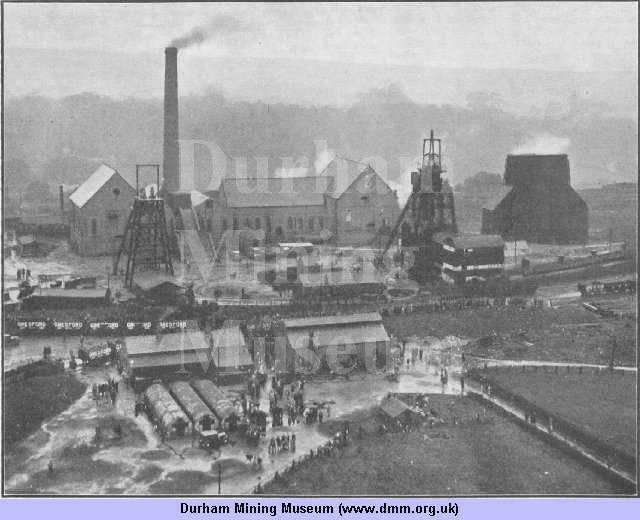
Aerial View of the Gresford Pithead
The Pit Sealed.
For a day and a half desperate efforts were made to overcome the barrier of fire behind which the victims lay trapped. Some progress rewarded the efforts to reach the imprisoned men, but this was offset by an extension of the fire. Further explosions finally made it clear that all hope must be abandoned, and later in the evening the rescue parties were withdrawn.
At 8 o'clock on Sunday evening, after an hour's conference, the following statement was issued :—
The attempt to overcome the fire in the main road has gone on ever since yesterday, but, in spite of very strenuous efforts, and although some progress has been made in this road, the fire has got further hold on a road to the right, through which it was hoped that access would have been got to any possible survivors. To-day several explosions inbye of the fire in the main road have occurred. This afternoon they became more frequent and closer to where the men were working on the fire.
The return air in both main returns is carrying carbon monoxide in dangerous quantities, and it is with great reluctance that all parties — the management, the representatives of the miners, and H.M. inspectors — have come to the conclusion that no person can possibly be alive in the workings. In these circumstances and in view of the increasingly grave risk to the men engaged in combating the fire on the main road, it has been decided that it would not be right to continue to expose these workers to such serious risk, and all persons have been withdrawn from the mine.
This statement was signed by the managing director of the colliery company, Mr. H. Dyke Dennis; Mr. Edward Jones, miners' agent; and Sir Henry Walker, H.M. Chief Inspector of Mines, who had spent several hours in the pit during the day.
At that time ten bodies had been brought to the surface, including those of the two rescue workers, John Lewis and Dan Hughes. Other bodies had been located in the main road.
On Monday the work of sealing the shafts was undertaken, structures composed of steel girders, backed by cement and sand, being erected, with apertures for 1½ in. diameter pipes to enable tests of the atmosphere to be taken at regular intervals. It was proposed, as soon as circumstances permitted, to erect a barrier in the main road leading to the Dennis District, in which case it was hoped that only a short time might elapse before the West District could be reopened and that East Side could be cleared and mining operations resumed throughout the pit in a month or two. On Tuesday, however, these expectations were upset by further violent explosions which damaged the seal in the main shaft and shattered the fan drift. One of the men on duty was thrown 40 yd. and fatally injured. Immediately afterwards a start was made in the work of repairing the damage, but the incident showed that further danger was to be apprehended, and the fan house has been seriously damaged.
Graphic stories were told by the few men who escaped from the inferno. One man extricated himself by a narrow ventilation-shaft. He immediately offered his services at the pithead. Many tales of unselfish heroism were told.
The inquest on the 10 bodies already recovered was opened by Mr. Maurice Evans, the coroner for East Denbighshire, on Monday and adjourned until Monday, October 22, at 1030 am., at the County Buildings, Wrexham.
Under the powers conferred by s. 83 of the Coal Mines Act, 1911, the Secretary for Mines has directed Sir Henry Walker, C.B.E., LL.D., H.M. Chief Inspector of Mines, to hold a formal investigation into the causes and circumstances of the explosion. The Secretary for Mines is inviting the Mining Association of Great Britain and the Mineworkers' Federation of Great Britain each to nominate a representative to be appointed to act as an assessor in holding the investigation. The place and date of the inquiry will be announced after consultation with the parties concerned. The inquiry will be opened as soon as possible but the pit having been sealed up it will not be possible for the present to complete the investigation into the cause of the explosion itself. The Secretary for Mines has therefore asked the Commissioner to submit as soon as practicable an interim report dealing with the condition of the mine before the explosion, and the exploration and rescue operations which were attempted after the explosion.
On Sunday afternoon The King telegraphed to Lieut.-Col. Williams Wynn, the Lord Lieutenant at Denbighshire, the following message of sympathy with the victims of the Gresford mine disaster: "The Queen and I are grieved to hear of the disaster at Gresford Colliery this morning and feel deeply for the miners involved and the terrible sorrow and anxiety of their families and friends. Will you please convey to all this message of our heartfelt sympathy and keep me informed of the gallant efforts that are being made to rescue the miners?" Messages were also received from the Prince of Wales, Mr. Stanley Baldwin, the Lord Lieutenant, Mr. Lloyd George and others, including representatives of the French, Belgian, German, and other Governments.
Relief Fund Started.
A relief fund was opened immediately. Funds were also opened by the Lord Mayor of London, the Lord Mayor of Liverpool and other municipalities, and numerous agencies are being employed to provide relief for the dependants who are believed to exceed a thousand, whilst the total number who have lost their employment reaches 2,500. On Tuesday a meeting was held at Wrexham for the purpose of establishing a joint county relief fund for Denbigh and Flint, with Col. R. Williams-Wynn, the Lord Lieutenant of Flintshire, as chairman. The Mansion House Fund has now reached a large sum, contributions including £200 from the Midland Bank, the Co-operative Insurance Society, the Duke of Westminster, and the National Provincial Bank; £262 10s. each from the Times Publishing Co. and the South Metropolitan Gas Co. ; £250 from Baring Bros. and Co., Ltd., James Summers and Sons, Ltd., the Anglo-Persian Oil Co., Ltd., the Shell Transport and Trading Co., Ltd., Lord Woolavington, Morgan, Grenfell and Co., Ltd., N. M. Rothschild and Sons, M. Samuel and Co., Ltd. £210 from J. and A. Scrimgeour; £200 each from Lord Gladstone, Lady Dalziel; £105 from the Liverpool Stock Exchange, Scala and Futurist Theatres, Sir Louis Newton, Bt., Viscountess Wakefield, Anderson and Sheppard, Ltd., the British Aluminium Co., Ltd., Bryant and May, Ltd., Hall and Co., the Pearl Assurance Co., Ltd., A. Huffer and Sons, Ltd., Central Mining and Investment Co., Ltd., Erlangers, Ltd., F. and C. Costin, Ltd., Gastrell and Co., Ltd., Hoppins and Giles, J. Saintsbury, Ltd., Mr. J. D. Charrington, Alliance Assurance Co., Ltd., Antony Gibbs and Sons, Linklaters and Paines, and the Phoenix Assurance Co. ; and £100 each from Mrs. H. G. Tetley, Col. W. B. Williams-Wynn, Goschens and Cunliffe, Wallace Bros. and Co., Ltd., Sir George Holcroft, Mrs. M. E. Woollett, Burna Corporation, Ltd., General Electric Co., Ltd., St. James and Pall Mall Electric Light Co., Ltd., Lord Derby, Explosives and Chemical Products, Ltd., and Reynolds and Gibson. All cheques should be made payable to "The Gresford Colliery Disaster Fund" crossed "Bank of England," and sent to the Lord Mayor, Mansion House, E.C.4. Envelopes should be marked "Colliery Fund."
Over £22,500 has been collected for the relief fund organised by the Daily Mirror in conjunction with the Sunday Pictorial. A cheque for £5,000 has been sent to the Mayor of Wrexham as a first contribution for the immediate relief of sufferers.
Mr. E Shinwell, Secretary for Mines in the Labour Government, speaking on Monday night at Dawdon, near Seaham Harbour, said "it is natural that the nation should deplore the unhappy mining disaster at Gresford Colliery, but I am afraid there are many who would set up a howl if the miners asked for a rise in wages. This is the time to speak out about such matters. In my opinion there is no need for such disasters. I am strongly of opinion that when the official inquiry takes place it should be presided over not by someone from the Mines Department, but by an independent chairman. When I was at the Mines Department I instituted a series of safety conferences which gave satisfaction in particular to the miners. I should like to know why these conferences have been stopped. Is it on the grounds of expense, and is the trifle of a few hundred pounds to stand in the way of the advancement of safety? What the nation has to consider is whether the men who undertake such risks should be amply compensated by paying them a satisfactory wage."
 |
 |
| Names mentioned in this article | |
 |
 |
| Name | Age | Occupation | Notes |
|---|---|---|---|
| Baldwin, Stanley | |||
| Boydell, Thomas R. | H.M. Senior Inspector of Mines | Whos Who Page | |
| Dennis, H. Dyke | Chairman | Whos Who Page | |
| Dennis, P. | |||
| Dominy, Percy George | H.M. Junior Inspector of Mines | Whos Who Page | |
| Evans, Maurice V. | Coroner | ||
| George, Lloyd | |||
| Hughes, Daniel | 56 | Rescue Worker | Deceased, Individual Page |
| Jones, Edward | Miners' Agent | ||
| Lewis, John | 48 | Rescue Worker | Deceased, Individual Page |
| Shinwell, Emanuel (Manny) | Whos Who Page | ||
| Walker, Henry, Sir | H.M. Chief Inspector of Mines | Whos Who Page | |
| Wynn, Williams, Lieut.-Col. | Lord Lieutenant |
|
|
| Links to Collieries/Mines mentioned in this article | |
|
|
 | Gresford Colliery |
 |
 |
| Related Articles | |
|
|
| Pub. Date | Article (Newspaper) |
|---|---|
| 13 Apr 1934 | Pitmen's Debt of Honour (The Science and Art of Mining) |
| 28 Sep 1934 | Explosion at a North Wales Colliery, Loss of 264 lives (The Colliery Guardian) |
| 29 Sep 1934 | The Gresford Disaster (The Science and Art of Mining) |
| 05 Oct 1934 | The Gresford Colliery Explosion, Relief Measures (The Colliery Guardian) |
| 05 Oct 1934 | Gresford Colliery Explosion, Date of Inquiry Fixed (The Colliery Guardian) |
| 13 Oct 1934 | The Gresford Inquiry (The Science and Art of Mining) |
| 19 Oct 1934 | Gresford Colliery Explosion, Splendid response to appeals (The Colliery Guardian) |
| 26 Oct 1934 | Gresford Colliery Explosion, Official Inquiry Opened (The Colliery Guardian) |
| 27 Oct 1934 | Gresford Fund (The Science and Art of Mining) |
| 02 Nov 1934 | Gresford Colliery Explosion, The Official Inquiry (The Colliery Guardian) |
| 09 Nov 1934 | Gresford Colliery Explosion (The Colliery Guardian) |
| 10 Nov 1934 | "House" and Gresford Inquiry (The Science and Art of Mining) |
| 16 Nov 1934 | Gresford Colliery Explosion (The Colliery Guardian) |
| 16 Nov 1934 | Notes from the Coal Fields, Administration of Gresford Funds (The Colliery Guardian) |
| 23 Nov 1934 | Notes from the Coal Fields, North Wales, Gresford Colliery Reopening Decision (The Colliery Guardian) |
| 23 Nov 1934 | Gresford Colliery Explosion (The Colliery Guardian) |
| 30 Nov 1934 | Gresford Colliery Explosion, Resumed Inquiry (The Colliery Guardian) |
| 30 Nov 1934 | Notes from the Coal Fields, North Wales, Position of Gresford Relief Fund (The Colliery Guardian) |
| 07 Dec 1934 | The Gresford Explosion, The Official Inquiry (The Colliery Guardian) |
| 07 Dec 1934 | Notes from the Coal Fields, North Wales, Preparations for Descent at Gresford Colliery (The Colliery Guardian) |
| 07 Dec 1934 | Notes from the Coal Fields, North Wales, Position of the Gresford Relief Fund (The Colliery Guardian) |
| 14 Dec 1934 | The Gresford Explosion, Technical Evidence (The Colliery Guardian) |
| 14 Dec 1934 | Notes from the Coal Fields, North Wales, Gresford Colliery Disaster: Inquest Adjourned (The Colliery Guardian) |
| 21 Dec 1934 | The Gresford Explosion, Inquiry Adjourned (The Colliery Guardian) |
| 22 Dec 1934 | The Gresford Inquiry (The Science and Art of Mining) |
| 19 Jan 1935 | Gresford Inquest (The Science and Art of Mining) |
| 02 Feb 1935 | Gresford Colliery (The Science and Art of Mining) |
| 02 Mar 1935 | The Gresford Fund (The Science and Art of Mining) |
| 16 Mar 1935 | The Gresford Task (The Science and Art of Mining) |
| 27 Apr 1935 | Gresford Relief Fund Officials (The Science and Art of Mining) |
| 25 May 1935 | Prospects at Gresford (The Science and Art of Mining) |
| 06 Jul 1935 | Gresford Recovery Plans (The Science and Art of Mining) |
| 12 Jul 1935 | Notes from the Coal Fields, North Wales (The Colliery Guardian) |
| 19 Jul 1935 | Notes from the Coal Fields, North Wales (The Colliery Guardian) |
| 26 Jul 1935 | Notes from the Coal Fields, North Wales (The Colliery Guardian) |
| 02 Aug 1935 | Notes from the Coal Fields, North Wales (The Colliery Guardian) |
| 09 Aug 1935 | Notes from the Coal Fields, North Wales (The Colliery Guardian) |
| 16 Aug 1935 | Notes from the Coal Fields, North Wales (The Colliery Guardian) |
| 17 Aug 1935 | Foresters And Gresford Fund (The Science and Art of Mining) |
| 23 Aug 1935 | Notes from the Coal Fields, North Wales (The Colliery Guardian) |
| 13 Sep 1935 | Notes from the Coal Fields, North Wales (The Colliery Guardian) |
| 20 Sep 1935 | Notes from the Coal Fields, North Wales (The Colliery Guardian) |
| 27 Sep 1935 | Notes from the Coal Fields, North Wales (The Colliery Guardian) |
| 04 Oct 1935 | Notes from the Coal Fields, North Wales (The Colliery Guardian) |
| 11 Oct 1935 | Notes from the Coal Fields, North Wales (The Colliery Guardian) |
| 25 Oct 1935 | Notes from the Coal Fields, North Wales (The Colliery Guardian) |
| 01 Nov 1935 | Notes from the Coal Fields, North Wales (The Colliery Guardian) |
| 09 Nov 1935 | Gresford Disaster Settlements (The Science and Art of Mining) |
| 15 Nov 1935 | Notes from the Coal Fields, North Wales (The Colliery Guardian) |
| 23 Nov 1935 | Gresford Disaster (The Science and Art of Mining) |
| 29 Nov 1935 | Notes from the Coal Fields, North Wales (The Colliery Guardian) |
| 06 Dec 1935 | Notes from the Coal Fields, North Wales (The Colliery Guardian) |
| 13 Dec 1935 | Notes from the Coal Fields, North Wales (The Colliery Guardian) |
| 01 Feb 1936 | Gresford Inquiry (The Science and Art of Mining) |
| 01 Feb 1936 | Gresford Relief Fund (The Science and Art of Mining) |
| 15 Feb 1936 | Gresford Position Unchanged (The Science and Art of Mining) |
| 29 Feb 1936 | Gresford Pit Conditions (The Science and Art of Mining) |
| 28 Mar 1936 | Gresford Inquiry (The Science and Art of Mining) |
| 11 Apr 1936 | Gresford Inquiry (The Science and Art of Mining) |
| 25 Apr 1936 | Gresford Inquiry (The Science and Art of Mining) |
| 20 Jun 1936 | The Gresford Inquiry (The Science and Art of Mining) |
| 17 Jul 1936 | Notes from the Coal Fields, North Wales, The Gresford Inquiry (The Colliery Guardian) |
| 18 Jul 1936 | Gresford Inquiry (The Science and Art of Mining) |
| 24 Jul 1936 | Notes from the Coal Fields, North Wales (The Colliery Guardian) |
| 07 Aug 1936 | Notes from the Coal Fields (The Colliery Guardian) |
| 02 Oct 1936 | Notes from the Coal Fields, North Wales (The Colliery Guardian) |
| 30 Oct 1936 | Notes from the Coal Fields, North Wales, Position of Gresford Relief Fund (The Colliery Guardian) |
| 16 Jan 1937 | The Position at Gresford (The Science and Art of Mining) |
| 13 Feb 1937 | Report On Gresford Explosion (The Science and Art of Mining) |
| 19 Feb 1937 | Award of Edward Medal (London Gazette) |
| 27 Feb 1937 | The Gresford Explosion, Chief Mines Inspector's Report (The Science and Art of Mining) |
| 27 Feb 1937 | Medal For Gresford Survivor (The Science and Art of Mining) |
| 10 Apr 1937 | Gresford Summonses (The Science and Art of Mining) |
| 08 May 1937 | The Gresford Case (The Science and Art of Mining) |
| 05 Jun 1937 | Heroism Recognised (The Science and Art of Mining) |
| 09 Jul 1937 | Notes from the Coal Fields, North Wales (The Colliery Guardian) |
| 17 Jul 1937 | Gresford Inquest Adjourned (The Science and Art of Mining) |
| 23 Oct 1937 | Gresford Inquest Adjourned (The Science and Art of Mining) |
| 21 Jan 1938 | Notes from the Coal Fields, North Wales (The Colliery Guardian) |
| 30 Sep 1938 | Notes From The Coal Fields, North Wales (The Colliery Guardian) |
| 12 Aug 1939 | Gresford Colliery (The Science and Art of Mining) |
|
|
| Links to related pages | |
|
|
 | Main page for Gresford Colliery |
| Accident/Disaster Page |
| Text of the official report into the incident |
| Memorial images gallery |



 Contains public sector information licensed under the

