


| Newspaper Articles |

|
Newspaper Articles |
 |
 |
6th August 1932, Page: 28, Column: 1
Successful Competitor
As already announced the winner of the Prize Competition, First Class stage, in Volume 42 was Mr. Robert Reuben Cook, of Hetton-le-Hole in the county of Durham. Following the usual custom Mr. Cook was invited to submit a statement of his career for publication in this journal; also his photograph. It is the usual experience that successful competitors accede to the request with mixed feelings — their pleasure in winning being tinged with feelings of regret that they can no longer engage in the activities of the Competition. Mr. Cook is not an exception to this rule, as will be gathered from the appended excerpts from his statement
It is with mixed feelings that I learn I have gained the premier position in the First Class or Colliery Manager's stage of THE SCIENCE AND ART OF MINING competition in the volume that has just run its course. I am naturally delighted to know I have come out top in the competition, but when such success prevents one from taking further part in the competition a different atmosphere is created. To have to retire from the competition brings a feeling of regret, as it is really and truly a fine educative medium. To comply with your request to give an account of my career is indeed a very difficult proposition however, I will do my best.
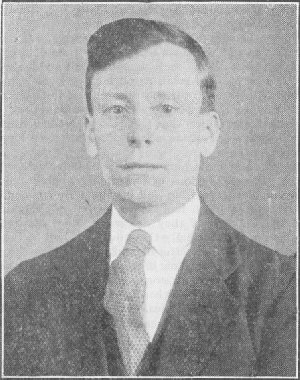
Robert R. Cook
"I was born on the 1st May, 1903, in the village of Hetton-le-Hole, a village depending entirely upon the coal industry for its prosperity. I received a good elementary education at Eppleton Council School under the headmastership of Mr. I. Williams. Leaving school at the age of 14 I commenced work on the following day at Eppleton Colliery, where I have since been in employment, and where I have gained all my practical experience, which includes pony driving; haulage lad (main and tail) ; pony putting; coal hewing; filling after both longwall and heading machines; stonework, including ripping and packing; repairing; and timber drawing. These activities afforded me opportunities of acquiring an extensive knowledge of the longwall and herd and pillar methods of working. I have also witnessed the opening out of districts with the arc-wall system of mining before finally opening out upon the longwall system of working.
"Just before I was 28 I was given the position of examiner in a large district ; after a few weeks in this capacity I was placed in charge of a district as deputy and shotsman, in which capacity I am still employed. The district was opened out on the bord and pillar method and finally worked by longwall, the face being cut by an electrical coal-cutter. This was the first electrical cutting machine to be installed at this colliery, in my position as deputy I have gained considerable experience in various channels of mining, including the driving of drifts from one seam to another.
"Like most other boys, when leaving school I thought everything was known that could be known, so I settled down to the future quite contented. It was not until I was 20 that I began to think seriously about the future, and it was while attending a deputy's course of instruction given by the local miners' lodge that I decided to study mining and make it a profession. When this course finished I had an interview with Mr. J. Heslop, the organising master of the local evening classes, which ended in my being fixed up to take a four-year course in mining at the Hetton Lyons Council School. The course included mining science, mechanics, geology, mensuration and drawing, mine surveying, colliery engineering and electrical engineering. I am extremely indebted to Mr. F. Kidd (mensuration and drawing), Mr. E. Shield (mine surveying), Mr. J. Thompson (mechanics), and Mr. W. Johnson, M.I.M.E. (mining science), for their careful tuition at this school in the subjects named. I obtained all the certificates given at the school upon mining and its allied subjects, never failing in any examination. Completing this course I decided to take the two final years in mining at the Sunderland Technical College. This was a Saturday afternoon class, and suited my employment. Here, under the tuition of Mr. J. R. Bailes, M.I.M.E., who lectured on geology, mining science and electrical engineering; Mr. T. Haswell, in colliery engineering; and Mr. G. H. A. Bell, in mine surveying, my knowledge of the subjects was greatly increased. I was also successful in passing all the examinations at this college.
"As time went on my term at Sunderland was finishing; I could see no further prospects of extending my knowledge, so I decided to enter the competition in this journal. I may say I was recommended to THE SCIENCE AND ART OF MINING by an official at the colliery when I first began my studies. I have taken it ever since, and it has proved a great help to me on many occasions. From the very first I became interested in the competition, reading with care the published answers, until in Volume 36 1 thought I would try answering the questions in the Firemen's stage, but this was only in a casual manner, as I only attempted the questions which appealed to me. It was not until Volume 40 that I decided to compete seriously. Entering the Second Class stage I finished second to Mr. W. Owen, last year's winner of the First Class stage, with 14 published answers to my credit. In Volume 41 I obtained five published answers in the First Class stage, while in Volume 42 I was successful in gaining first place with 18 published answers, and so accomplishing my objective.
"I have thoroughly enjoyed every moment of my connection with the competition, and I realise its great value from an educational point of view. Its educational value indeed cannot be fully estimated, and I can honestly say that the practice I gained in answer writing helped me considerably when I sat the Home Office examination for my Second Class Certificate at Newcastle-on-Tyne in May, 1931. I was successful at the first attempt.*
"Besides my Second Class Certificate and the certificates obtained at the evening classes, I possess the Firemen's Certificate, the St. John's Ambulance Certificate, and five certificates won in connection with THE SCIENCE AND ART OF MINING competition. I wish the Editor and the Publishers every success in their efforts to put before the mining public the high standard of mining literature that is to be found in this journal.
"To D.C.M. I tender my best thanks for his many helpful remarks in the footnotes to my answers and others; they have proved to be a great help in the art of answering the questions.
"One cannot help admiring the friendly rivalry of the other competitors. I wish them every success both in their profession and the competition, and I hope that other students realise the great opportunities offered by the competition.
"In conclusion, I wish THE SCIENCE AND ART OF MINING every success. May it long continue to be the 'friend' of students and mining men. I hope also that soon we may see a distinct change for the better in the mining industry."
 |
 |
| Names mentioned in this article | |
 |
 |
| Name | Age | Occupation | Notes |
|---|---|---|---|
| Bailes, J. R. | Lecturer | ||
| Bell, G. H. A. | Lecturer | ||
| Cook, Robert Reuben | Whos Who Page | ||
| Haswell, T. | Lecturer | ||
| Heslop, J. | Lecturer | ||
| Johnson, W. | Lecturer | ||
| Kidd, F. | Lecturer | ||
| Owen, W. | |||
| Shield, E. | Lecturer | ||
| Thompson, J. | Lecturer | ||
| Williams, I. | Headmaster |




 Contains public sector information licensed under the

