


| Newspaper Articles |

|
Newspaper Articles |
 |
 |
10th August 1929, Page: 17, Column: 1
Bumps In Mines
At the 37th annual meeting of the Mining Society of Nova Scotia a paper written by Mr. W. Herd on Bumps, No. 2 Mine, Springhill, N.S., is referred to in the Canadian Mining Journal by Mr. Sydney C. Mifflen as the outstanding paper presented for discussion.
The seam in which the bumps occur is 9ft. thick and the present workings are at points underlying 2,300 to 2,800 ft. of cover. The main slope is 7,700 ft. long, dipping 30° for 2,400 ft., at which point the seam is folded vertically for 100 feet, the inclination thereafter gradually flattening to 20°. The immediate roof consists of 9 to 16 ft. of strong arenaceous shale with a similar but perhaps weaker shale pavement of the same thickness. A feature of the field is the introduction and disappearance of sandstone bands of considerable thickness within very short distances, often a few hundred feet. No faults of greater displacement than 14 feet are known, but where the ground has been faulted bumps do not occur. There does not appear to be any undue initial stress in the strata due to faults or folding.
A bump is described as the sudden bursting, accompanied by a loud report, of the coal or the strata immediately in contact with it, in contradistinction to the gradual weighting usually accompanying mining at depth. A bump may occur at the coal face ; on the roadways leading thereto, particularly if they are in solid coal, or in the waste. They have been responsible for much material loss in the way of destruction of equipment and closing of places, above which they have often taken toll of the lives of workmen.
The first appearance of bumps of severity was about eight years ago, at 1,900 ft. of cover, when the method of work was room and pillar, followed by extraction of the pillar immediately the room was driven. They usually occurred when a room was being driven parallel to a waste at the rise and at any time when the room face was 300 ft. or less distant until it was almost through on the waste, but did not occur when pillars were being drawn after the room was through. As the waste in a district subject to bumps extended, the liability of bumps to occur farther from the waste was increased. This type of bump caused the coal to be thrown suddenly and without warning from the ribs at or near the face.
Later, as a considerable area of pillars in affected districts had been extracted, waste bumps occurred, often unnoticed in the mine, but felt very distinctly as earth tremors on the surface, shaking buildings two miles from the supposed location and half a mile beyond the outcrop of the seam.
Subsequently a third type, more destructive in character and known as a "district Bump," appeared at 2,050 ft. of cover, affecting roadways driven in solid coal to the dip of extracted areas and extending over a few acres, often closing portions of rooms with coal driven from the low or high side rib and damaging inclines and main levels some considerable distance from the edge of the waste, but rarely affecting the working faces.
Longwall retreating was established in 1925, with faces 200 to 250 ft. long. On the extended faces roof breaks, often reaching over the coal, occurred every 40 to 60 ft. of advance and these occasionally closed the face. However, when some 250 ft. of waste had been formed bumps again appeared in much the same form as heretofore.
To make the working conditions at the coal face more secure waste packs were gradually strengthened, and after experience the carrying of 14 ft. wide mid-walls at 30 ft. intervals in the waste with two lines of face chocks has proved satisfactory and eliminated apparently, face bumps, as none have occurred since this method was introduced. The wall faces make an advance of 5 feet per day.
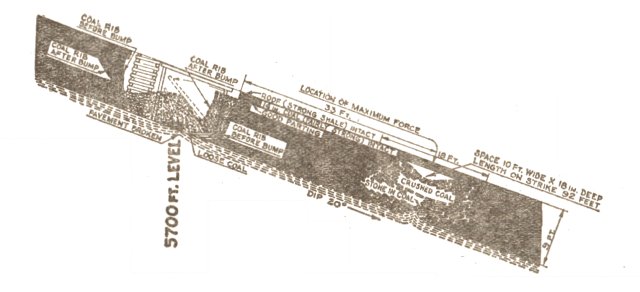
Several district bumps of great severity are described in the paper, of which the accompanying sketch is such an excellent illustration of one as to be self-explanatory.
Mr. Herd believes that the bumps in No. 2 Mine are the result of mining under and above a peculiar strata condition at considerable depth, that is, a very strong and tough immediate shale roof and relatively slightly weaker shale floor, which are respectively over and underlain by marine beds of sandstone. He is not of the opinion that the inclination of the strata is a material cause.
As the sandstone is very strong and compact, it has not the ability to fall or shear until a very considerable area has been excavated, during which time it is hanging as a cantilever in the waste supported on a fulcrum at the coal face, resulting in an upward stress in this band and those above reaching far over the solid coal. When this band finally breaks somewhere back in the waste or possibly only slips very slightly on a fracture, the cantilever effect ceases, the rocks in upward strain over the coal are subject to a sudden reversal of stress, and the coal ahead is struck a sudden hammerlike blow, which is so intense that, though lowering the roof only the fraction of an inch, it causes the solid coal to burst into the roadways, breaks the floor, splits pillars and occasionally, due to the jar, brings the roof down.
Mr. Herd's knowledge and considerable experience have led him to the conclusion that no known method of mining will eliminate these bumps and allow of coal production on a commercial basis, but he believes that it is possible to establish conditions which will mitigate their effect, and to this end efforts at Springhill are now being directed. The establishment of longwall retreating has certainly been an improvement.
Mr. J. C. Nicholson spoke of his own experience when Superintendent at Springhill. Packs would be shifted as a whole without a stick being disturbed, conveyor pans turned upside down and steel lugs torn off, track thrown to the roof and held there by coal thrown from the ribs, in some instances pushed out as solid coal as shown in the illustration. They had had available no information on similar phenomena but had to feel their way. The change to longwall was a big undertaking considering that the coal was 9 to 11 feet thick, pitching at 20° and at 2,500 ft. cover.
 |
 |
| Names mentioned in this article | |
 |
 |
| Name | Age | Occupation | Notes |
|---|---|---|---|
| Herd, W. | |||
| Mifflen, Sydney C. | |||
| Nicholson, J. C. |




 Contains public sector information licensed under the

