


| Newspaper Articles |

|
Newspaper Articles |
 |
 |
18th May 1929, Page: 342, Column: 1
The Application Of Welding To Mining Plant
By C. W. Brett.
Managing Director, Barlmar, Ltd., Scientific Welding Engineers.
To talk to mining engineers and students of mining about welding appears, at first sight, to be scarcely more reasonable than the futile enterprise of "carting coals to Newcastle." Most of the readers of The Science and Art of Mining are fully aware of the important part which one or other of the fusive agents now universally used in metallic or mechanical reconstructions play in the maintenance at the high efficiency level of units of every description. Nevertheless, in discussing the possibilities of a technical subject with those who have not made it a special subject one commonly finds that there are many details which have either been overlooked or have not received the attention which they merit. Even in the case of those who actually use, or are familiar with the use, of scientific welding one frequently encounters misconceptions and misapprehensions raise doubts and difficulties.
In the course of a short paper it is not, of course, possible to "make crooked paths straight" or to attempt to solve even a tithe of the problems which, in welding practice, beset the operator. All that may be done is to outline the scope of welding as it is applied to the reparation of mechanical devices, and to deal at somewhat greater length with specific uses.
Of the half dozen fusive agents now employed by experts in all parts of the world, three stand out as being more widely applicable to general engineering than the others, though one must beware of falling into the common error of believing that any single process can invariably be relied upon to effect the successful recreation of any industrial metal, or the partial or complete reconstruction of worn, broken or damaged machinery or plant that has become inefficient. Each method has its particular advantages and limitations, which it is the business of the specialist to determine in relation to any given job. The three which, speaking broadly, are most widely applicable are : Oxy-Acetylene, Electric Arc, and Thermit processes. To give an idea of their respective value for the purposes indicated one cannot, perhaps, do better than cite specific instances in which they have been successfully employed. Such examples, however, must not be regarded as marking any limitations or indicating restricted use in any class of work.
In all-metal aeroplane construction — which, manifestly demands the utmost reliability under varying, and frequently adverse conditions — the oxy-acetylene process is almost exclusively employed by the best constructors to unite the steel tube members of the fuselage, wings and tail, etc. ; in the fabrication of oil and petrol tanks ; and, in many instances, in the building of the power unit. It is constantly used, too, in cowls, light metal sections and sheet metal portions formed of steel or aluminium.
As evidence of the strength, durability, capacity to resist the disintegrating and destructive effects of constant vibration, and ability to resist the incidence of compound and complicated stresses and strains which change from moment to moment, and are thrown now on this member now on that, this increasing application of welding may well be taken as conclusive proof of the high efficiency of the oxy-acetylene process.
It is of interest to note, in this connection, that the aeroplanes used by Colonel Lindbergh, Mr. Chamberlain, Lt. Maitland and Commander Byrd were all welded jobs.
In the sphere of heavy engineering the following details leave little room for doubt that here also scientific welding represents the ideal method of mechanical reconstruction, both from the point of view of mechanical soundness and economy in time and cash expenditure.
The High, Low, and Intermediate Cylinders of the S.S.C...... C.......were extensively fractured. As the value of the engine was about £150,000, and that of the cylinders £50,000, the matter was one of extreme seriousness, especially as the time required to fit new cylinders would have meant a loss of six months, during which the ship would have been laid up in dry dock, with consequent loss of freight earnings. Although inspecting engineers were doubtful as to the possibility of a welded repair in metal three inches thick extending over a distance of fourteen and a half feet, the makers decided to call in a welding specialist, who, in due course, reported favourably on the project. The work was immediately commenced, in situ, and five days later was completed to the entire satisfaction of Lloyd's surveyor, who duly signed the "A1" certificate. The total cost was merely a small fraction of the price quoted for replacement, quite apart from the loss involved in tying the ship up for a lengthy period.
Clearly, therefore, for light or heavy work the value of the oxy-acetylene process is beyond question. Its suitability to any given job is, of course, entirely a matter for the expert whose knowledge of metallurgy and thermics, and the effects of high temperatures upon modern industrial metals — including the high-speed steel alloy series — enables him to select unerringly the process from which best results may be obtained.
As regards electric arc welding, which can profitably be used in a variety of ways, great development has been recorded during the past few years, notably in the direction of railway engineering, shipbuilding, and steel frame buildings. Here, to a large extent, the use of this system has been in substitution for riveting, and the results obtained have completely justified its adoption. First of all, no welded portion has given way where, under similar circumstances, a riveted portion would not also have given way. In other words, arc welded joints or connections have at all times shown themselves to be equal in rigidity and strength to those effected by other methods. Beyond this, however, arc welding possesses the very material advantage of being considerably cheaper, both as regards original fabrication, and subsequent upkeep, than any other method. In construction work the saving has approximated 25 per cent., while in repair or reconstruction work the economy has been as high as 80 per cent.
The ability to withstand repeated sudden shocks and recurrent impacts is another feature of scientifically welded members and components. Where, normally, bolts or rivets would shear the welded joint remains intact, or suffers no greater damage than is sustained by the parent metal to which it is united.
It is obviously not possible to indicate the innumerable purposes to which arc welding can be applied ; each job represents a problem which must be considered individually, in the light of special circumstances and factors. Thus, it would be unwise to assert that arc welding should be employed on such-and-such a reconstruction without knowing what metals had to be dealt with, and the local or particular conditions under which the work would have to be done. All such matters call for the judgment of the expert.
Turning to the last of the three most widely known and used fusive processes, thermit, we find a high temperature agent (capable of developing upwards of 5,500°F.) which possesses several notable advantages ; it is safe and convenient to handle, does not explode, and is relatively simple to use for the purpose to which it is adapted. It can be employed in the repair of fractured crankshafts, transmission shafts, rails, rudder stocks, crossheads, loco, driving wheels, steel frames, vertical pipes, railway and tramway "frogs," etc. Its use in the repair of cast-iron is not, however, to be recommended, except in special cases and when special precautions are taken. This is due, for the most part, to the fact that thermit steel contracts very much more rapidly than cast-iron, with the result that there is a tendency for shrinkage cracks to make their appearance at or near the weld. Where it is found necessary or desirable to use thermit for cast-iron repairs a special compound (C.I. Thermit) may be obtained, but, in general, it will be found better to employ one or other of the other fusive processes to deal with this class of work.
As we have already suggested, it is not advisable to say offhand or without examination previously what can be done by each or any of the processes referred to, and no welding specialist could hope successfully to handle general reconstruction or repair work without the material (and mental) equipment requisite to carry out the work by each or all of the fusive agents now universally used, as occasion demanded. Scientific welding, therefore, must not be regarded as pertaining to this or that system of high temperature treatment. Spot welding, resistance welding, percussive welding, etc., each has its special advantages and shortcomings, but each, in the hands of the expert, contributes something to the practice of welding which raises it to that degree of perfection which justifies the description "The Ideal Method of Metallic and Mechanical Reconstruction."
To the mining engineer its manifold uses are well known, but the following incomplete list of units and plant which can be completely restored to 100 per cent. efficiency may serve to indicate the class of job which is now regarded by the expert as strictly routine.
The reparation of furnaces, mechanical stokers and fuel feeds, boilers (all types and sizes), engine room plant and equipment, power units (steam, gas, oil, petrol or electrically driven), overhead shafting and transmission gear, cranes, gantries, jibs, derricks, winches, gravity runways and ropeways, pumps (all sizes and types), fans, blowers, air circulators, haulage plant, winders, exhausters, by-product plant (tar distillation, benzol, and sulphuric sets), drills, cutters, pit locos., pit wagons, hoppers, buckets, trams, tubs, pipes (all purposes and sizes), ovens, screeners, washers, crushers, pit cages, etc. All metal parts of all types of road transport unit and works locos., including the repair of cracked, fractured, scored or worn cylinders (without enlarging the bore or fitting new pistons), crankcases, crankshafts, cams, gear boxes, gears, axle boxes, axles, hubs, wheels, radiators, mudguards, lamps, chassis frames, light metal sections, garage tools, equipment, etc.
In short, scientific welding means the rapid and economical restoration to full load full-time service of units or components of all description, irrespective of their condition. Worn or fractured, old or new, rusty or bright, their complete restoration is merely a question of knowledge, skill and the application of the fusive process best suited to the given work.
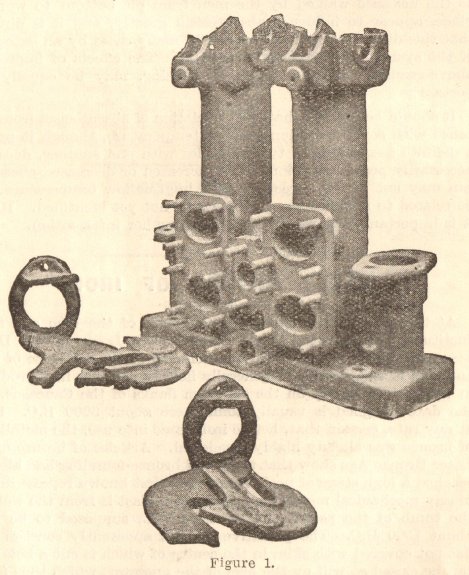
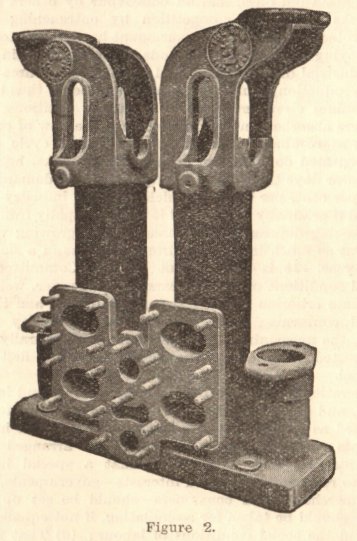
Reference may be made to Figure 1, showing cast-iron pump and valve boxes from a colliery in the Middlesborough district. The tops of the pumps were completely broken away. The weight of casting was 1½ tons. Now refer to Figure 2. The weld was carried out so that the repaired parts would be stronger than when new. The work was executed under a money-back guarantee, and a large sum was saved in the cost of replacement. The work was completed within a few days.
 |
 |
| Names mentioned in this article | |
 |
 |
| Name | Age | Occupation | Notes |
|---|---|---|---|
| Brett, C. W. | Managing Director | ||
| Byrd, —, Commander | Aviator | ||
| Chamberlain, — | Aviator | ||
| Lindbergh, —, Colonel | Aviator | ||
| Maitland, —, Lt. | Aviator |




 Contains public sector information licensed under the

