


| Newspaper Articles |

|
Newspaper Articles |
 |
 |
20th April 1929, Page: 306, Column: 1
Natural And Mechanical Ventilation
By L. S. Buxton, B.Sc.
From paper presented at the March meeting of the Past and Present Mining Students' Association in the Wigan Mining and Technical Collage Mr. Buxton is Assistant Manager of the Parsonage Pits at West Leigh, Lancashire.
The various reports already published by the Committee on "The Control of Atmospheric Conditions in Hot and Deep Mines" have brought into prominence some of the problems connected with ventilation which will arise in mines worked at great depths. One of the most important points raised is that of the wet-bulb temperature and the various physiological phenomena related to it. Investigations have also been made into the causes of high underground air temperatures, and the effect of such high temperatures on the miner. As a result of their investigations, the Committee have shown that the best way of overcoming the difficulties presented by high strata temperatures, and the presence of moisture, is by a brisk circulation of air.
Bearing in mind the fact that the workings at the Wigan Coal and Iron Company's Parsonage Pits are approaching a depth of 4,000 feet, and that a strata temperature of 105°F. has already been recorded, it was considered desirable that an attempt should be made to determine, firstly, to what extent the ventilation of the mine is due to natural causes, and secondly, to investigate the effect on natural ventilation of mechanical aids. As the experiments proceeded other points evolved relevant to the matter in hand, which will be dealt with in the course of this paper.
Arrangement of the Ventilation.
It would perhaps be well at this point to give a brief description of the general ventilation arrangement of the mines. Of the air descending the downcast shaft approximately one-half enters an inset at a depth of 1,923 feet and ventilates the Bickershaw Seven Feet and Crombouke Mines. The remainder descends to the Arley Mine at a depth of 2,946 feet, where it is split. About 20,000 cubic feet per minute go to the East Side and about 80,000 to the West.
The air on the West Side travels a slightly rising course for 450 yards, where a portion of it is diverted to the rise workings. Fifty yards further on another split is made, some of the air going to the No. 1 West dip workings, and the remainder to the No. 2 West dip workings. On the East Side of the downcast shaft the air is split once. One portion ventilates the main level heading, and the other the dip workings. There are only two regulators in the mine; one on the East Side near the upcast shaft, and the other in the return brow of the No. 1 West dip workings.
Two regulators are also required in the Seven Feet Mine. One is situated in the main return near the upcast shaft, and restricts the quantity of ventilation for the whole mine. There are three main splits in the mine, and it is in the least of these, the Crombouke, that the second regulator is needed.
The ventilation plant consists of a Walker Indestructible double-inlet fan, 28 feet in diameter and 9 feet wide. At its maximum speed of 120 revolutions per minute it is capable of dealing with 750,000 cubic feet per minute at a 6-inch water-gauge. The fan is driven by a double tandem compound non-condensing engine, through a cotton rope drive. At present the fan is found to create sufficient ventilation at a little over half speed, i.e., 74 revolutions per minute with a water-gauge of 3.2 inches. The total quantity of air entering the downcast shaft at this speed is roughly 188,000 cubic feet per minute in summer, and 210,000 in winter.
These figures alone demonstrate to what a great extent the flow of air is affected by variations of surface temperature, and it was felt that in the winter, at any rate, the greater part of the air flow would be maintained without the aid of the fan. In view of the rather gassy nature of the Crombouke and Seven Feet seams, there was naturally some apprehension as to what would happen if the fan was stopped for several hours, and a preliminary experiment was carried out to see exactly what would happen. The test was made on a Saturday morning in December, 1927, between 6-0 a.m. and noon. The surface temperature during the test averaged 34°F. In every district there were stationed two men, a fireman and an observer, equipped with anemometer and hygrometer. An inspection was made and a set of readings taken in each district before 6-30 a.m., at which time the fan speed was reduced from normal to 50 B.P.M. At 6-45 a.m. another set of readings was taken and a report on the condition of each district was made. At 7-0 o'clock the fan was stopped, and at 7-30 a.m., and every hour up to 11-30 a.m., each party reported to the manager the general conditions in the district, together with the wet and dry bulb temperatures and the quantity of ventilation at the pre-determined point. As soon as the fan stopped the regulator in the Crombouke district was pulled down. At the same time the areas of the main Seven Feet and the No. 1 West downbrow regulators were slightly increased, and were further increased each succeeding hour, a record being kept of the exact area of each opening.
In the Arley Mine the greatest diminution in quantity was naturally expected in the rise workings, but, although there was a decrease in quantity, it was not nearly so great as was anticipated. Measurements taken at the face at the highest point of the workings showed 5,000 cubic feet per minute to be circulating when the fan was running at its normal speed. A quarter of an hour after the fan was slowed down to 50 B.P.M., the quantity was 4,500. At 7-30, with the fan stopped, the quantity was 3,240 and gradually decreased to 2,630 at 8-30 a.m. An hour later the circulation had increased to 2,810, in spite of the fact that both the No. 1 West downbrow and the Main Seven Feet regulators had been further opened. From 9-30 onwards to the conclusion of the test the quantity varied slightly between 2,800 and 3,000 cubic feet per minute, but never fell lower. During the test the temperature increased irom 82° to 85°F., with a corresponding rise in the wet-bulb temperature from 66° to 69°. No trace of gas was found at any point throughout the whole time of the experiment, and conditions generally were such that work could have been carried on in quite as great a degree of comfort as under normal conditions,
In the No. 1 West downbrow most interesting results were obtained. As a result of slowing down the fan the quantity of ventilation at the point of measurement (the main brow a few yards back from the face) increased from 6,000 to 7,000 cubic feet per minute. There was a loss of 250 cubic feet per minute when the fan stopped, but as the regulator opening was increased, the quantity increased until at 11-30 a.m. there was a circulation of slightly over 8,000 cubic feet per minute. The temperature rose from 84°F. to 88°F., but working conditions were actually better than with the fan running at normal speed.
In the two remaining districts the measurements were taken in the intake airway near the point of splitting. In the West Tunnel district the quantity dropped from 16,000 at normal speed to 13,000 cubic feet per minute when the fan stopped. The East district showed a reduction from 28,000 to 18,000, and in both districts there was a further slight drop, probably due to the opening of the regulators. These readings, however, did not represent the true conditions at the face, for both districts reported a sufficient ventilating current and no trace of gas. It is probable that the greater part of the diminution of quantity in both districts was compensated for by a decrease in short-circuit losses.
In the Seven Feet main intake the total quantity was reduced from 108,000 cubic feet per minute to 68,000 by the stopping of the fan, but the opening of the regulator brought it up to 83,000 cubic feet per minute. In the Crombouke district the quantity dropped from 24,000 to 17,000, but quickly recovered, and at 11-30 a.m. there was rather more than the normal quantity of air circulating. Reports from the other districts showed only a slight reduction of ventilation at the face, with working conditions normal and a general reduction in temperature of 1°F.
Were such results obtainable all the year round, the fan might very well be dispensed with altogether, but, unfortunately, from the point of view of natural ventilation, such conditions of surface temperature rarely occur for more than a few days at a time.
It may perhaps be suggested that the test was of too short a duration to prove conclusively that such a large volume of air could be circulated by natural causes alone; but a further test, carried out under conditions that ensured the elimination of all effects, such as momentum imparted by the fan, afforded further proof of the permanent nature of the natural ventilating current. The air measurements were made after the fan had been stopped for 24 hours, when the surface temperature was 47°F. In the level headings and rise workings in the Arley Mine about half the normal quantity was circulating, whilst in the dip workings the stopping of the fan had not made the slightest difference at the face. Had the downbrow regulator been opened as in the previous test there is no doubt that an increased rate of circulation would have resulted.
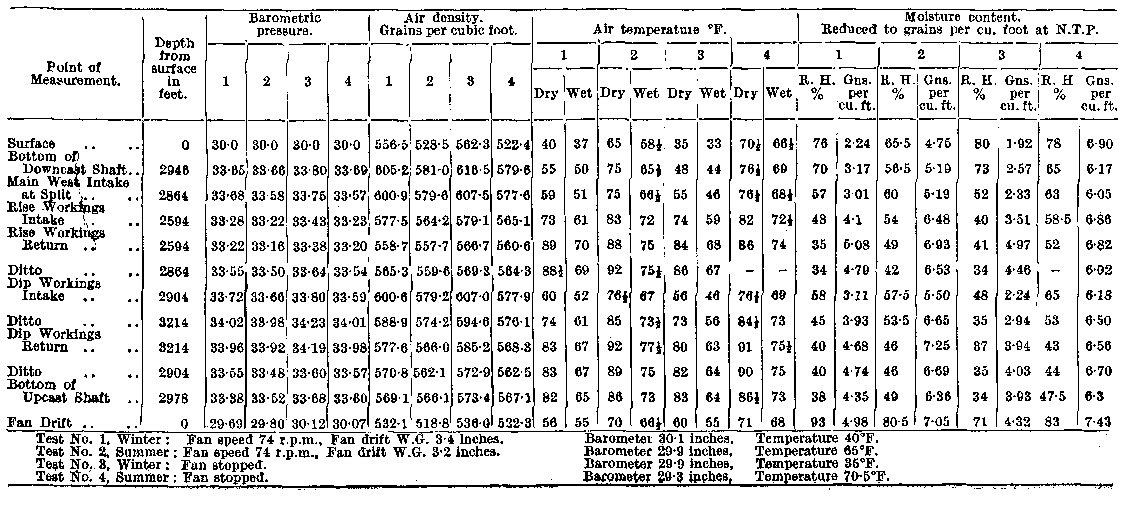
The results obtained from these experiments required further tests for their elucidation, and it was decided that two tests should be carried out at as near the same surface temperature as possible ; one with the fan running at normal speed, and the second with the fan stopped. The chief points to be determined were : The extent to which the fan influenced the difference of atmospheric pressure between intake and return in the dip and rise workings ; the variation in temperature in the workings, and the comparative efficiency of ventilation, this being defined as the ratio of the quantity of air reaching a given point in the workings to the total quantity entering the district.
A difficulty then arose as to the means to be used to measure the underground atmospheric pressure. A portable aneroid barometer was the instrument required, but unfortunately none of those available was graduated higher than 32 inches. The one chosen had its dial graduated continuously right round its circumference, the 32-inch mark coinciding with the 26-inch mark. It was thought that, by comparing the readings taken with the depth at the point of measurement, it might be possible to calibrate the instrument as far as was required. It will be obvious that the experiment should be carried out as expeditiously as possible, in order to obviate the complications arising from changes in the surface temperature and pressure. For this reason the number of places at which readings were to be taken was cut down as much as possible, and the following places were chosen : Surface and fan-drift, intake and return at the Seven Feet insets, bottom of downcast and upcast shafts, and two points in each of the intakes to the rise and dip workings respectively, and the corresponding points in the return airways. Even with this limited programme it was found impossible to complete the test under five hours, so that records had to be kept of the surface temperature and pressure whilst the experiment was in progress. In order to be able to compare and contrast conditions under extreme variations of surface temperature, tests were carried out both in summer and winter.
Calibration of Barometer.
The pressure readings obtained in both summer and winter natural ventilation tests were plotted in graph form against depths from the surface. In each case a straight line was obtained up to about 31.8 inches, but at greater depths the readings gradually fell away from the straight line. By comparing the two curves, which started at different surface pressures, it was found that, for any given reading of the instrument, the difference between the reading and the corresponding point on the straight line was the same in each case. It may reasonably be assumed, therefore, that the true pressure at any point is that given by the straight line. From the data obtained from the graph a further curve was plotted, showing the true pressure for any reading of the barometer, and from this curve the readings taken in the other tests were evaluated. The following are the more important of the corrected pressure readings reduced to normal pressure at the surface:—
 |
 |
| Names mentioned in this article | |
 |
 |
| Name | Age | Occupation | Notes |
|---|---|---|---|
| Buxton, L. S. |




 Contains public sector information licensed under the

