


| Newspaper Articles |

|
Newspaper Articles |
 |
 |
23rd February 1929, Page: 241, Column: 1
Electricity In Mines
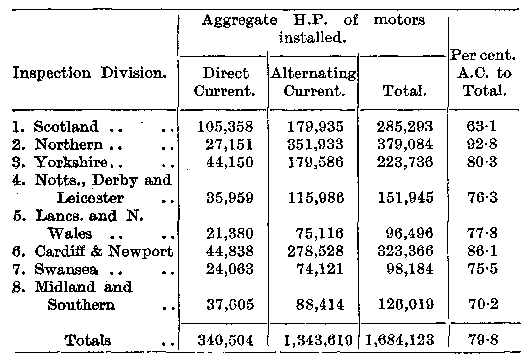
Progress in electrical development at mines under the Coal Mines Act has been steady in recent years, and rather more rapid on the surface than below ground. This is apparent upon examination of the statistics supplied by Mr. J. A. B. Horsley, H.M. Electrical Inspector of Mines, whose last report shows that though fewer mines at work in 1927 used electricity compared (say) with the year 1923, the total H.P. of motors installed was 1,684,123, the total in the earlier year being 1,364,745. The respective totals on the surface were 805,812 and 611,607, and below ground 878,311 and 753,138, the percentage increases approximating 31 and 16.
Regarding the H.P. of motors scheduled under the headings direct current and of alternating current, it is interesting to note that A.C. is favoured to four times the extent of D.C., when the total for the eight inspection divisions is considered. Thirty per cent. of the aggregate H.P. of direct current motors are to be found in Scotland, whilst in the Northern Division the alternating system predominates. The A.C. figures most largely for almost all the various purposes, the exceptions being winding and portable machinery.
Nearly 45 per cent. of the H.P. installed for winding is found in the Cardiff and Newport Division, where this load is usually provided for by D.C. motors with Ward-Leonard control. In the case of portable machinery, approximately 43 per cent. of the H.P. installed for that service is in the Scottish Division, where D.C. was early in the field, and where the use of electricity in that service is most developed.
A regional analysis has been made admitting of comparisons of the systems as follows:—
In a general statement on the fatal accidents in 1927, Mr. Horsley says :—
During the year there were eleven fatal accidents attributable, either directly or indirectly, to the use of electricity, involving the loss of sixteen lives and serious injury to eight other persons. With one exception, all occurred below ground. Seven accidents, one of which was a double fatality, were simple cases of electric shock. There was one ignition of firedamp, which resulted in three deaths and injury to two other persons ; one outbreak of fire below ground, which resulted in three deaths and injury to five other persons, and two accidents of a mechanical nature, each causing the death of one man. This constitutes the most serious record, to the debit of electricity, since 1924.
Of the seven accidents in which death was due to electric shock, five arose from the rashness, or carelessness, of the individual who lost his life, while two can be classified under the heading of misadventure. Of the remainder, the ignition of firedamp is attributed to the omission of a fixing screw, a common defect in accidents in this category; the serious fire, which followed injury to an armoured cable by a small fall of rock, could have been mastered in its initial stages quite easily and without danger to anybody, if the men in the vicinity had not run away ; the horrible case in which a machine man was caught and cut to pieces by the cutter wheel, was due in large measure to the man's own neglect to use the safety catch provided to prevent the motor from starting accidentally; the accident in which a circuit-breaker of modern design exploded, ejecting burning oil on to the operator, from the effects of which he subsequently died, was due, according to the evidence that was available, to an extraordinary omission on his part, for it would seem that he omitted to fill the oil tank properly before using the switch after re-erecting it.
While it is not difficult, in most of these accidents, to find carelessness on the part of the victim, perusal of the accounts that are included in the report will perhaps suggest that the organisation appears to rely unduly upon the discretion or knowledge of the individual workman.
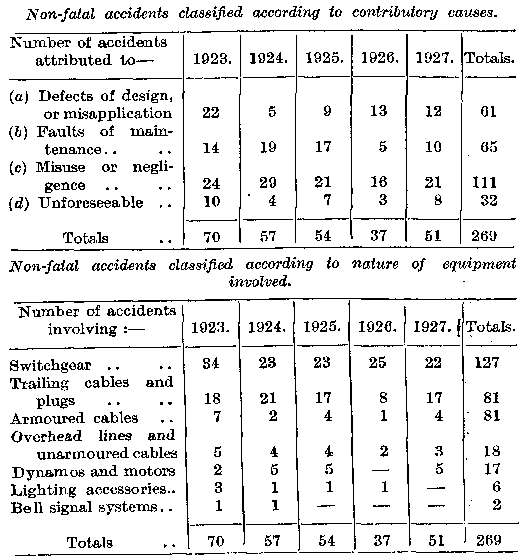
Analysis according to Contributory Causes and Nature of Equipment. — In the two tables which follow, the non-fatal accidents and dangerous occurrences during the last five years are classified according to that which was in my opinion the contributory cause and according to the nature of the equipment that was involved.
 |
 |
| Names mentioned in this article | |
 |
 |
| Name | Age | Occupation | Notes |
|---|---|---|---|
| Horsley, James Arthur Bennett | H.M. Electrical Inspector of Mines | Whos Who Page |




 Contains public sector information licensed under the

