


| Newspaper Articles |

|
Newspaper Articles |
 |
 |
1st December 1928, Page: 154, Column: 1
The Grading And Sampling Of Coal
By Neville Simpkin, M.Sc.
From Paper read at the November Meeting of the Manchester Geological and Mining Society.
There has been a marked tendency during recent years to pay more attention to the sizing and constancy in composition of coals put on the market by the individual collieries. This tendency has been influenced to a large extent by economic conditions, and by the demands of the buyers for coals suitable for different purposes. In order to supply the big consumers of coal, it is necessary to-day to put on the market products of such a nature that their variance in composition is only small and kept within well-defined limits. It is only reasonable to expect that a buyer should pay for what he receives and not what he should receive. This may sound rather drastic, but if any attempt was made to sell other commodities on the same lines that a large percentage of coal is sold at the present day, it is easy to imagine what would be the results.
The selling of coal on a scientific basis, as it is sometimes called, is being shown in the increased tendency to arrange contracts on a calorific value and ash content basis, with penalties and bonuses depending upon whether the coal is below or above a previously arranged standard. The problem leads naturally to the question of coal purification. It is outside the scope of this paper to treat this subject beyond referring to a few points which are related directly with the question of variation in the composition of marketed products. In addition to other advantages, the washing, or cleaning, of a coal, has a marked tendency to give products of fairly even composition provided that the purification process received adequate supervision. Putting it another way, the ordinary run of mine coal if subjected merely to dry screening will, under certain conditions, yield products each of which may vary considerably in itself in ash content from day to day, or even during each day, due to the nature of the seam and the method of working. Purification of the coal tends to "even" the products and give sizes which in themselves maintain a more constant ash content not varying to the same extent as in the uncleaned coal. There are, of course, cases where this difference is not very marked, but unwashed slacks are liable to wide variations in ash content.
According to the 7th Annual Report of the Secretary for Mines for the year 1927, 20.5 per cent. of the total output of saleable coal in Great Britain had been washed or subjected to a dry cleaning process. It is rather interesting to note that the figure for Lancashire and Cheshire was 19.2 per cent., the highest being South Yorkshire with 38.8 per cent. and Cumberland and Westmorland with a similar figure. The Report deplores the fact that no previous figures are available for comparison purposes, but "it is estimated that the quantity of coal washed or cleaned in 1927 was approximately double the quantity so treated in 1913. The washing of 51½ million tons of coal (the quantity washed in 1927) would result in the separation of (say) over 2½ million tons of dirt, allowing a removal of approximately 5 per cent. A loss of 1 per cent. of coal in the dirt is equivalent to 25,000 tons of coal, and this figure represents very good practice in coal washing. In many washers, the loss is very much increased ; it is not very unusual for this to mount up to 5 per cent., 10 per cent., and even higher, due frequently to insufficient supervision and necessary adjustment of the washer. The choice lies between efficiency in the washer with supervision or inefficiency and loss without it.
The buying and selling of coal by any means involving a regulation of price according to the analysis involves the question of sampling. The sample taken must contain coal and impurities in the same proportion as they occur in the grade of coal which it represents. A further point which requires special attention is the different sizes of coal in the product being sampled. As an example, a 2-inch slack may contain (say) 10 per cent. of 1"-2", 20 per cent. of ½"-1", 17 per cent of ¼"-½", and so on, each fraction containing a different percentage of ash and varying in other properties such as calorific value, sulphur and so forth. The following figures may be quoted obtained from screening slacks passing a 2" mesh into different sizes and determining the ash content of each :—
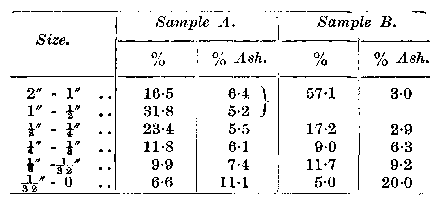
Obviously it is necessary to ensure that each of these fractions is truly represented in the sample. The easiest method of obtaining samples is when the coal is in motion, e.g., being conveyed along a belt, picking belt, falling off a chute, or from other similar places. Sampling is performed regularly at a great number of power stations, electricity and gas works, industrial concerns, and similar places. Why should it not be done at the pits so that the colliery proprietors could know what was being sold and have a ready answer to any complaint ? False sampling may often result in totally absurd figures. To show the type of thing which does occur, I should like to quote two actual cases out of several which have come to my notice. The first arose through a complaint being made concerning delivery of some unwashed mixed coal of about 3-inch downwards. The complaint was accompanied by a sample which consisted principally of shale, shaly coal, and similar material, and was very high in ash. Upon investigation it was found that the "sample" had been obtained by carefully picking some dozen pieces of the dirty material from the top of each wagon, no attempt being made to sample the whole. The second case was due to a misunderstanding on the part of the man carrying out the sampling. The bulk sample had been obtained in the proper way and was being coned and quartered. The man who was doing the mixing was working so efficiently that every time he saw a piece of dirt or dirty coal he picked it out and discarded it. When sampling is done, it should be carried out by someone who understands thoroughly what he has to do. It is no use leaving it to the indiscretions of a convenient surface hand, for however good his intentions may be, he makes mistakes simply because he does not understand exactly what he has to do and the reason for doing it in a particular manner.
 |
 |
| Names mentioned in this article | |
 |
 |
| Name | Age | Occupation | Notes |
|---|---|---|---|
| Simpkin, Neville | S.M.R.B. |




 Contains public sector information licensed under the

