


| Newspaper Articles |

|
Newspaper Articles |
 |
 |
17th November 1928, Page: 136, Column: 2
Coal Mining In India
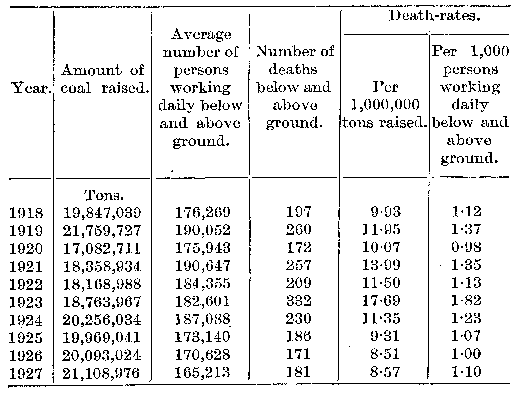
According to the annual report of the Chief Inspector of Mines in India (Mr. R. R. Simpson, M.Sc), the number of persons employed in coal mines last year under the Indian Mines Act was 165,213, which is 5,415 less than in 1926. Of these persons 41,786 were coal-cutters, 9,900 were male loaders, and 33,841 were females — chiefly loaders. The number of workers is perhaps not, in excess of the number of working places, but it is in excess of the transport arrangements even at the best equipped mines. The miner lacks confidence in the transport arrangements and will not commence work until an empty tub has been allotted to him. A great deal of his time underground is spent in sitting down waiting for tubs. Until such time as transport has been improved managers would be well advised to admit fewer workers into the mines. To do so would not cause loss of output, but would lead to a considerable reduction in the number of hours spent underground, which is often not less than twelve hours per shift. The output of coal per person employed has improved in recent years and may be ascribed to the greater use of coal-cutting machinery. At Jamadoba colliery in the Jharia coalfield where the coal is cut by machines and hauled underground by electric locomotives the output per person employed was double the average figure for Bihar and Orissa and Bengal.
Women in Mines.
Mr. Simpson comments in his report on the movement for the abolition of women's labour underground. During the year the question of female labour in mines was again under discussion and advanced a further stage. Draft proposals were put forward for a gradual reduction of the employment of women underground in the coal and salt mines, leading to elimination at the end of a period of seven years. By the representatives of the larger coalmines the proposals were accepted, but without enthusiasm and with the suggestion that the period within which the gradual reduction is to be effected may be extended. The owners of the smaller coal mines persisted in their attitude of strong disapproval.
The objections urged in former years were again set forth, but in stronger terms. It is said that men will not work in mines and leave their wives at home, but the fact that large numbers of them are doing so already is ignored. A similar argument was used when it was first proposed to prohibit the employment of children in mines. Prohibition of child labour has, however, had no effect on the attendance of women. It is said that men will not carry loads, although from the annual returns it appears that 9,960 men were so employed in Indian coal mines during the year 1927. The number is actually greater, as many men who both cut and carry coal are entered in the registers as coal-miners ; at certain large mines there are more men than women carrying coal. It is said that there are not enough men to take the place of the women, but there has been a surplus of coalmining labour in the major coalfields for some years, and at the present time the mines are over-manned, and there is reason to believe that the present output of coal could be obtained with a reduction of one-quarter of the labour force.
It is contended that work in coal mines is healthful and easy, but the writer is unable to agree that the work which women are seen to be performing in the photographs reproduced is suitable for women. The four women shown in one of the illustrations work in a mine in which the humidity is 97 per cent. The air in the mine is practically saturated, and at the time when the measurement was made the air on surface was very dry (humidity 20 per cent). The mere effort of walking about the mine is sufficient to cause so profuse perspiration that clothing becomes saturated within a short space of time.
The main opposition to the prohibition of female labour in mines is, however, based on economic grounds. Female labour is cheaper than male labour, and women are docile and work with greater regularity than men. It is feared that without female labour the cost of production will increase. Were the change to be introduced at once there would probably be a temporary increase in cost, but if, as proposed, it is introduced gradually the increased efficiency of the men, which may be expected to follow the elimination of women, the introduction of regular shifts, and the greater use of labour-saving appliances will minimise and may possibly overbalance such increase.
The following is a quotation from the report on the working of the Indian Mines Act made by the Deputy Commissioner, Chhindwara, Central Provinces :— "The problem of controlling, and still more of reducing, the consumption of liquor by mine labour presents peculiar difficulties. The arduous nature of the work and the conditions in which it is performed make men specially prone to drink liquor. It has been suggested that another cause is the employment of women. The workman on return to his home wants food and finds that his wife has not yet had time to prepare it. He accordingly goes to the liquor shop for a drink whilst he is waiting. . . . The prohibition of women labour and the provision of more amenities will in time reduce consumption."
The total coal output last year was 21,108,976 tons, an increase of 1,015,952 tons or 5.06 per cent. on the previous year. All the coalfields contributed towards the increase. A total of 2,253,251 tons of cargo coal was exported as compared with 2,058,667 tons in 1926. Bunkers, however, fell from 910,459 to 870,289 tons. The collieries consumed 1,466,743 tons, and for coking at the collieries 946,520 tons were used, 608,612 tons of soft coke and 42,445 tons of hard coke being made. The number of collieries using electric energy was 110 and the aggregate horse-power employed increased from 54,548 to 59,539, i.e., by 9 per cent. During the year electric plant was installed and brought into operation in four more coal mines, but three mines using electricity were closed down. The number of coal-cutting machines in use increased from 126 to 141 ; of these 124 were driven by electricity and 17 by compressed air, fifty-five mines employing machines. The total area undercut by the machines was 7,555,748 square feet, as compared with 6,076,352 square feet undercut in the previous year. The use of machines for winning coal in the Raniganj coalfield is rapidly extending. During the year 2,029,125 lb. of gunpowder, 243,244 lb. of high explosives, and 192,115 lb. of permitted explosives were used at coal mines, comparing with 1,762,498 lb., 269,742 lb., and 73,656 lb. used in 1926. Sixty-seven mechanical ventilators were in use as compared with 66, and 17,600 safety-lamps as conmared with 15,659.
Table showing output, etc., at coal mines under the Indian Mines Act.
 |
 |
| Names mentioned in this article | |
 |
 |
| Name | Age | Occupation | Notes |
|---|---|---|---|
| Simpson, R. R. | Chief Inspector of Mines in India |




 Contains public sector information licensed under the

