


| Newspaper Articles |

|
Newspaper Articles |
 |
 |
17th November 1928, Page: 129, Column: 1
Intensive Mining Requirements
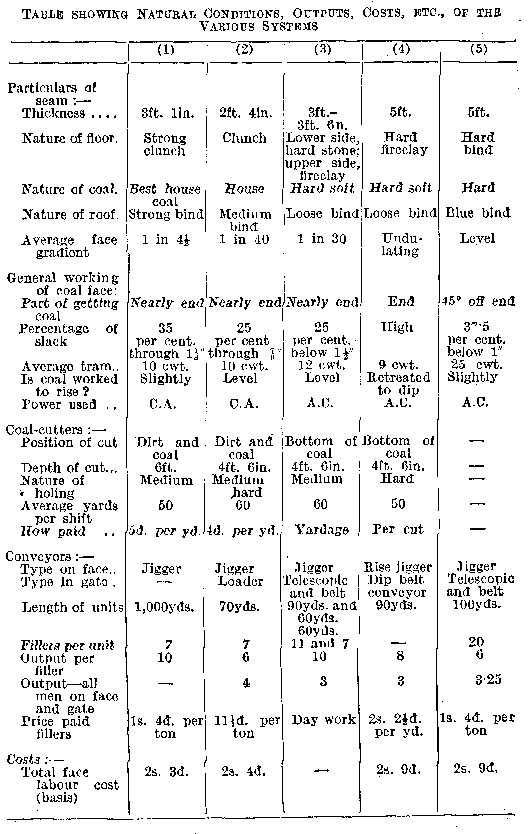
Before the Midland Counties Institute of Engineers, Mr. N. J. Muschamp in a paper on "Practical Applications of Intensive Mining," says that the face figures may not show great reduction in costs on good longwall handgot figures, but it is not so much here as on the material and labour on the roads, supervision, etc., that intensive mining pays. At present few collieries are worked completely by intensive methods, and so it was not possible to get a comparative pit bottom cost. If the total capital cost in roads, rails, ponies, material, etc., to get, say, 600 tons a day from a longwall handgot face, where the stalls turn about 20 tons per day, were compared only with the capital cost to get the same output by intensive methods (without taking into account the subsequent advantages), the latter would be employed still more.
He describes five systems, namely: (1) Panel advancing, machine cut, single unit delivering into tub or on to gate loader or gate conveyor. (2) Panel advancing, machine cut, double unit delivering on to gate loader or gate conveyor. (3) Panel advancing, machine cut, double unit delivering via telescopic loader on to gate conveyor. (4) Panel retreating, machine cut, double unit delivering on to a short jigger conveyor working in tandem with a gate conveyor. (5) Panel advancing, hand-got, double unit, delivering via telescopic loader on to gate conveyor.
Mr. Muschamp says the following are some of the points which seem to require attention for the success of intensive mining :—
(1) It is necessary to study very carefully all conditions.
(2) Start with the right lay-out and the right plant. All details, as far as possible, must be worked out before commencing operations.
(3) Everyone, from the highest official to the lowest haulage hand, must be of the right type, must understand his job and be interested in it.
(4) The ingrained suspicion of the men for all new machinery and ideas must be overcome, and this may be done to some extent by allowing and encouraging the pioneers to earn good money.
(5) It is better to over-estimate than under-estimate the power required. In this connection electric power appears to be handier than compressed air, especially with regard to trailing cables compared with hoses in heading work. There are no gate-end boxes, switches, etc., required with compressed air, however.
(6) All machinery should be systematically examined and overhauled at certain definite intervals, whether running well or not.
(7) An adequate supply of spares should be kept available.
(8) It pays to keep a very careful record of outputs, costs and other records. In this respect, graphs may be found useful.
(9) A plentiful supply of tubs is a necessity at all loading-points. Reference is made here to the advantage of having large tubs where it is possible.
(10) Very careful attention to roof control is necessary, and the advantage of straight faces in this connection is important. It is usually found that the correct size of gates packs and wastes is a matter of experiment.
Reference is made to a recent invention whereby the nut and bolt connection on jiggers, which is such a source of trouble, is replaced by a rope connection.
Intensive mining has come to stay, and it is interesting to look ahead. In the past, in many cases, mining machinery has been merely adapted to old systems. It is doubtful whether, in a number of cases, this is the right method of tackling the problem. In a number of successful modern installations the system has been made to suit the machinery. The ideal system would appear to be when both are taken into account. It is possible that in the future much more use will be made of the retreating system, whereby the roads are driven out at an actual or (more likely) arbitrary boundary at a very fast rate of about 80 yards per week, and are brought back at a correspondingly fast rate. This will do away With a large amount of dead work such as packing, etc. Under the present system of advancing to the boundary, long lengths of road have to be kept up right to the end. When the boundary is reached they are of no further use. It is admitted that the system is not applicable to all conditions, particularly where subsidence is an important point. The initial cost is probably higher, and the return on the money invested (an important point with shareholders) is slower, but even then it is felt it might be adopted in many more places than it is.
One of the main difficulties of a scheme such as this is that, although there are machines to undercut or overcut the coal, in medium and thin seams there is as yet no machine that will cut, get down, and load the coal on to a conveyor. The latter is by no means perfect, and we need a conveyor which will combine the good points of the present conveyors and leave out their admittedly bad ones. In this connection we shall not have to wait very long. We shall then be able to get a face advance or retreat such as is referred to, and faces will be cleared nine times in 24 hours instead of twice a week.
 |
 |
| Names mentioned in this article | |
 |
 |
| Name | Age | Occupation | Notes |
|---|---|---|---|
| Muschamp, N. J. |




 Contains public sector information licensed under the

