


| Newspaper Articles |

|
Newspaper Articles |
 |
 |
3rd November 1928, Page: 122, Column: 1
Underground Illumination
By Charles C. Reid and Albert V. Reis.
Excerpts from paper on "The Light Given by Various Types of Miners' Lamps," prepared by the authors for presentation at the 39th Annual General Meeting of the Institution of Mining Engineers.
In view of the many advantages of good illumination underground and of the strong evidence that miners' nystagmus is caused by defective illumination, the management of the Fife Coal Company, Limited, have carried out a number of experiments and tests on the various types of lamps available, and have recently equipped one of the pits completely, and two in part, with electric cap-lamps. The tests were conducted at the request of the Coal Owner's Research Committee on the lamps in use or on trial at the companys' pits, and the findings are the results of their employment under working conditions.
In American pits electric cap-lamps are in general use wherever safety-lamps are required, and hand safety flame-lamps, practically speaking, have never been used except for testing purposes. In this country, on the other hand, it was as hand-lamps that electric lamps were first introduced ; and there has been apparently no large-scale trial or electric cap-lamps until quite recently, although attention has often been drawn, particularly in the First Report to the Medical Research Council of the Miners' Nystagmus Committee, to the greatly superior illumination given by a bulb in a cap-lamp as compared with that of a similar bulb in a hand-lamp. It is remarkable how little use of cap-lamps has been made in this country, particularly in view of the extremely significant fact that careful medical search has revealed no cases of miners' nystagmus among American coal-miners.
The cap-lamp has certain evident advantages, which may be summarised as follows :— (1) The lamp is practically always as near as possible to the surface of the object at which the man is working. (2) The reflector concentrates the light on the surface. No light is wasted elsewhere, and the lamp itself throws no shadows. (3) The man's hands are free, as he carries the lamp on his head. (4) When men are travelling, the man behind is not dazzled by the light of the man in front of him.
In recent photometric measurements made underground, Dr. T. Lister Llewellyn pointed out that the actual illumination of surfaces on which several different men were working was about ten times greater with the 2-volt cap-lamp than with a hand-lamp of equal bulb capacity. This, of course, does not mean that a man can see ten times as much detail with a cap-lamp as with a hand-lamp, since the eye has a marvellous capacity for adapting itself to low illumination. Just as a man can manage to do good work with very imperfect tools skilfully used, he has also the faculty of adapting his power of vision so that he can work with an extremely poor light, although to the detriment of his sight. The adaptation of the eye is far easier with a cap-lamp ; and those who start from the cage at the pit-bottom with a cap-lamp realise this at once.
The following disadvantages of the cap-lamp may be mentioned : (1) The weight of the battery on the belt. (2) Objection to cable and headpiece. (3) The initial cost exceeds that of a hand-lamp. (4) The danger of burns (alkaline battery).
The factor of breakage has not been dealt with in the comparison of the advantages and disadvantages of the cap-lamp. Although in practice the cap-lamp has a decidedly smaller breakage cost than the hand-lamp, it is believed that breakages are a question of discipline.
The weight of the battery on the belt may be relieved by slinging an extra strap over the shoulder to the belt at the position of the battery in order to take the drag of the weight of the battery from the belt to the shoulder. There is no doubt that objection to the strap over the shoulder is a real one, particularly for face-men. In some districts the battery is carried in the pocket of the jacket. Objections to the cable and headpiece are more or less those of prejudice and lack of custom in the use of a cap-lamp. The initial cost of the alkaline lamp is approximately twice the price of the 2-volt acid lamp.
The electric cap-lamps of the Ceag type with the unimproved headpiece give a candle-power in the region of 1.4. Poor indeed as this light is compared with that of the new improved headpiece, it is still immensely superior to that of the 2-volt electric hand-lamp. Several cases have cropped up with complaints of threatened nystagmus from the workers using electric hand-lamps. Yet, on being furnished with cap-lamps even of the unimproved headpiece type, the men so afflicted were enabled to continue at work and have never lost a day's employment on this score. Our men generally are unanimously in favour of the cap-lamp. Many who still carry hand-lamps are ever complaining of the lack of light and of the inherent defect of the hand-lamp, necessitating change of position of the lamp from time to time to illuminate the object at which the man is working.
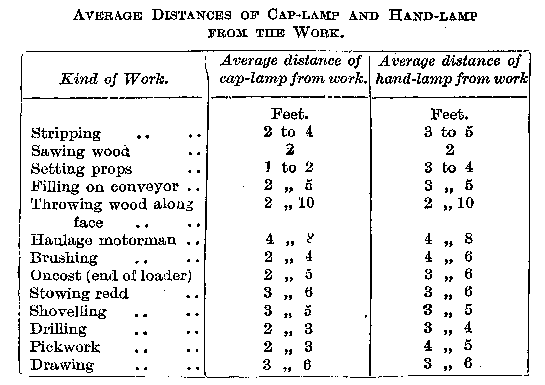
The paper gives an account of the tests with explanations and results of the work carried out, the figures in each case being averages of twenty or thirty lamps so as to be representative. As a result of the experiments and tests carried out the Authors have formulated the following conclusions, which embody the results contained in the paper :—
(1) The 2-volt hand-lamp is neither suitable nor capable of affording the essential light required for underground purposes. Experience of over 20 years confirms the fact that the introduction of the electric hand-lamp has not assisted in the reduction of nystagmus cases. The light afforded by the hand-lamp is little better than that of the safety flame-lamp.
(2) The safety flame-lamp is neither sufficient nor efficient as a lighting medium. Firemen should be supplied with a good headlight in addition to the safety flame-lamp for the inspection of roof and sides.
(3) The Ceag 2-volt cap-lamp of the improved type gives a sufficient light for underground requirements for all classes of workers.
(4) The Edison and Wolf alkaline cap-lamps are suitable for underground requirements for all classes of work.
(5) A direct-reading photometer should be provided in every lamp-room for the periodic testing of all types of lamps ; and the results obtained should be recorded in a book kept for that purpose.
(6) A better and more systematic training of lamp chargemen should be undertaken, and really competent men for this work should be appointed.
(7) More systematic records of spares and of the life history of the lamps used should be kept. The weaknesses of the organisation and administration, if any, and any defects of the lamp, would be immediately apparent.
 |
 |
| Names mentioned in this article | |
 |
 |
| Name | Age | Occupation | Notes |
|---|---|---|---|
| Llewellyn, T. Lister, Dr. | |||
| Reid, Charles Carlow | Whos Who Page | ||
| Reis, Albert V. |




 Contains public sector information licensed under the

