


| Newspaper Articles |

|
Newspaper Articles |
 |
 |
3rd November 1928, Page: 116, Column: 1
Tru-Lay Wire Ropes And Tru-Loc Fittings
By A. T. Adam.
From paper prepared for presentation on 20th October, at General Meeting of the North of England Institute of Mining and Mechanical Engineers.
Tru-lay Wire Ropes. — When an ordinary spring is made by wrapping wire round a mandril, allowance has to be made for the resilience or elasticity of the wire, since the spring becomes quite slack on the mandril once the tension has been removed. In stranding wire and closing a wire rope, the tension applied is never completely released, the wires being held forcibly in position. The truth of this will at once become evident if a rope be cut at any point, or if the serving is removed at one end. The operation of closing, in short, is not complete. Perfect closing can be obtained only by pre-forming the wires and strands, i.e., by giving them, prior to stranding and closing, the helical formation required so that they will take their natural position in the rope without constraint. In an ordinary spring, the wire may be said to have been pre-formed by the simple process of winding it round a mandril, the diameter of which is smaller than that of the internal diameter of the finished spring. An ordinary wire rope is analogous to the spring just after coiling, before the tension has been released, i.e., it is a complex double-helical spring already loaded. Tru-lay rope is analogous to the spring when the tension has been released : it is an unloaded spring. The Tru-lay formation is, therefore, the more logical, and wire ropes ought really to have been made in this way from the beginning.
The Tru-lay rope can be unwound strand by strand, and wire by wire, and built up again. This indicates that it will be more easily handled when being cut, fitted, or spliced. If some of the wires should break through wear, the broken ends lie in position, and do not stick out as do those of an ordinary rope, causing damage to the other wires. In a Tru-lay wire rope the strands form helical springs, as do also the individual wires in each strand. The final result on each wire is rather complex, as may be seen by removing one. In ordinary rope the wires and strands lie in the form of helices only by constraint: separate them from one another and they become almost straight. They are thus under continual initial stress, and this stress is a torsional one. If, now, we apply an external load to such a helix, we are applying additional torque, and a point will eventually be reached where the individual crystalline units of the steel will begin to slip. This will not matter if such a load is applied only occasionally, but if it be applied repeatedly, the steel will become fatigued and the wires will ultimately fail. Let us suppose, then, that this crystal slipping begins when the wire helix is subjected to a load tension of 50 pounds, and suppose a load of 20 pounds is required to hold each wire in the form of a helix, obviously an additional load of only 30 pounds will be required to cause slipping and commence fatigue. If, however, the wire is lying dead in the form of a helix, as in a Tru-lay rope, there is no initial load of 20 pounds, and an external load of 50 pounds will be required to cause slip.
Turning to the elastic properties of the Tru-lay ropes, we find some points of interest. The term "modulus of elasticity" cannot strictly be applied to such an article as a rope or a spring, because Young's modulus is a property of material representing the relation between stress and strain within the range in which these are proportional. In practice, however, it is convenient and quite legitimate to speak about the modulus of a rope. Like a piece of rubber, wire rope is not perfectly elastic. Roughly speaking, anything from a quarter to one-half of the total stretch occurring where the rope is loaded to 50 per cent. of the breaking-load is permanent stretch. In a Tru-lay rope by for the greater part of the permanent stretching takes place at the first time of loading. Thereafter it gradually dies away, until after about twenty loadings the rope becomes almost perfectly elastic. Ordinary rope behaves differently. There is less permanent stretch on the first loading, but the rope keeps on stretching during its entire life, and never becomes perfectly elastic, the reason being that the wires in an ordinary rope are always under an initial load and in service are being continually stressed beyond their elastic limits, thus causing gradual creep and fatigue. In the Tru-lay rope the permanent stretch is mainly due to bedding-down on the core, and once this is accomplished the rope becomes almost elastic.
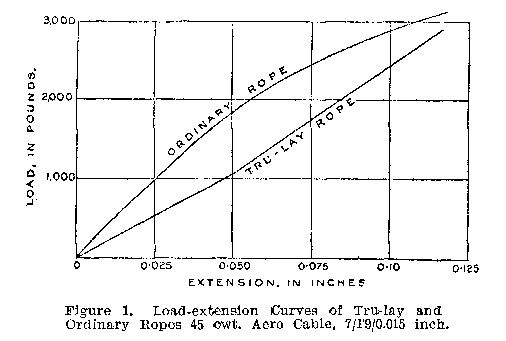
There is one feature of the elastic stretch in Tru-lay ropes which is probably connected with this bedding-down on the core. In Tru-lay ropes there are two distinct moduli of elasticity, namely : (1) A lower modulus for loads between zero and a fifth of the breaking-load. (2) A higher modulus for loads between a fifth and one-half of the breaking-load. The first is due in all probability to the lateral contraction, and will depend largely on the core.
The curves in Figure 1 provide proof of the fact that the wires in a Tru-lay rope are more uniformly stressed. This is to be found in the suddenness of the change from the lower modulus to the higher, at about a fifth of the breaking-load. As will be seen from the curves, there is no gradual change such as one would expect with strands or wires unequally loaded. The lower modulus occurs while the strands are bedding-down. That this takes place simultaneously in all the strands is evident from the abrupt change in the modulus, the rope acting first as a free spring, and then suddenly as a spring on a flexible mandril.
To sum up, Tru-lay rope is virtually an unloaded spring, while ordinary rope is a spring already under load. The former has all the resilience of the unloaded spring, being able to take up work or energy resilience of the unloaded spring, being able to take up work or energy and return it again completely without undue straining of its sinews (i.e., the individual steel crystals). In the ordinary rope, the sinews of which are already taut, additional load will cause permanent straining of these sinews, and the work done will not be returned in full: some of it has gone into the fibres of the steel, causing slight fatigue.
Tru-loc Fitting. — The Tru-loc fitting can be readily applied only to ropes of Tru-lay construction. This fitting in its simplest form consists of a mild-steel sleeve, which is slipped over the end of the rope and cold-pressed on to it. In this way the mild-steel is caused to flow into the interstices of the rope, thus making a perfect joint. There are many advantages in the Tru-loc method of attaching a fitting to the end of a rope. These will have a variable appeal, according to requirements. Probably the most valuable feature is that the joint can be made as strong as the rope itself.
The Tru-loc method enables the fitting and its shank to be considerably lighter than many other forms of attachment. This, of course, is a distinct advantage in its application to aircraft, and in other less obvious uses. The fitting is very compact, and enables attachments to be put on a rope where space is very confined and the overall length of the rope is comparatively short. The overall length of a rope can be made more nearly to the required dimension when Tru-loc fittings are attached than by splicing. This feature may not appeal to some users, because they are interested only in large ropes several hundred feet long ; but cases occur where an overall length is required to be correct within 1 inch, and this degree of accuracy certainly could not be obtained by splicing. A Tru-loc fitting can be used for connecting together two or more ropes. When this feature is fully realised by designers and engineers, it will doubtless appeal to them.
The Tru-lay and Tru-loc system is no longer in the experimental stage ; I have no hesitation whatever in stating that it is a thoroughly sound engineering proposition, and one which has been amply proved in actual practice.
 |
 |
| Names mentioned in this article | |
 |
 |
| Name | Age | Occupation | Notes |
|---|---|---|---|
| Adam, A. T. |




 Contains public sector information licensed under the

