


| Newspaper Articles |

|
Newspaper Articles |
 |
 |
8th September 1928, Page: 59, Column: 1
Some American Notes
Accident Statistics.
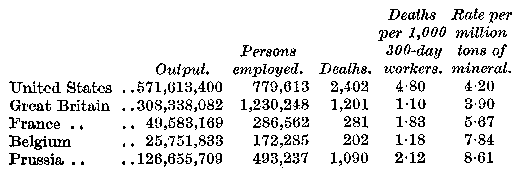
Bulletin 283 of the U.S. Bureau of Mines details and examines the U.S. fatalities in 1928. Reports show that 2,514 men were killed by accidents. The output of coal included 578,290,000 tons of bituminous and 85,000,000 tons of anthracite coal. Continuous records, which are now available, covering accidents in coal mines in the United States since 1870 show that in 1870 the loss of life averaged 13.47 per million tons of coal produced ; the next year the figure stood at 10.86 ; for the years 1871 to 1880 it ranged from 10.86 in 1871 to 5.16 in 1880, averaging 7.87 for the 10-year period. During the decade ended with 1890 the average was 5.55, and for the 10 years ended with 1900 it was 5.57. For the decade 1901-1910, a period which witnessed some of the worst coal-mine disasters that have occurred in the United States, the average was 5.80. The average was reduced to 4.27 during the 10 years 1911 to 1920, and finally to 3.96 for the half decade 1921-1925. Thus the price in human life of a ton of coal is shown to have been greatly lowered during the period for which yearly figures on fatal accidents are available. Of the 2,514 fatalities in 1926, falls of roof accounted for 1,213 or 48 per cent. ; underground haulage claimed 431 or 17.1 per cent. of the victims ; the deaths from explosions numbered 422 or 16.8 of the total from all causes. A table is given comparing the production (in short tons), number of persons employed, the number killed and rates, from which we extract particulars for the year 1921 as follows :—
Embrittlement of Boiler Plate.
This is the subject of Bulletin No. 177 of the Engineering Experiment Station of the University of Illinois, the Authors being Professor Samuel W. Parr and Mr. Frederick G. Straub. The general conclusions drawn from the results obtained in the investigation are : (1) Embrittlement in boiler plate is caused by the combined action of stress and chemical attack. The stresses are inherent in the construction and operation of the boiler, while the chemical attack is caused by the presence of sodium hydroxide in the boiler water. (2) Certain methods of water treatment tend to convert some waters into the characteristic type which produces embrittlement. (3) The presence of sodium sulphate in the feed water tends to retard the embrittling effect of sodium carbonate feed waters, and, if in proper proportions, will stop it entirely. (4) The presence of phosphates, tannates, chromates, acetates, etc., will also inhibit the embrittling action of caustic soda if these salts are present in the boiler water in proper amounts. (5) Methods for the introduction of these inhibiting agents to feed waters have been worked out and are in operation in large power plants. (6) No steel suitable for boiler plate has been found which is resistant to the embrittling action of caustic soda.
Heat Transmission Through Boiler Tubes.
Mr. Hubert O. Croft in Bulletin No. 168 of the University of Illinois, as a result of an investigation on boiler heat transmission, draws the following conclusions: (1) The coefficient of heat transmission of the apparatus is affected by : (a) the rate of gas flow ; (b) the temperature difference between flue gas and water ; (c) the pressure at which steam is generated ; (d) the temperature of the gas stream. (2) The water velocity in the tube has slight effect on the over-all coefficient of heat transmission. (3) The water velocity in the inclined tube of the apparatus varies as the steam rate and total energy input, and tends to approach a practical maximum at slightly over 3 feet per second. (4) The water velocity is affected by the steam pressure. (5) The temperature gradient from the flue gas to the water in the tube varies with the flue-gas temperature, the rate of gas flow, and the steam pressure.
 |
 |
| Names mentioned in this article | |
 |
 |
| Name | Age | Occupation | Notes |
|---|---|---|---|
| Croft, Hubert O. | |||
| Parr, Samuel W., Prof. | |||
| Straub, Frederick G. |
 |
 |
| Related Articles | |
|
|
| Pub. Date | Article (Newspaper) |
|---|---|
| 11 Sep 1926 | American Notes (The Science and Art of Mining) |
| 07 May 1927 | Some American Notes (The Science and Art of Mining) |
| 08 Jun 1927 | Some American Notes (The Science and Art of Mining) |
| 10 Sep 1927 | Some American Notes (The Science and Art of Mining) |
| 24 Sep 1927 | Some American Notes (The Science and Art of Mining) |
| 07 Apr 1928 | Some American Notes (The Science and Art of Mining) |
| 19 May 1928 | Some American Notes (The Science and Art of Mining) |
| 16 Jun 1928 | Some American Notes (The Science and Art of Mining) |
| 28 Jul 1928 | Some American Notes (The Science and Art of Mining) |
| 25 Aug 1928 | Some American Notes (The Science and Art of Mining) |
| 08 Sep 1928 | Some American Notes (The Science and Art of Mining) |
| 20 Oct 1928 | Some American Notes (The Science and Art of Mining) |
| 09 Feb 1929 | Some American Notes (The Science and Art of Mining) |



 Contains public sector information licensed under the

