


| Newspaper Articles |

|
Newspaper Articles |
 |
 |
8th September 1928, Page: 52, Column: 1
Pithead Baths
An inquiry received for information regarding pithead baths may perhaps be most suitably answered by reference to two documents emanating from the Miners' Welfare Committee, namely, the sixth report on the Miners' Welfare Fund (1s. 6d., H.M. Stationery Office), and a pamphlet by the Rt. Hon. Viscount Chelmsford on The Miners' Welfare Fund (3d., H.M. Stationery Office). Both documents have already been referred to in this journal, but the notes appended may not only satisfy the requirements of the inquiry but prove of interest to other readers.
In the pamphlet the various activities of the Fund are dealt with, and are worthy of close study. The figures indicate the position in November last, and under the heading of pithead baths Lord Chelmsford says the advantages are too well recognised to require emphasis. In most foreign coalfields the provision of washing and drying accommodation at the pithead is compulsory.
In the section of the Act which established the Fund, pithead baths were specifically recognised as one of the purposes to which the Fund might be applied. But the Miners' Welfare Committee realised that considerations of cost prohibited anything in the nature of attempting their general establishment during the first five years.
There are now 36 installations, still not including those reserved for the sole use of officials. There has thus been an increase of 26 in six years and of these 18 have been the result of allocations from the Fund. The corresponding increase in the number of shower bath cubicles is 1,547, of which the Fund has provided 1,235. In the welfare installations there is clothes accommodation for approximately 16,500 workmen and the total sum of money spent on them has been £152,500, of which £126,413 has been provided from the Fund and £26,087 from other sources, mainly from the owners of the collieries concerned.
Provision is made in the Mining Industry Act, 1926, for the collection by the Inland Revenue Department of a special levy of one shilling in every pound of royalties derived from coal. The annual revenue from this levy is estimated at about £250,000 in normal years, but for the first year it did not amount to as much as £200,000 in consequence of the coal stoppage, calculated to have its effect on the second year's income also. The money is paid into the Welfare Fund and, until the Board of Trade otherwise direct, it is applied solely to the provision of washing and drying accommodation at the pithead ; the Miners' Welfare Committee are made responsible for securing as far as reasonably practicable suitable provision at all coal mines.
In anticipation of this measure the Miners' Welfare Committee had for some time previously been giving detailed attention to various problems connected with the design and cost of pithead bath installations, with a view to improving the design and at the same time to reducing, if possible, the cost of both construction and upkeep.
The design followed by all the existing pithead baths in Great Britain is based on the installations erected on the Continent, and follows very closely in its details the practice in France and Belgium. The building consists essentially of a large and lofty hall surrounded by shower-bath cubicles of the enclosed type. The hall is used both for undressing and for dressing, and is equipped with a system of ropes or chains by which either the clean or dirty clothes, as the case may be, are suspended in the roof of the building.
Plans have been produced for a new type of bath, in which the dirt is confined to its own part of the building. At the same time the opportunity has been taken of giving special attention to all the minor points, in which improvement seemed capable of being effected and greater efficiency gained at the minimum of capital cost and expenditure on upkeep. The new design consists essentially of three sections, one for pit-clothes, one for bathing and one for clean clothes. These sections may, of course, be placed in any convenient position relative to one another according to the nature of the site.
The bathing section of the new design consists of shower bath cubicles, similar to those generally in use, but so designed as to be as economical as possible in the use of material and the consumption of water. The pit-clothes and clean clothes sections (which may also be referred to as the "dirty" and "clean" sections) are each equipped with lockers, one for each man, the principle being that a man, after coming to the surface, leaves his pit clothes in his dirty locker, has his bath, and then resumes his clean clothes previously left in his clean locker ; in consequence, clean clothes and clean men will never come into contact with dirty clothes and grimy men, and Will be in a separate portion of the building from those parts Where coal dust is likely to collect. The dirty lockers will be constructed so as to dry and fumigate the pit-clothes, as well as to confine the dirt which comes from them to a controllable area, While the clean lockers will also be capable of drying clothes if wet owing to a rainy day. There will always be sufficient seating accommodation, however big the rush, because each man will have the space in front of his own locker; and questions of ample ventilation and sufficient light are being thoroughly considered. Adequate lavatory accommodation, a first-aid room for dressing minor injuries, arrangements for boot cleaning and greasing, arrangements for supplying drinking water to fill water bottles, and also a special hot-air drying chamber for dealing with very wet clothing, are included as a matter of course, and there is no difficulty in adding provision for a canteen, laundry, the repair of clothes and boots, etc., if desired.
It is not by any means claimed that this design represents the last word on the subject. It is hoped that many improvements will still be effected as the result of further suggestions as the result of visits by members of welfare committees, and after practical experience has been gained. It is indeed clear that the advantages and disadvantages of the new design can only be ascertained if installations of that type are actually erected, where experiments on points which are still doubtful can be carried out. With this object in view four experimental installations are being erected in advance of the main programme, and these will be completed as early as possible in order that the necessary experiments may be carried through, without delay. One will be in Scotland, one in Durham, one in Warwickshire and one in South Wales, the places having been so chosen as to be easy of access from as many districts as possible.
The Act of 1926 imposes upon the Miners' Welfare Committee the duty of securing as far as reasonably practicable the provision of washing and drying accommodation at all coal mines and it is obvious that this duty cannot be effectively carried out simply by awaiting independent applications from the more progressive collieries without regard to the relative urgency of individual cases. Some system has therefore to be devised by which the circumstances of all existing collieries can be reviewed, and pits classified according to their relative priority, in order that definite proposals to the owners and workmen may be made on the basis of a long-period plan.
The Royal Commission recommended that collieries with a probable life of less than 15 years be excluded from consideration and that preference be given to mines where double shifts are worked. They also suggested that the relative need is greater, other things being equal, in the case of those mines where the workmen have a long distance to walk or bicycle to their homes, or have to travel in public conveyances, or have no bathrooms in their houses.
The owners will be expected to provide a suitable site, as near as possible to the pithead, to be transferred to four trustees representing the owners and workmen concerned. The trustees will be required to execute a Declaration of Trust which will include provision for management by a joint management committee, consisting of the trustees ex officio and of four other nominated members, half owners and half workmen. The management committee will be empowered to draw up their own procedure and rules ; they will be responsible for keeping the building and fittings in good condition and repair, for maintaining order and discipline, for the efficient organisation of all arrangements, for the appointment and supervision of attendants and cleaners, and for receiving and applying the maintenance contributions.
Referring now to the sixth report of the Miners' Welfare Committee, it is explained that they have ascertained that pithead baths erected under the Act of 1926 and vested in trustees in the manner contemplated in the regulations would be held by the Mines Department not to be part of the mine premises within the meaning of the Coal Mines Acts. The jurisdiction of the mine manager under those Acts will therefore not extend to the bath installation ; there is accordingly no conflict with the statutes in question in providing that the management of the baths shall vest solely in the joint management committee appointed under the Trust Deed as laid down in the regulations.
For similar reasons a workman suffering any injury in the bath building would not be eligible for benefit under the Workmen's Compensation Act, and to secure adequate compensation in the event of such injury resulting from accidents on the bath premises it will be essential for the users of the bath to be covered by insurance. Insurance will also be necessary to cover the Trustees and the Management Committee against the risk of having to pay compensation for injury to users resulting from any negligence on the part of the former, against the risk of injury to their employees under the Employers' Liability and Workmen's Compensation Acts, and against the risk of loss or damage to the building and/or its contents (including the clothes and other property of the users) from fire or other similar cause. The Welfare Fund Committee consider it essential to require insurance to be effected to cover all these risks, and the cost must therefore be regarded as a necessary item in the upkeep charges ; they have accordingly drawn up a form of comprehensive policy under which the cover would be satisfactory. This policy has the special advantage of securing for accidental injuries to users of the baths a rate of compensation as nearly as possible identical with the rate that would be obtained under the Workmen's Compensation Act, if that Act applied.
For the purpose of estimating the relative priority to be assigned to the various collieries in each district, certain information was sought at the end of 1926 through the district welfare committees. The completion of the returns required took a long time ; in one or two districts in fact, they had not been completed by the end of 1927. But in most cases they were sufficiently complete by the autumn for a preliminary classification of collieries to be drawn up. This preliminary classification divides the collieries in each district (those with a probable life of less than 15 years being definitely excluded from consideration) into four sections, determined by various factors which the Committee had decided to regard as being of chief importance, the greatest weight being given to the distance of the workmen's homes from the pithead and to the question whether or not the men travel by public conveyance.
The Committee are prepared to consider modifications of this preliminary classification when the local knowledge of district welfare committees indicates that anomalies are created by the too rigid application of the factors selected. In any case, further investigation in necessary to determine an order of relative priority within the sections themselves, and where necessary district welfare committees have again been consulted in regard to this. Priority lists are thus being drawn up for each district. It is hoped that considerable progress will have been made by the time the first results of practical experience with the new type of building become available.
The Committee propose to base the first programme on the funds estimated to be available in the period ending on 31st December, 1931. It will be recognised that it will be many years before collieries low down on the lists are likely to be reached. They do not expect in the first period to deal with more than 150 in all ; these will include some of the biggest, and a greater number will probably be practicable in the second and succeeding periods. But in order to accelerate the provision, they will be prepared to give a higher position than would otherwise be occupied to collieries whose owners are prepared to find a substantial part of the cost of the installation, or in respect of which substantial assistance can be obtained through the district welfare committee from a district fund. Special progress will be possible in North Staffordshire, where the district welfare committee have decided to contribute no less than £52,000 from the district fund in the first period, and where some of the colliery owners have indicated their willingness to give assistance also.
The Committee have definitely adopted the principle of appointing a salaried staff for the purpose of dealing with all the technical work arising out of the administration of the baths fund.
The following table, extracted from the annual report of the Secretary for Mines, shows the number of pithead baths at coal, mines and the accommodation provided and in course of installation at the end of 1927. (The statement does not include baths installed for the use of the managerial staff) :—
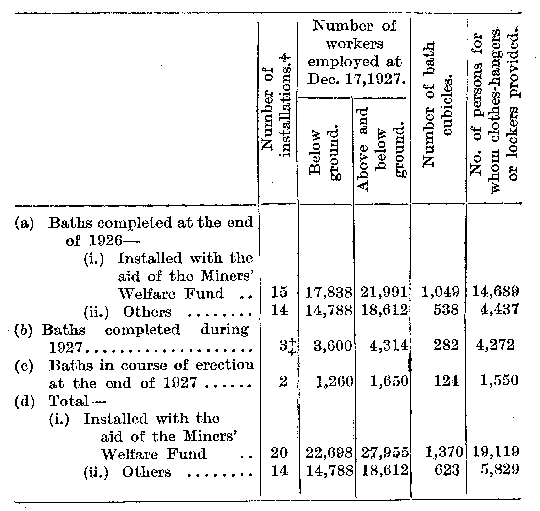
* At 12 of the installations for "general use" 92 bath cubicles with clothes hangers or lockers for 616 persons have also been provided for the sole use of overmen, etc. In addition there are 22 installations for overmen, etc., where baths for "general use" have not been provided. These comprise 135 bath cubicles with clothes hangers or lockers for 735 persons. ++ Not including two existing installations which had additional cubicles during the year.
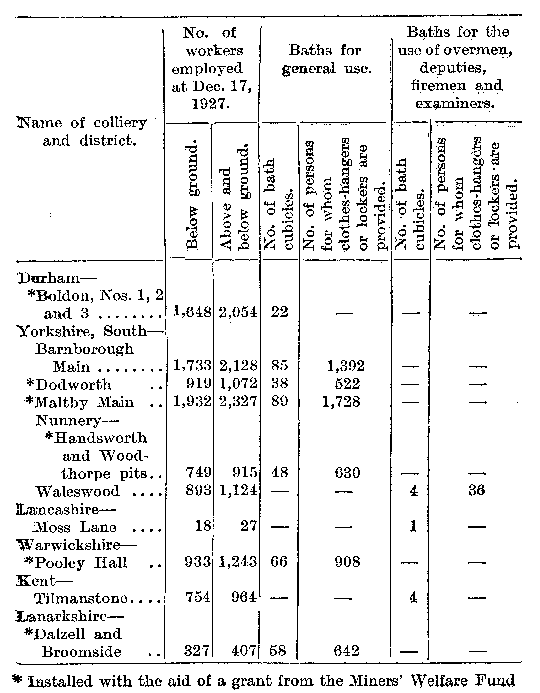
The following shows the baths completed in 1927 (or in course of erection at the end of the year) :—
 |
 |
| Names mentioned in this article | |
 |
 |
| Name | Age | Occupation | Notes |
|---|---|---|---|
| Chelmsford, The Viscount | Whos Who Page |
 |
 |
| Related Articles | |
|
|
| Pub. Date | Article (Newspaper) |
|---|---|
| 28 Apr 1855 | Baths For Workmen (Newcastle Guardian and Tyne Mercury) |
| 29 Aug 1925 | News And Notes (The Science and Art of Mining) |
| 27 Mar 1926 | News and Notes (The Science and Art of Mining) |
| 24 Apr 1926 | News and Notes (The Science and Art of Mining) |
| 10 Mar 1928 | News and Notes (The Science and Art of Mining) |
| 16 Jun 1928 | Pithead Baths (The Science and Art of Mining) |
| 08 Sep 1928 | Pithead Baths In North Wales (The Science and Art of Mining) |
| 08 Sep 1928 | Pithead Baths (The Science and Art of Mining) |
| 20 Oct 1928 | Pithead Baths Ballot (The Science and Art of Mining) |
| 01 Dec 1928 | Pithead Baths (The Science and Art of Mining) |
| 15 Dec 1928 | Pithead Baths (The Science and Art of Mining) |
| 26 Jan 1929 | Baths Proposal Rejected (The Science and Art of Mining) |
| 09 Feb 1929 | Pithead Baths (The Science and Art of Mining) |
| 06 Apr 1929 | Pithead Baths (The Science and Art of Mining) |
| 29 Jun 1929 | Pithead Baths (The Science and Art of Mining) |
| 13 Jul 1929 | Welfare At Ashington (The Science and Art of Mining) |
| 13 Jul 1929 | Pithead Baths, Mainsforth Installation Opened (The Science and Art of Mining) |
| 10 Aug 1929 | Welfare At Wearmouth (The Science and Art of Mining) |
| 19 Oct 1929 | Pithead Baths (The Science and Art of Mining) |
| 28 Dec 1929 | Baths For Miners (The Science and Art of Mining) |
| 28 Dec 1929 | Baths At Grassmoor (The Science and Art of Mining) |
| 25 Jan 1930 | Pithead Baths (The Science and Art of Mining) |
| 08 Feb 1930 | Romance Of Welfare (The Science and Art of Mining) |
| 22 Feb 1930 | Baths For Horden (The Science and Art of Mining) |
| 22 Mar 1930 | Pithead Baths, Views of Welfare Committee (The Science and Art of Mining) |
| 03 May 1930 | Eppleton Pithead Baths (The Science and Art of Mining) |
| 17 May 1930 | Pithead Baths (The Science and Art of Mining) |
| 31 May 1930 | Pithead Baths (The Science and Art of Mining) |
| 26 Jul 1930 | Pithead Baths (The Science and Art of Mining) |
| 06 Sep 1930 | Rating Of Pithead Baths (The Science and Art of Mining) |
| 18 Oct 1930 | Edlington Pithead Baths (The Science and Art of Mining) |
| 07 Feb 1931 | Pithead Baths (The Science and Art of Mining) |
| 07 Mar 1931 | Pithead Baths (The Science and Art of Mining) |
| 18 Apr 1931 | Pithead Baths (The Science and Art of Mining) |
| 16 May 1931 | Pithead Baths (The Science and Art of Mining) |
| 06 Jul 1931 | News in Brief (The Times) |
| 08 Aug 1931 | Pithead Baths (The Science and Art of Mining) |
| 03 Oct 1931 | Pithead Baths (The Science and Art of Mining) |
| 31 Oct 1931 | Pithead Baths (The Science and Art of Mining) |
| 28 Nov 1931 | Pithead Baths (The Science and Art of Mining) |
| 12 Dec 1931 | News and Notes (The Science and Art of Mining) |
| 26 Dec 1931 | Prospects Of Industry In Britain (The Science and Art of Mining) |
| 23 Jan 1932 | Pithead Baths (The Science and Art of Mining) |
| 23 Jan 1932 | Durham Pithead Bath Ceremony (The Science and Art of Mining) |
| 05 Mar 1932 | Pithead Baths (The Science and Art of Mining) |
| 16 Apr 1932 | Pithead Baths (The Science and Art of Mining) |
| 30 May 1932 | News in Brief (The Times) |
| 11 Jun 1932 | Pithead Baths (The Science and Art of Mining) |
| 06 Aug 1932 | News and Notes (The Science and Art of Mining) |
| 06 Aug 1932 | Pit Girls And Tennis (The Science and Art of Mining) |
| 20 Aug 1932 | News and Notes (The Science and Art of Mining) |
| 01 Oct 1932 | Blaengarw Pithead Baths (The Science and Art of Mining) |
| 15 Oct 1932 | Appeal For Unity (The Science and Art of Mining) |
| 21 Dec 1932 | Pithead Baths (The Science and Art of Mining) |
| 24 Dec 1932 | Pithead Baths (The Science and Art of Mining) |
| 24 Dec 1932 | Pithead Baths (The Science and Art of Mining) |
| 07 Jan 1933 | Sunbaths At A Durham Colliery (The Science and Art of Mining) |
| 04 Feb 1933 | Welfare Work In N.W. Durham (The Science and Art of Mining) |
| 18 Feb 1933 | Pithead Baths (The Science and Art of Mining) |
| 04 Mar 1933 | Pithead Baths: Appeal To Wives (The Science and Art of Mining) |
| 18 Mar 1933 | Pithead Baths at Bedlington (The Science and Art of Mining) |
| 15 Apr 1933 | Pithead Baths (The Science and Art of Mining) |
| 29 Apr 1933 | Baths For Whitwell (The Science and Art of Mining) |
| 29 Apr 1933 | Colliery Owner And Amalgamations (The Science and Art of Mining) |
| 13 May 1933 | Pithead Baths At Kelty (The Science and Art of Mining) |
| 13 May 1933 | Pithead Baths At Fenton (The Science and Art of Mining) |
| 24 Jun 1933 | Vote For Baths (The Science and Art of Mining) |
| 08 Jul 1933 | Miners' Welfare Schemes, Pithead Baths In N. Staffs (The Science and Art of Mining) |
| 28 Oct 1933 | Pithead Baths (The Science and Art of Mining) |
| 11 Nov 1933 | Pithead Baths Assessments (The Science and Art of Mining) |
| 11 Nov 1933 | Pithead Baths At Stirling (The Science and Art of Mining) |
| 09 Dec 1933 | Pithead Baths (The Science and Art of Mining) |
| 23 Dec 1933 | Pithead Baths In Lancashire, Coroner and Good Will (The Science and Art of Mining) |
| 06 Jan 1934 | Problem For Miners' Fund (The Science and Art of Mining) |
| 20 Jan 1934 | Pithead Baths (The Science and Art of Mining) |
| 17 Mar 1934 | Pithead Baths: Growing Demand (The Science and Art of Mining) |
| 17 Mar 1934 | Pithead Baths Programme (The Science and Art of Mining) |
| 31 Mar 1934 | Ferryhill Votes For Baths (The Science and Art of Mining) |
| 10 May 1934 | Silksworth Pithead Baths (Sunderland Echo and Shipping Gazette) |
| 09 Jun 1934 | Pithead Baths (The Science and Art of Mining) |
| 07 Jul 1934 | Pithead Baths (The Science and Art of Mining) |
| 07 Jul 1934 | Pithead Baths (The Science and Art of Mining) |
| 04 Aug 1934 | North Staffordshire Tribute (The Science and Art of Mining) |
| 10 Aug 1934 | Blackhall's £25,000 Baths, Opening Ceremony To-morrow (Sunderland Daily Echo) |
| 18 Aug 1934 | Pithead Baths An Asset (The Science and Art of Mining) |
| 18 Aug 1934 | Spirit Of Co-Operation (The Science and Art of Mining) |
| 02 Feb 1935 | Pithead Baths (The Science and Art of Mining) |
| 30 Mar 1935 | Pithead Baths (The Science and Art of Mining) |
| 11 May 1935 | Pithead Baths (The Science and Art of Mining) |
| 06 Jul 1935 | News (The Science and Art of Mining) |
| 06 Jul 1935 | Pithead Baths (The Science and Art of Mining) |
| 17 Aug 1935 | Vote For Baths (The Science and Art of Mining) |
| 28 Sep 1935 | Baths For Bentley (The Science and Art of Mining) |
| 26 Oct 1935 | Appointment (The Science and Art of Mining) |
| 18 Jan 1936 | Baths Experiment (The Science and Art of Mining) |
| 01 Feb 1936 | Value of Pithead Baths (The Science and Art of Mining) |
| 28 Mar 1936 | Pithead Baths (The Science and Art of Mining) |
| 11 Apr 1936 | Pithead Baths (The Science and Art of Mining) |
| 12 Sep 1936 | Why Some Pits Become Derelict (The Science and Art of Mining) |
| 21 Nov 1936 | Baths At Carluke (The Science and Art of Mining) |
| 05 Dec 1936 | Pithead Baths (The Science and Art of Mining) |
| 02 Jan 1937 | More Pithead Baths (The Science and Art of Mining) |
| 27 Feb 1937 | Pithead Baths At Whitburn (The Science and Art of Mining) |
| 13 Mar 1937 | Pithead Baths at East Wemyss (The Science and Art of Mining) |
| 08 May 1937 | Pithead Baths (The Science and Art of Mining) |
| 05 Jun 1937 | Pithead Baths (The Science and Art of Mining) |
| 03 Jul 1937 | Pithead Baths (The Science and Art of Mining) |
| 17 Jul 1937 | Pithead Baths (The Science and Art of Mining) |
| 31 Jul 1937 | Pithead Baths Assessment (The Science and Art of Mining) |
| 15 Nov 1937 | £121,363 for Pithead Baths (The Times) |
| 20 Nov 1937 | Pithead Baths — Then Pensions! (The Science and Art of Mining) |
| 04 Dec 1937 | Miners' Welfare Fund, Baths Building Programme (The Science and Art of Mining) |
| 15 Jan 1938 | Pithead Baths (The Science and Art of Mining) |
| 12 Feb 1938 | Pithead Baths (The Science and Art of Mining) |
| 12 Mar 1938 | Pithead Baths (The Science and Art of Mining) |
| 23 Apr 1938 | The Rossington Baths (The Science and Art of Mining) |
| 07 May 1938 | Baths Depend Upon Men (The Science and Art of Mining) |
| 16 Jun 1938 | Pithead Baths (The Science and Art of Mining) |
| 02 Jul 1938 | Pithead Baths (The Science and Art of Mining) |
| 16 Jul 1938 | "Modified" Pithead Baths (The Science and Art of Mining) |
| 30 Jul 1938 | Pithead Baths (The Science and Art of Mining) |
| 13 Aug 1938 | Pithead Baths (The Science and Art of Mining) |
| 27 Aug 1938 | Pithead Baths (The Science and Art of Mining) |
| 24 Sep 1938 | Pithead Baths (The Science and Art of Mining) |
| 19 Nov 1938 | Pithead Baths (The Science and Art of Mining) |
| 17 Dec 1938 | Pithead Baths (The Science and Art of Mining) |
| 14 Jan 1939 | Pithead Baths (The Science and Art of Mining) |
| 11 Feb 1939 | Pithead Baths (The Science and Art of Mining) |
| 25 Feb 1939 | Baths Charges Settled (The Science and Art of Mining) |
| 11 Mar 1939 | Pithead Baths And Physical Fitness (The Science and Art of Mining) |
| 22 Apr 1939 | Pithead Baths (The Science and Art of Mining) |
| 06 May 1939 | Pithead Baths (The Science and Art of Mining) |
| 03 Jun 1939 | Pithead Baths (The Science and Art of Mining) |
| 17 Jun 1939 | Pithead Baths (The Science and Art of Mining) |
| 01 Jul 1939 | Fishburn Colliery Baths (The Science and Art of Mining) |
| 15 Jul 1939 | Pithead Baths (The Science and Art of Mining) |
| 29 Jul 1939 | Pithead Baths (The Science and Art of Mining) |
| 12 Aug 1939 | Pithead Baths (The Science and Art of Mining) |
| 26 Aug 1939 | "Where There's Dirt" (The Science and Art of Mining) |
| 23 Sep 1939 | Baths For Blantyreferme Colliery (The Science and Art of Mining) |
| 07 Oct 1939 | Pithead Baths (The Science and Art of Mining) |
| 21 Oct 1939 | Pithead Baths (The Science and Art of Mining) |
| 18 Nov 1939 | Pithead Baths (The Science and Art of Mining) |
| 02 Dec 1939 | Pithead Baths (The Science and Art of Mining) |
| 16 Dec 1939 | Pithead Baths, Engineering Feat Recalled (The Science and Art of Mining) |
| 13 Jan 1940 | Pithead Baths (The Science and Art of Mining) |
| 09 Mar 1940 | Pithead Baths (The Science and Art of Mining) |
| 23 Mar 1940 | Pithead Baths (The Science and Art of Mining) |
| 20 Apr 1940 | Pithead Baths (The Science and Art of Mining) |
| 18 May 1940 | Pithead Baths (The Science and Art of Mining) |
| 18 May 1940 | Cambois Pit-head Baths Opened (Newcastle Evening Chronicle) |
| 15 Jun 1940 | Pithead Baths (The Science and Art of Mining) |
| 10 Aug 1940 | New Baths at Monckton (The Science and Art of Mining) |
| 17 May 1941 | Pithead Baths (The Science and Art of Mining) |
| 18 Sep 1943 | Pithead Baths (The Science and Art of Mining) |
| 13 Oct 1952 | Pithead baths for all in North-East by 1954, Forecast by Sir Noel Holmes (The Yorkshire Post) |



 Contains public sector information licensed under the

