


| Newspaper Articles |

|
Newspaper Articles |
 |
 |
11th February 1928, Page: 235, Column: 2
Warm Atmosphere And Efficiency
It is to-day well recognised as an established fact that, in a warm atmosphere, the manual worker considered as a human machine cannot be efficient when the warm air is too humid. In other words, muscular work can be carried out efficiently even in a warm atmosphere if the air be reasonably dry, so that the heat generated in the body by muscular friction can be removed by the natural evaporation of moisture from the skin surface in order to keep the blood temperature very little above normal. To a large extent this is also the case with regard to evaporation taking place in the lungs.
The human machine may be compared to a steam power plant in that it requires fuel, air and water supply in order to convert heat energy into mechanical work. The analogy could be pursued in many directions with regard to the details and parts of a power plant, but, so far as atmospheric conditions are concerned, the principal items of similarity are the cooling arrangements.
Every engineer knows very well that with a warm moist stagnant atmosphere the efficiency of the steam power plant suffers severely. With the human power plant the case is much more serious, because the permissible limits of temperature are very narrow, and outside these limits the machine stops entirely.
In a steam power plant one may have a furnace temperature of, say, 1,800° F., and, with water at freezing point and air temperature equally low, very great efficiency is obtained, but the human power plant has an internal range of only a few degrees above and below the normal of 98.4° F., and extremes of external conditions of fuel, water and air supply must be carefully regulated and controlled.
The human machine is, therefore, not a machine acting for the production of power upon the thermodynamic principle of a heat engine, whereby the theoretical efficiency is measured by the formula :
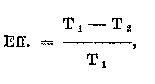
but so far as heat generated by muscular effort is concerned, the heat generated thereby must be removed in ordinary cases entirely by the surrounding atmosphere, the chief factors being the combination of coolness and dryness. In this the dryness plays the principal part.
The above represents an engineer's view of the basic principles involved in connection with atmospheric influence on manual efficiency in ultra-deep level mines, where the temperature is high and the air humid, especially so on the mines of the Rand, where, whether a mine is naturally wet or dry, the mining regulations compel such a profuse supply of water that the air underground as always saturated (or super-saturated). — E. J. Laschinger and A. L. Egan before the South African Institution of Engineers.
 |
 |
| Names mentioned in this article | |
 |
 |
| Name | Age | Occupation | Notes |
|---|---|---|---|
| Egan, A. L. | Mining Engineer | ||
| Laschinger, E. J. | Mining Engineer |




 Contains public sector information licensed under the

