


| Newspaper Articles |

|
Newspaper Articles |
 |
 |
11th February 1928, Page: 232, Column: 2
Coal Mining In India
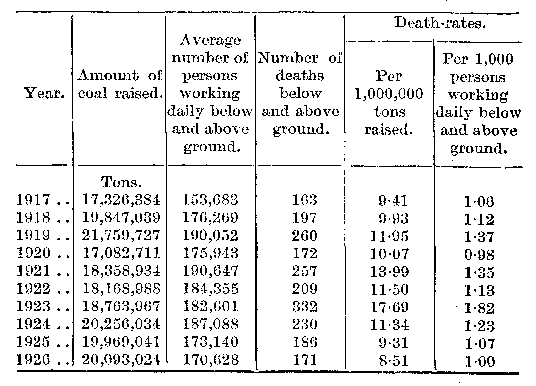
From the annual report of the Chief Inspector of Mines in India (Mr. R. R. Simpson, M.Sc), it would appear that in 1926 there were 170,628 persons employed at coal mines under the Indian Mines Act, which is 2,512 less than the number employed in the preceding year. Coalcutters numbered 41,770, male loaders 9,378, whilst females employed (chiefly loaders) numbered 35,607. In the coalfields of Bengal and Bihar and Orissa labour generally was sufficient for requirements, and wages were lower by an amount estimated to be from 10 to 15 per cent. The total coal output was 20,093,024 tons, which is 123,983 tons, or 0.63 per cent. more than in the previous year. The number of collieries using electric power increased from 108 to 111, and the aggregate horse-power employed at collieries increased from 52,336 to 54,548. The number of coal-cutting machines in use was 126 (increase 1), 109 being driven by electric power and 17 by compressed air. Of the machines, 66 were at work in the Jharia coalfield, 54 in the Raniganj coalfield, and 6 in the Central Provinces. The value of coal-cutting machines in the mining of coal is now fully realised, and during the year machines were installed in nine additional coal mines, although the depression in the trade led to the withdrawal, perhaps temporarily, of machines from six mines. There are now several mines from which the greater part of the output is obtained by means of coal-cutting machines. During the year 1,762,498 lb. of gunpowder, 269,742 lb. of high explosives and 73,656 lb. of "permitted" explosives were used at coal mines under the Act, comparing with 1,783,756 lb., 339,142 lb., and 54,972 lb. used in 1925.
The following table shows the amount of coal raised, the average number of persons working daily and the death-rates during the years 1917 to 1926 in respect of coal mines under the Indian Mines Act:—
 |
 |
| Names mentioned in this article | |
 |
 |
| Name | Age | Occupation | Notes |
|---|---|---|---|
| Simpson, R. R. | Chief Inspector of Mines in India |




 Contains public sector information licensed under the

