


| Newspaper Articles |

|
Newspaper Articles |
 |
 |
31st December 1927, Page: 178, Column: 2
Points From The Inspectors' Reports
Underground Haulage Accidents
During 1926 underground haulage accidents were responsible for the death of 131 persons at pits under the Coal Mines Act, 678 persons being "reported" injured whilst the total disablements for more than three days numbered 21,210. As stated by Mr. H. Walker, C.B.E., in his annual report as Chief Inspector of Mines, these haulage accidents stand second to falls of ground as the most fruitful source of accident, and the means of prevention of falls will be found to be the means by which many haulage accidents can be prevented. The Chief Inspector expresses the view that the conditions under which the work of haulage is done should be improved, and one means of obtaining improvement is by the use of steel arches for the support of roads. With improvement in the conditions under which haulage operations are performed and the more general and persistent use of the various contrivances for safety which are already well and widely known, his view is that a reduction of the number of accidents from this source can easily be attained.
In the Scotland Division, as reported by Mr. J. Masterton, twelve persons were killed and 53 were injured by reportable haulage accidents, the total number of persons disabled for more than three days being 2,355. He says that one feature last year was the number of fatalities on comparatively flat roads where one least expects such accidents. A fatality is described occurring to a miner on a haulage road the gradient of which was 1 in 69 in favour of the loaded tubs. The miner was passing between a train of empty tubs and the side wall, at the curve into this haulage road, when three loaded tubs which had run from an inbye lye arrived at the turn, jumped the rails and crashed broadside into the empty tubs, one of which crushed him against the wall and fatally injured him. No evidence could be obtained as to why the tubs should have run away from the lye and gained such speed on a road with such a low gradient, but the lesson is that tubs should always be properly secured by stop blocks in every siding, no matter how flat. Another accident is described in which a drawer left the working face with his last tub, followed two or three minutes later by another drawer, also with his last tub. The latter crashed into the first drawer. The conclusion of Mr. Masterton is that with ordinary care this accident and several more of the same class should not have happened.
The deaths due to haulage in the Northern Division numbered 17, and 90 persons were reported injured, there being 4,307 persons disabled for more than three days. A 14-year old trapper boy was fatally crushed in his hurry outbye at the end of his shift. He attempted to pass a moving pony-drawn set, although he had been told by the deputy to follow behind the set. This was only deceased's fourth shift underground, and Mr. T. Greenland Davies in his report indicates that in his opinion young boys, until they acquire experience and some "pit-sense," should not be allowed to travel outbye alone, but should be accompanied by some responsible person. The accident also demonstrates the necessity of maintaining a safe clearance between the tub and the sides of the roadway. Apparently the cause of the death of a loading lad aged 14 years was that he had not been properly trained in the right way to perform the simple operation of coupling tubs, whilst the death of a 15-year old pony driver when riding the limbers illustrates the necessity for a safe clearance between the tub and the roof, and also the danger always associated with a sudden decrease in the clearance. If there is to be a decrease in this class of accident, Mr. Davies is of the opinion that no boy should be permitted to ride on the limbers unless there is a safe clearance between the tub and the sides and roof in all parts of the roadway.
Underground haulage accidents in the Yorkshire Division caused 23 deaths, reportable injuries to 101 persons, whilst 3,951 were disabled for more than three days. The report shows that many unnecessary deaths occurred, and the Divisional Inspector, Mr. H. M. Hudspeth, says that riding — except possibly in an empty tub where there is plenty of road height — should be discontinued. The accidents which occurred during the year disclosed no new features. In most cases the remedies are obvious, and the observation of the Inspector is that there are no good reasons why the number of haulage accidents should not be very largely decreased. Persons ought to be protected against runaway tubs, and discipline in the mine should be such that persons will not ride.
Mr. Hudspeth says it is most encouraging to find managers closely interesting themselves in safety devices. He notes that a runaway tub catch (Ball's Patent) which can be used to arrest either "forward" or "backward" runaway tubs is now on the market. As a "forward" runaway arrester it operates only when a speed considerably in excess of the normal is attained. A feature of the appliance is that by reversing the rocking lever it can be used as a "jack catch" on gradients up which tubs are being hauled. Mr. W. H. Ball is the manager at Silverwood Colliery. Another contrivance, used by Mr. John Walker, the manager of Yorkshire Main Colliery, to arrest forward runaways, also depends upon the super-normal speed attained by travelling tubs throwing over a rocking lever which operates a pair of runaway points.
The North Midland Division underground haulage accidents in 1926 accounted fdr 18 deaths, 111 injuries reported to the Inspector, and 2,961 disabled for more than three days. These results, having regard to the reduced period of working during the year, are in the aggregate far from satisfactory. That is the verdict of Mines Inspector J. R. Felton, expressed in his annual report. Ten of the fatal and 56 of the non-fatal accidents 11 reported occurred to boys of 16 or under; 12 boys of 14 years Were killed or seriously injured. There are more "avoidable" accidents in the case of haulage, the Inspector declares, than under any other head, the percentage of such for the year being 72 for fatal and 69 for non-fatal accidents. It is apparent, therefore, that this class of accident presents the most promising field for improvement; nevertheless the figures remain practically stationary year by year. Mechanical (including self-acting) haulage showed the highest percentage of avoidable accidents, namely, 81 ; horse haulage had a percentage of 64, and hand haulage 63. The Inspector gives a table showing the causes of accidents, and says he is anxious that colliery officials should seriously consider the figures, and make a determined effort to improve the present unsatisfactory position. He suggests for the prevention of a large number of haulage accidents attention to the following points : (a) Prohibition of riding on full tubs or sets. (b) Provision of better haulage roads, particularly horse roads, (c) Less travelling on mechanical roads while tubs in motion, (d) More use of lockers or sprags — no tub should be left standing unsecured. (e) Use of second stop-block at top of inclines, and runaway switches or "jazz" rails. (f) Better lighting at clipping and unclipping places, (g) More careful training of boys for their duties.
Thirteen deaths, 65, reported injured, 2,276 disabled for more than three days. That is the record of haulage accidents underground last year in the Lancashire and North Wales Division, and Mr. A. D. Nicholson reports that the number of accidents from being crushed or run over by tubs is disproportionately high when the six or seven months' stoppage is taken into account. They are mostly due to neglecting to use efficient scotches and stop blocks, inadequate fencing of haulage wheels, and runaway tubs. Mr. Nicholson says the Inspectors have made a very determined effort to get the type of fencing for haulage pulleys and wheels improved, and those managers whose attention has been drawn to the matter have taken it up and dealt with it in a thorough manner. In connection with this important matter the Inspector gives two full-page illustrations of a type of fencing which has been introduced at several collieries, embodying the following most essential features : (a) It affords absolute protection to anyone working or passing near ; (b) it is easily taken down and as easily erected again. It may be constructed of wooden boards or sheet iron adapted to hook on to bars or the framework in which the wheels are set. The underside of the wheel is boxed in by two boards clipped on to the lower edges of the vertical hanging boards on all sides. When completed, the wheel is entirely boxed in, a small hole being left in two of the boards for the rope to pass through. When the lashing chains are not detached from the rope a larger hole is, of course, necessary, and an additional protection is sometimes necessary where the rope leads on to the pulley. In most collieries haulage wheels at curves on the haulage roads are usually of the same size and pattern, and Mr. Nicholson says it would tend in the direction of safety and improved fencing if, when haulage wheels were sent underground, a uniform type of fence on the lines suggested was regarded as part of them, and sent with them, instead of leaving the pusher-on or other haulage hand to erect a crude fence.
In the Cardiff and Newport Division the deaths numbered 24, persons reported injured 85, and disablements for more than three days 2,063. The Divisional Inspector, Mr. J. Macleod Carey, is glad to report that constant attention is given to the prevention of persons being upon the engine planes during the running of the ropes, and to acknowledge the willingness and anxiety of the managers to comply with his request to enforce better discipline in regard to the travelling backwards and forwards of the men in the mines, thus ensuring that, during such times, persons are not placed in jeopardy owing to the movement of the traffic. The Inspector then mentions that a certain number of accidents to riders and others are caused by trams becoming derailed at crossings and elsewhere, due, he is afraid in many instances, to badly laid tracks. Apart from the risk of accident due to such deficiencies, he says it must surely be a sound proposition from every point of view to put down a heavy and well-laid railway. Much time is wasted and many unnecessary risks taken, in re-railing trams which have become derailed owing to poorly laid tracks.
The neighbouring Division of Swansea had a record of 13 deaths, 57 persons reported injured, and 948 disabled for more than three days. The Inspector of this Division, Mr. W. J. Charlton, classifies all the fatal and 41 of the 55 non-fatal accidents as follows :—
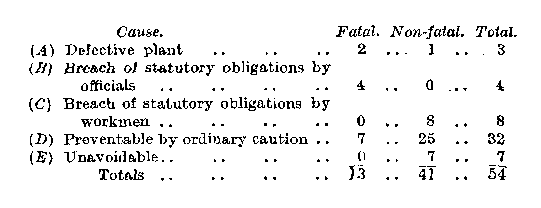
Stated as percentages of investigated accidents these were (A) 5½, (B) 7½, (C) 15, (D) 59, and (E) 13 respectively. Mr. Charlton says this last figure is small, and supports his decided opinion that most haulage accidents are preventable.
Haulage accidents underground in the Midland and Southern Division were the cause of 11 deaths, 110 persons being reported injured, and 2,309 disabled for more than three days. In the fatal and non-fatal accidents reported to the Inspector, 2 persons were killed and 1 injured while riding, and 3 persons were injured by going in front instead of behind tubs while moving them by hand on inclined roads. Mr. H. A. Abbott in his report discusses six of the fatal accidents. Scanning the accounts of these accidents the eye meets such phrases as (1) "it was a foolish thing to attempt"; (2) "if this had been done" ; (3) "an error of judgment" ; (4) "steps could have been taken in time," ; (5) "took the risk and paid the penalty" ; (6) "the direct outcome of a breach of Section 43 (2) of the Coal Mines Act."
 |
 |
| Names mentioned in this article | |
 |
 |
| Name | Age | Occupation | Notes |
|---|---|---|---|
| Abbott, Henry Arnold | H.M. Divisional Inspector of Mines | Whos Who Page | |
| Ball, W. H. | Colliery Manager | ||
| Carey, Joseph Macleod | H.M. Divisional Inspector of Mines | Whos Who Page | |
| Charlton, William John | H.M. Divisional Inspector of Mines | Whos Who Page | |
| Davies, Thomas Greenland | H.M. Divisional Inspector of Mines | Whos Who Page | |
| Felton, John Robinson | H.M. Divisional Inspector of Mines | Whos Who Page | |
| Hudspeth, Henry Moore | H.M. Divisional Inspector of Mines | Whos Who Page | |
| Masterton, John | H.M. Divisional Inspector of Mines | Whos Who Page | |
| Nicholson, Arthur Darling | H.M. Divisional Inspector of Mines | Whos Who Page | |
| Walker, Henry | H.M. Chief Inspector of Mines | Whos Who Page | |
| Walker, John | Colliery Manager |
 |
 |
| Related Articles | |
|
|
| Pub. Date | Article (Newspaper) |
|---|---|
| 08 Oct 1927 | Mines Inspectors' Reports For 1926 (The Science and Art of Mining) |
| 22 Oct 1927 | Points From The Inspectors' Reports, Statistical Record (The Science and Art of Mining) |
| 05 Nov 1927 | Points From The Inspectors' Reports, Explosions of Firedamp or Coal Dust (The Science and Art of Mining) |
| 19 Nov 1927 | Points From The Inspectors' Reports, Falls of Ground (The Science and Art of Mining) |
| 03 Dec 1927 | Points From The Inspectors' Reports, Steel Supports (The Science and Art of Mining) |
| 17 Dec 1927 | Points From The Inspectors' Reports, Shaft Accidents (The Science and Art of Mining) |
| 31 Dec 1927 | Points From The Inspectors' Reports, Underground Haulage Accidents (The Science and Art of Mining) |



 Contains public sector information licensed under the

