


| Newspaper Articles |

|
Newspaper Articles |
 |
 |
3rd December 1927, Page: 147, Column: 1
Electricity In Mines
The Report of H.M. Electrical Inspector of Mines for the year 1926 (H.M. Stationery Office, 4d. net), gives a table showing the extent to which electrical power is used at mines under the Coal Mines Act, 1911, in comparison with the preceding year :—
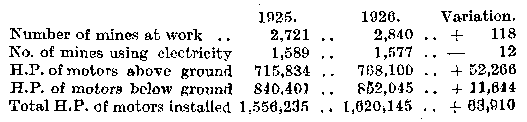
Mr. J. A. Bernard Horsley points out in his report that whereas in 1912 62 per cent. of the total horse-power installed was below ground, the proportion has now fallen to 52.6 per cent. There has been a relative increase in the horse-power of motors installed for winding and for miscellaneous services above ground, while all other services are relatively either stationary or recessive.
There are remarkable differences as between the different divisions under most headings ; haulage below ground being an exception, with an upper limit of barely 30 per cent. and a lower limit of rather less than 20 per cent. Winding has markedly greater application in the Newport and Cardiff area, while on the other hand electricity is practically excluded from the vicinity of the coal face in that area. Pumping, which in Yorkshire is at the lower limit round about 13 per cent., rises to over 35 per cent. in Scotland. Coal face machinery, which accounts for more than 16 per cent. of the total horse-power of motors installed in Scotland, is relatively insignificant elsewhere except in Division 4, where it accounts for over 10 per cent.
Three fatal accidents occurred at collieries, one life being lost in each instance. They were simple cases of electric shock. There was one instance of the ignition of firedamp by arcing in a trailing cable.
Referring to 37 notifiable non-fatal electrical accidents and dangerous occurrences of which 35 occurred at collieries, it would appear that 13 were attributable to defects of design or misapplication ; 5 to faults of maintenance; 10 to misuse or negligence ; 3 being unforeseeable.
Trailing Cables. — Under this sub-head the report informs that whilst the true flexible cable, with a cab-tyre or tough rubber sheath, still holds the field, and indeed is not likely to be improved upon for use with coal-cutting machines and for portable drills, where great flexibility is necessary, there is scope for another type of cable for other classes of coal face machinery such as conveyors. With such machines, which are not locomotive, but which have to be moved forward either daily or at longer intervals, a cable having relatively less flexibility suffices, provided it is sufficiently pliable to allow the surplus, which is necessary to permit the regular advance of the machines, to be coiled down, or to be otherwise conveniently stowed out of the way of traffic. Such pliable cables are actually in use at several collieries, notably at three of the pits owned by the Consett Iron Co., Ltd., in Durham, where nine lengths serving conveyors have been in operation since the end of 1925, and have given complete satisfaction. Internally these cables are exactly like an ordinary trailing cable, but in place of the outer layer of tough rubber there is a sheathing of stranded galvanised steel wires which serve as the earthing conductor for the apparatus, having the requisite (Conductivity for that purpose, and also provide a strong barrier of earthed metal between the live cores of the cable and the persons who have to handle it. Outside the stranded armouring there is a braiding of hard cord to check any tendency to bird cageing of the armour. At the Consett Co.'s pits the surplus length of cable is coiled in a figure of 8 on a light iron double bollard. To distinguish this type of cable from the ordinary armoured cable as used in the roadways of a mine, on the one hand, and from the true flexible cable which may have an internal sheathing of fine copper strand or braid, commonly known as a fer-flex braid, this new type may be aptly described as pliable armoured cable. Plug connectors at each end of the cable are unnecessary, and are not used by the Consett Iron Co. Instead, the cable is made off to cable dividing boxes, in which it can be properly sealed, and these boxes are bolted to the gate end or other terminal fitting oi the permanent cable at one end and to the machine at the other end. The hazard inseparable from the use of detachable plugs is thus eliminated, without the expense and complication of automatic electrical interlocks between machine and gate-end switch. For equal duty this cable is little, if any, larger than a plain cab-tyre sheathed flexible cable.
Electric Drill for Shotholes. — A handy and compact rotary electric drill has been tried out at several collieries during the year for putting shotholes into the coal. It is used single-handed, the weight of the machine being 25½lb. The three-phase squirrel cage motor rated at ¾ horse-power, and designed for 125 volts, 50 cycles, runs at 2,800 revolutions per minute, and drives a hollow drill spindle through double spur gearing at 320 revolutions per minute. The control switch is fitted in one of the two lug handles and a small four-core C.T.S. flexible cable and connector, which carries the current to the drill from a transformer rated at 1 kilowatt 600/125 volts three-phase, allows the operator freedom of movement. In actual trial at Cannock Chase Colliery by colliery workmen, holes to a depth of 4 feet, which necessitated a change of drills halfway, were put into a strong measure at the rate of 2 feet per minute. The machine is designed to be flame-proof. An exemption was sought and obtained from the Secretary for Mines, as provided for by Regulation 137 (a), permitting the use of a suitable type of flexible cable with four cores, each having a sectional area of 0.0033 square inch.
Statistical and other information is given showing that the number of electrically driven machines appears to be becoming stabilised round about 7/16 ths of the total number of machines of the disc, bar and chain types. It is also evident that machines of the chain type are steadily displacing those of the disc and bar types, for they now represent 60 per cent. of the totalnumber, excluding percussive drills, whereas in 1917 they represented 28 per cent. of that total. Percussive air drills are barely holding their own, for although they have increased 70 per cent. in number since 1917, they now represent substantially the same proportion, viz., 33 per cent. of all machines in use, that they did at the beginning of the decade.
In the Scottish division dependence upon machine mining and the relative use of electricity in that service are much greater than in any other part of the British coalfield. If the results of the three years working are summarised the following comparison can be made :—
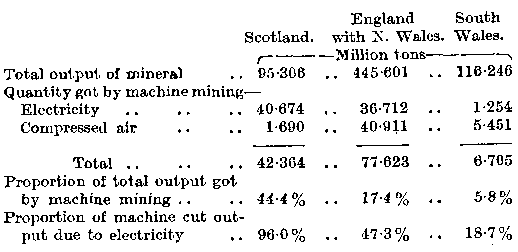
Taking the figures for the year 1926, out of a total of 3,114 electrical machines, 1,446, or 46½ per cent. are in use in Scotland. Disc and bar machines are chiefly used in Scotland, and chain machines are relatively predominant elsewhere. Percussive drills, for which there is no satisfactory electrical equivalent, are chiefly used on the North-East Coast and in Lancashire. Although percussive drills are well established in Yorkshire their numbers in that area are not increasing.
 |
 |
| Names mentioned in this article | |
 |
 |
| Name | Age | Occupation | Notes |
|---|---|---|---|
| Horsley, James Arthur Bennett | H.M. Electrical Inspector of Mines | Whos Who Page |




 Contains public sector information licensed under the

