


| Newspaper Articles |

|
Newspaper Articles |
 |
 |
19th November 1927, Page: 136, Column: 1
Points From The Inspectors' Reports
Falls of Ground
In his annual report as Chief Inspector of Mines, Mr. H. Walker, C.B.E., says that falls of roof and side continue to account for more than half of the fatal accidents in mines. Innumerable pages have been written on this subject and innumerable suggestions made, but the progress made towards a lessening of the number of accidents can only be described as disappointing and disheartening. Mr. Walker indicates that the question of support is resolving itself into one of materials rather than methods. In this connection he refers to the benefits, not only from the safety point of view, but also from that of economy, to be derived from the use of steel arches for the support of roads and steel props for the support of working places. Mr. Walker says "the benefits are either not known or are not appreciated by most of those who own and manage mines. Either there is a lack of initiative on the part of agents and managers, or owners are not willing to provide funds with which to purchase steel supports. The first cost is greater than that of timber but is repaid many times over within a year or two."
In the Divisional reports are many references to steel supports, and these will be brought before the notice of readers in a future contribution, attention at present being devoted to the more immediate question of falls of ground.
Scotland Division.
Last year in this Division there were 41 persons killed, 103 injured in reportable accidents, and 2,725 disabled for more than three days from falls of roof and side. Falls of roof and side either at the working face or on roads are always the cause of most of the accidents underground. Typical cases are described by Mr. J. Masterton in his report.
In one a miner was taking down machine holed coal on the face when a stone fell from between two roof breaks 2 feet 6 inches apart and killed him. Three back-heeled straps each with a single prop nearer to the waste than the roof breaks were broken off near the props by the stone. The Inspector says straps are of little value as supports unless properly set up with props under each end, and where the prop cannot be set up next the coal face till the coal-cutting machine has passed, the straps should be needled into the coal and props set there immediately the machine has passed.
In another accident a repairer and his son were preparing to set a crown tree to replace a broken one on a haulage road when a fall of roof occurred at the broken crown tree and caught the senior repairer. If even one temporary prop had been set to the broken crown tree, the report says the accident would not have occurred, as there was little evidence of weight other than that already resting on the defective timber.
Northern Division.
Mr. T. Greenland Davies gives a table showing that there were 50 deaths, with 128 persons injured in reportable accidents and 4,183 disabled for more than three days as a result of falls. Of the fatal accidents he mentions that 2 per cent. can be attributed to neglect on the part of officials, 11 per cent. to neglect on the part of workmen, and over 10 per cent. might have been prevented by the exercise of ordinary caution.
Mr. Davies expresses the opinion that close systematic timbering, rigidly enforced under all classes of roof, is the only way to reduce the appalling loss of life from falls of ground in mines. He most strongly advocates the more liberal use of planks and bars in the faces and on roadways near the face where coal filling into tubs is carried on, and emphasises the necessity to support properly such planks and bars at each end. He would like to see the practice of a centre single prop under bars abolished except only as a temporary expedient to allow of the proper setting of the end props. Some managers are adopting the practice of posting the timbering rules for the particular seam or seams at the meeting stations below ground, in addition to the surface, with very good effect.
Some of the accidents from falls are reviewed showing that obvious risks were taken and instructions not carried out, two of the fatalities occurring to workmen of ripe experience which could have been avoided if the safety appliances which were provided for the safe withdrawal of timber had been used.
Yorkshire Division.
In this Division 43 deaths, 155 persons reported injured, and 5,142 disabled for more than three days constitutes the record of falls last year.
Mr. H. M. Hudspeth directs attention to the report on the Support of Underground Workings in the East Midland Coalfield. One recommendation he says applies particularly to the new mines in the Yorkshire Division; "In all mines the more experienced men should have responsibility and authority to guide other workers as to the safe working of the stall." He adds that this obviously applies to working places in which several workmen are engaged at the same time, and it is clear that a youth having the minimum of experience required by Section 73 of the Coal Mines Act cannot be expected to share equally in the responsibility for working a stall with those men of mature experience.
The Inspector is satisfied that a reduction of accidents from falls of ground will not result until the lessons learned from past experience are applied. He recalls that in 1906 Mr. (now Sir) W. Walker pointed out that irregular and spasmodic advance of coal faces was conducive to a high accident rate, and that the speed of advance of the faces was too slow, the more frequent use of bars being recommended. Mr. Hudspeth adds that these observations hold good to-day. He classifies 12 accidents under rates of advance : 8 occurred where the rate was not over 2 yards a week; 2 occurred where the rate was over 2 but not over 2½ yards per week ; 1 occurred where the rate was over 2½ but not over 3 yards per week ; 1 occurred where the rate was over 3 yards per week.
Slow rates of advance are generally not associated with machine mining. The slower the rate of advance the better should be the timbering, and the greater the need for the use of bars.
North Midland Division.
Falls of ground in this Division caused the death of 44 persons, 159 persons were reported injured, and 4,860 were disabled for more than three days.
Mr. J. R. Felton, in his report, says it is impossible to review the results without feeling a keen sense of disappointment. He also refers to the report of the Support of Workings in Mines Committee, and hopes the recommendations made therein will be carefully studied by all managers in the Division, and discussed with their officials and representatives of the workmen, and that they will lead to much greater efforts being made than hitherto to deal with this question. Chief among the recommendations noted are the more general adoption of self-adjusting steel props, the extended use of bars, the greater use of lagging and forepoling over bars at the working face, and stricter discipline in regard to timbering.
The Inspector again appeals for a more extensive use of the "Sylvester" type of appliance instead of the ringer and chain, adding : "It is generally agreed that the Sylvester is a much safer and better appliance than the ringer and chain for the purpose of withdrawing timber from the wastes, since a much greater pull can be applied with it and the necessity for cutting props before withdrawal materially reduced ; the process of replacing the ringer and chain by the Sylvester is, however, a remarkably slow one. This is apparently due to the fact that the men themselves in most cases have to provide the safety appliance, hence they not unnaturally purchase the ringer and chain which is the cheapest type they can obtain. The management usually provide one or two Sylvesters for each district, but a stallman cannot reasonably be expected to send round the district for a Sylvester, and perhaps wait a long time before it arrives, when he has timber to withdraw. Sylvesters ought to be provided by the owners in large numbers and their regular use enforced ; this would certainly be in the interests of safety."
Other points are raised by the Inspector, including the need of seriously considering the adoption of some alternative means to that of cutting props by a pick or axe to loosen them, and he leaves the subject of falls by quoting from the report of the Committee mentioned above : "It should be considered unpitmanlike and almost a crime to neglect the timbering of the working places to draw timber without using proper appliances, or not to take other rudimentary precautions."
These words, concludes Mr. Felton, should be printed in bold type and conspicuously displayed at every mine.
Lancashire and North Wales Division.
In this Division the record from falls was 37 persons killed, 97 reported injured, and 3,012 disabled for more than three days.
Practically 75 per cent. of the accidents from falls occurred at the working face. The Inspector, Mr. A. D. Nicholson, says that 14 per cent. of the fatal accidents and 8 per cent. of the nonfatal accidents were the result of the non-observance of the spragging and timbering rules, adding that greater care and better judgment would have probably prevented 6 per cent. of the fatal and 34 per cent. of the non-fatal accidents. Out of 26 fatal accidents at or near the working face, five deaths could have been prevented by using safety contrivances for withdrawing timber. In all these cases such an appliance, if not actually on the spot, could have been obtained in a minute or so.
Amongst the accidents described by the Inspector, was one proving fatal to a dayman, a fall of roof occurring while knocking out a prop with a hammer. No instructions had been given by the fireman when he previously visited the working as to removing timber. There were, however, four Sylvesters in the district. The accident could probably have been prevented by setting a temporary support.
Cardiff and Newport Division,
The deaths from falls numbered 47, there were 142 persons reported injured, and disablement cases numbered 5,200 in this Division. Mr. T. Macleod Carey is more convinced than ever that the solution, or the partial solution, of the problem of the prevention of accidents of this nature will be found in the systematic and complete stowing of the gobs.
It is noticeable, he says in his report, how often the presence of a small fault crossing the roadway near the face Causes, during ripping operations, the roof to collapse along the line of the fault. Careful examination will reveal such points of weakness and the necessary precaution taken in time might obviate an accident. By far the largest proportion of the fatal falls of roof occurring in this district are caused by unseen slips in the roof bedding — slips which are not usually seen until after an accident. Mr. Carey appreciates the great difficulty in detecting such weaknesses, but believes that a certain number of these fatalities might be avoided if there were always a thorough and systematic examination of the roof before ripping operations were commenced, both by the officials and the workmen concerned.
He says it should be the unwritten law of every person — "No Risks Shall be Taken," and like all laws it would become second nature.
Swansea Division.
Thirty-two persons were killed by falls, 72 were reported injured, and 1,964 were disabled for more than three days in this Division.
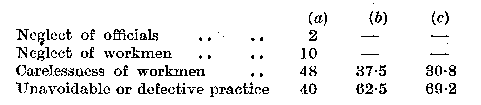
All the more serious accidents were investigated, and Mr. W. J. Charlton has classified them in an attempt to apportion responsibility for their occurrence. The percentages (a) at the face, (b) on roads while repairing or enlarging, (c) on roads while otherwise working or passing, are thus given :—
Amongst others described, Mr. Charlton mentions that two young men were killed on the delivery road from a face conveyor. The road extended forward to another face, which was in advance, and hence on one side there was solid coal, while on the other there was a road pack. The rib side was an obvious line of weakness, particularly near the following on conveyor face, and this danger was badly guarded against in that the roof was not supported close to the side, but by a row of props 6 feet from it. A party of five persons were sitting having food just inbye of the face conveyor, when a panel of stone, 7 inches thick, fell without warning from between the row of props and the coal. Two of these persons were caught by the fall and killed instantly. After the accident a new mode of support was adopted — a row of props being kept along the rib side.
Midland and Southern Division.
The report for this Division shows that falls were responsible for 34 deaths, 131 persons reported injured, and 2,889 disabled for more than three days. Falls caused 63 per cent. of the total of underground fatal accidents and 48 per cent. of all the underground accidents. Of the falls, 81 per cent. of the fatal and 78 per cent. of the fatal and non-fatal accidents occurred at the coal face.
The Inspector (Mr. H. A. Abbott) describes some of the accidents from falls which present features of special interest and contain important lessons. In connection with one of them he says : "Two colliers were engaged building a pack, which had reached a height of 2 feet 3 inches, in the waste at the coal face, the height of the working place being 4 feet 6 inches. Two props had been withdrawn from the front of the last pack three days previously. One of the men knocked the lid off a prop in the back row with his axe and liberated a large stone, one end of which was resting on the lid. He was struck by the falling stone and killed instantaneously. No attempt should have been made to draw the prop until the pack had been built to within a few inches of the roof ; a contrivance such as a 'Sylvester' should then have been used for withdrawing the prop. Such a contrivance was provided, and close at hand. The stone that fell was bounded by weight breaks. Careful examination (which includes sounding) of the roof would have revealed the weak portion which fell. Delayed packing also contributed materially to this accident. Temporary supports had not been erected, and therefore Section 52 (1) of the Coal Mines Act was contravened. Section 52 (2) also was contravened in that an attempt was made to withdraw a prop without first getting the fireman's consent and direction as to method Of withdrawal."
 |
 |
| Names mentioned in this article | |
 |
 |
| Name | Age | Occupation | Notes |
|---|---|---|---|
| Abbott, Henry Arnold | H.M. Divisional Inspector of Mines | Whos Who Page | |
| Carey, Joseph Macleod | H.M. Divisional Inspector of Mines | Whos Who Page | |
| Charlton, William John | H.M. Divisional Inspector of Mines | Whos Who Page | |
| Davies, Thomas Greenland | H.M. Divisional Inspector of Mines | Whos Who Page | |
| Felton, John Robinson | H.M. Divisional Inspector of Mines | Whos Who Page | |
| Hudspeth, Henry Moore | H.M. Divisional Inspector of Mines | Whos Who Page | |
| Masterton, John | H.M. Divisional Inspector of Mines | Whos Who Page | |
| Nicholson, Arthur Darling | H.M. Divisional Inspector of Mines | Whos Who Page | |
| Walker, Henry | H.M. Chief Inspector of Mines | Whos Who Page | |
| Walker, William | H.M. Divisional Inspector of Mines | Whos Who Page |
 |
 |
| Related Articles | |
|
|
| Pub. Date | Article (Newspaper) |
|---|---|
| 08 Oct 1927 | Mines Inspectors' Reports For 1926 (The Science and Art of Mining) |
| 22 Oct 1927 | Points From The Inspectors' Reports, Statistical Record (The Science and Art of Mining) |
| 05 Nov 1927 | Points From The Inspectors' Reports, Explosions of Firedamp or Coal Dust (The Science and Art of Mining) |
| 19 Nov 1927 | Points From The Inspectors' Reports, Falls of Ground (The Science and Art of Mining) |
| 03 Dec 1927 | Points From The Inspectors' Reports, Steel Supports (The Science and Art of Mining) |
| 17 Dec 1927 | Points From The Inspectors' Reports, Shaft Accidents (The Science and Art of Mining) |
| 31 Dec 1927 | Points From The Inspectors' Reports, Underground Haulage Accidents (The Science and Art of Mining) |



 Contains public sector information licensed under the

