


| Newspaper Articles |

|
Newspaper Articles |
 |
 |
19th November 1927, Page: 133, Column: 1
Impinger Method Of Sampling Atmospheric Dust
By Alden H. Emery.
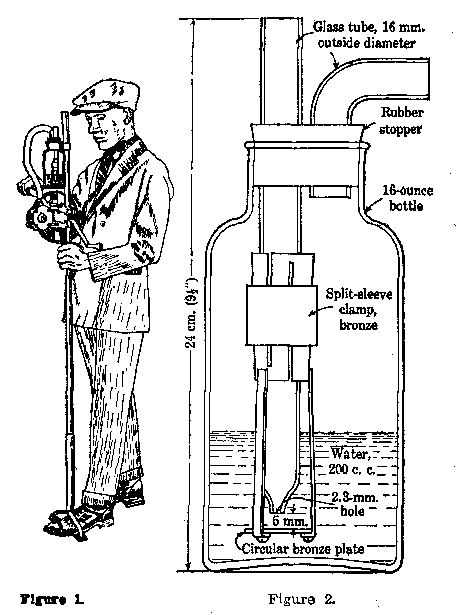
The apparatus for sampling atmospheric dusts, as developed in the laboratories of the Bureau of Mines, and described in Circular No. 6048, consists of a collapsible stand carrying a portable, hand-operated suction pump connected by means of rubber tubing to the impinging device inserted in a sampling bottle. (See Figure 1.) Suction is supplied by a small rotary-vane pump made as light as possible. This should be calibrated at intervals against an accurate gas meter to obtain the ratio between the number of revolutions per minute and the number of cubic feet of air drawn through the apparatus. The practice has been to use that rate of speed which will draw 1 cubic foot of air a minute against the resistance of the impinger. The impinging device (see Figure 2) consists of a ½-inch glass tube, 8 inches in length, drawn down sharply at one end to an orifice 2.3 millimetres in diameter. A 1-inch bronze disc is supported 5 millimetres from the end of this tube. The whole device is inserted in a 2-hole rubber stopper, in the other opening of which is a short glass tube of the same diameter connected to the suction pump with a rubber hose. A 16-oz. wide-mouth laboratory bottle taking a No. 8 or 9 rubber stopper is used. In this 150 to 200 c.c. of liquid is placed and the impinger inserted, extending nearly to the bottom. When suction is applied, the dust-laden air is drawn in through the glass tube, the dust impinges on the wet brass plate at the bottom at high velocity and floats off in suspension in the surrounding liquid.
Preparation of Apparatus. — Care should always be taken to see that the impinger pump is in good mechanical condition before sampling. Small defects will considerably increase the effort expended. It is therefore advisable in preparation for field work to take the pump apart and carefully clean it with some solvent such as gasoline or benzene, which will remove all dirty oil. After assembly, the parts should be adjusted until the pump operates smoothly. A light machine oil should be used after cleaning and frequently during use. After such overhauling, a new calibration curve should be made. The accuracy of the gas meter selected as a standard will control the accuracy of the calibration. It is suggested that a 5 light, dry, test meter for gases be used. This is attached to the intake side of the impinger (which contains the usual amount of collecting liquid). It is then calibrated at different rates of rotation in order to ascertain the speed (usually about 80 r.p.m. of the handles) required to draw one cubic foot of gas per minute. The time for each speed should be accurately noted and the results plotted. From these data it can easily be determined at what speed the pump must be operated to draw the desired amount of air at the determined rate.
Selection of Sampling Points. — The selection of the point of sampling is important. In general, each sample should be planned to give some definite piece of information or data pertinent to the study or investigation. If the purpose is to determine the dust breathed by a man under definite working conditions, the sample bottle, equipped with an extension hose, should be held by an assistant as near the nose of the worker as possible. If it is in a ventilation current the bottle should be moved about to traverse the entire cross-section. If information is desired regarding the dust raised by some single operation, caution should be exercised to see that no other operations affect the dust produced. For example, a sample collected in a mine during dry drilling alone means more for comparison than one taken while men are drilling both wet and dry or with ore being shovelled in the vicinity. In any case, a full report of the conditions surrounding the collection of the sample should be reported to the laboratory.
The period of sampling varies in relation to the concentration of dust in the atmosphere; 15 minutes is necessary for ordinary dusty-air. The more dust present the shorter the sampling period, and the lower the concentration the longer the sampling period. The correct balance between concentration and period of sampling can only be obtained by experience. After sampling, the impinger should be removed from the bottle, first agitating in the liquid to prevent dust from adhering to the tubes. This movement of the liquid can be induced by shaking and if necessary, gentle blowing through the dust intake side of the impinger. The stopper is quickly inserted and the bottle sealed and packed for return to the laboratory. Bottles should be shipped promptly to the laboratory. All information available in regard to the conditions under which samples were collected should be submitted at the same time. Prompt shipment lessens danger from deterioration (mainly through solubility) and gives the laboratory more time to arrange for making analysis in event other work is in progress.
 |
 |
| Names mentioned in this article | |
 |
 |
| Name | Age | Occupation | Notes |
|---|---|---|---|
| Emery, Alden H. |




 Contains public sector information licensed under the

