


| Newspaper Articles |

|
Newspaper Articles |
 |
 |
16th July 1927, Page: 405, Column: 1
Explosibility Of Coal Dust
Technical Paper 386 of the U.S. Bureau of Mines gives the results of tests on the "Explosibility of Coal Dust from Four Mines in Utah," and has been prepared by H. P. Greenwald. In the Preface Mr. George S. Rice, the Bureau Chief Mining Engineer, says :—
Representative Mines in Utah.
"The Bureau of Mines, in its investigations of the prevention of mine explosions, studies the relative hazard of explosion in typical coal mines in different parts of the country. After the disastrous explosion which killed 172 men at the Castlegate mine in Utah on March 8th, 1924, the question arose of the adequacy of the preventive methods used in that district. The Bureau of Mines had not then tested the explosibility of coal dust from beds mined in Utah. Because of the question as to preventive methods it seemed desirable to make tests to determine whether the Utah coal dust was more explosive because of its high content of volatile combustible, including resinous matter, than dusts tested from eastern mines, and whether the percentages of rock dust found necessary by tests of eastern coals would be adequate for Utah mines. Before the explosion disaster at Castlegate, rock-dusting had not been used in Utah mines, but watering had been employed since the Winterquarters mine disaster in 1900, which killed 200 men. The watering was perhaps done more systematically than in mines in any other part of the country. State regulations required water lines to be laid to the face of all workings and the workings to be washed down regularly. Although there had been some small explosions between the Winterquarters and the Castlegate disasters, none had been serious enough to shake the confidence of the Utah mining officials in the efficacy of the watering method.
"In the mines of the Book Cliffs field the conditions that affect explosions hazards are severe, possibly worse than in any other coal-mining district in the country. The principal bed mined is 7 to 24 feet thick and is high-volatile coal, virtually free from partings carrying impurities. The roof in most of the workings is strong massive sandstone, sandy shale, or coal, and the floor is hard sandstone or shale. Hence impurities do not get mixed with the coal to any extent in mining and loading. Usually in the entries a coal roof is left, and any coal that falls from the roof or ribs or drops from cars is ground to dust on the hard floor. It has been the common practice to pile the cars high above the sides with coal, resulting in much coal being spilled along the roadways, where it is ground under the wheels. As the coal is clean, this road dust is almost pure coal and is very explosive. Watering tends to lay the dust, but, as is well known, it is extremely difficult to keep coal dust wet in a region of naturally dry air where ventilation currents evaporate the water and continually carry out large amounts as vapour.
"After the Castlegate explosion the State officials conferred with the mine operators and then issued special orders which required rock-dusting in the intake roads, the use of water on the cutter bars of machines in the faces, and the washing down of faces by hose. As a result of watering at the face, the air in the returns is humid and tends to moisten rock dust so that it will not rise in a cloud if an explosion occurs. For protecting the returns the State requires the use of rock-dust barriers. On the main intake roads the ribs and any timbers present are generally well rock-dusted, but the floor, especially between the rails, becomes covered with coal dust so rapidly that spraying the floor from tank cars was tried, although dry rock dust had been applied to the ribs and sides of the entry.
"In addition to the dust hazard, another factor of danger in the Castlegate district is that firedamp is encountered as the mine workings extend farther below the surface. Small percentages of firedamp increase the explosibility of dust mixtures, and it was desirable to determine the effects on Utah coal dust and rock dust mixtures. The mine operators desired to know the adequacy of the methods being employed for preventing explosions, as well as the relative explosibility of their dust, so a railroad car was carefully loaded with coal samples from four typical mines. This coal was furnished and sent to the Bureau of Mines jointly by certain operators and the tests described in this paper were made with the dusts ground from the four large samples. Although coals from only four mines were tested, the mines chosen for test are widely separated, but have much the same natural conditions, and are believed to be representative of general conditions in the Book Cliffs field."
Proximate Analyses of Dusts.
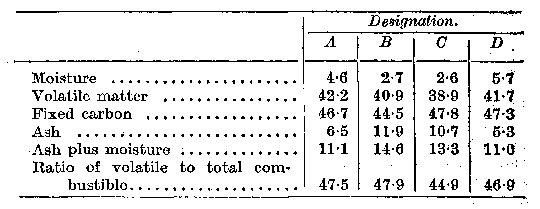
The four coals tested are designated in the report as A, B, C, and D. The proximate analysis of a coal ordinarily has been used in correlating the explosibility of various coals. The average proximate analyses of the coal dusts as prepared for the tests are as follows :—
Results of Tests.
The results of the tests of the four Utah coals and the conclusions drawn therefrom may be summarised as follows :—
1. The four coals, A, B, C, and D, required 67, 66, 65, and 62 per cent. respectively, of rock dust in a mixture to prevent the continuance through them of a developed explosion in the absence of gas. The total incombustible content of these mixtures was 71, 71, 70, and 66 per cent. respectively, which includes the inherent moisture and ash of the coal.
2. Additional rock dust must be present when there is gas in the air-current. For each per cent. of gas present up to 5 per cent. there must be 7 per cent. of additional rock dust with coals A, B, and C, and 8 per cent. with coal D, to prevent continued propagation of a well-developed explosion, such as might originate from a gas explosion at the face of an entry.
3. It follows that with 1 per cent. of gas present the amount of shale dust present must be 74, 73, 72, and 70 per cent. respectively, for coals A, B, C, and D.
4. When a weaker source of ignition, such as a blown-out shot of 4 pounds of black blasting powder, is used, a smaller amount of rock dust is required in the mixture.
5. Preventing direct ignition of the mixed dust from a blown-out shot of 4 pounds of black blasting powder in the absence of gas required 30 per cent. of rock dust in the mixture of coal C, 35 per cent. with coal D, and 40 per cent. with coal B. A determination was not made with coal A, but 40 per cent. of rock dust would probably be enough.
6. For each per cent. of gas in the air-current an additional 12 per cent. of rock dust for coals A and B, 13 per cent. for coal D, and 14 per cent. for coal C will be required to prevent direct ignition of the dust from a blown-out shot of 4 pounds of black blasting powder.
7. There is a maximum amount of water that coal dust will absorb when wet; it was found to be 20 per cent. with coal C, and this figure can be used for all four coals.
8. Mixtures containing 20 per cent. of added water propagated explosions in three of six trials. When the dust was ignited by an explosion of gas, the coal-dust explosion was violent and destructive.
9. Twelve per cent. of added water prevented the ignition from a blown-out shot of 4 pounds of black blasting powder, in the absence of gas, with all the coals except coal A, for which no such determination was made.
10. The number of gas tests with wet dusts was small, but a mixture of coal C containing 16 per cent. of added water failed to ignite with 2 per cent. of gas in the air-current.
11. When there is a strip of more or less pure coal dust on the floor in the centre of the entry (as from spillage) this strip must receive special consideration. Well rock-dusted ribs will not take care of it, and unless rock dust can be placed on overhead timbers or projections extending entirely across the entry the centre strip must be separately treated.
12. The centre strip required a minimum of 10 per cent. of added water in the few tests made and the rock-dusted parts should be kept above the limit determined in the standard tests.
 |
 |
| Names mentioned in this article | |
 |
 |
| Name | Age | Occupation | Notes |
|---|---|---|---|
| Greenwald, H. P. | U.S. Bureau of Mines | ||
| Rice, George S. | U.S. Bureau of Mines |




 Contains public sector information licensed under the

