


| Newspaper Articles |

|
Newspaper Articles |
 |
 |
16th July 1927, Page: 404, Column: 1
Live Electrical Conductors
Danger During Examination and Test
A circular letter signed by Mr. H. Walker, H.M. Chief Inspector Of Mines, and emanating from the Mines Department, has been addressed to the owners, agents and managers of mines, relating to the danger from live electrical conductors during examination, test and repair.
It is pointed out that every year there are a number of mine accidents (some of them fatal) by electric shock from apparatus or cables which are being examined, tested or repaired. Every one of these accidents could be avoided if the essential importance of the requirements of General Regulation 131 (g) were more effectively recognised.
That Regulation requires first, that electrical conductors shall be discharged before they are handled and, secondly, that suitable means shall be taken to prevent them from again becoming charged so long as the work is in progress which necessitated their isolation and discharge.
Discharge of the Electrical Conductors. — While it is generally realised by electricians that it is necessary (more particularly on high pressure circuits) temporarily to earth a conductor after switching off in order to remove the residual or electrostatic charge, it is not by any means common to find that suitable means have been provided to effect this discharge safely. The practice of "flicking" contacts or conductors that are assumed to be dead with a piece of cable held in the hand in order to discharge them is not safe and should be prohibited.
Precautions Against Accidental Recharging. — (a) High pressure circuits: It is not sufficient to remove the residual charge by earthing the conductors momentarily. They may be recharged by leakage or by the closing of a distant switch.
The conductors should therefore be kept at earth potential until the work in hand is finished. This precaution should never be omitted on high pressure circuits. (b) Low and medium pressure circuits. — Upon single circuits at low pressure, or medium pressure, it may be necessary to prove that the circuit is dead by earthing it but it is generally necessary to ensure that the circuit shall not be accidentally recharged. Where there is no constructional provision in the switchgear for earthing the conductors, the precautions may consist in locking the switch at the origin of the circuit in the off position and arranging that the key shall remain in the possession of a person responsible to the management for the work in hand, until the work is completed for the time being.
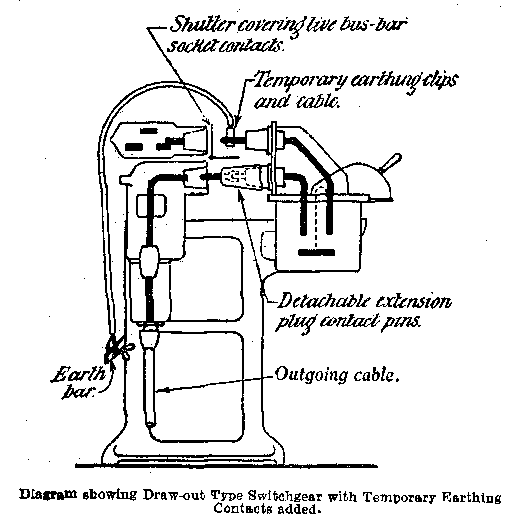
Suggestions for Constructional Provision in Switchgear. — (a) Principle advocated: The principle advocated is that the circuit shall be earthed through the circuit-breaker so that if by any mischance the circuit is alive from the distant end the operation described is merely the equivalent of a short-circuit on the line and the circuit-breaker will trip without danger to the operator if it is adequate for dealing with such a fault, (b) Application to draw-out type switchgear: Where switchgear of the draw-out type is installed, detachable extension contact pieces are plugged on to, and thus lengthen, the circuit terminals of the circuit-breaker after withdrawal from the pedestal base. An earthing clip is attached to the other, or bus-bar, terminals of the circuit-breaker which is then pushed back until the circuit contacts engage with the base. The circuit is then put to earth through the circuit-breaker by switching on. The method is illustrated on the attached diagram, (c) Application to other types of switchgear: In the case of fixed switchgear of the cubicle or panel type an isolating switch or isolating links having a third position in which the circuit is put to earth should be introduced between the circuit-breaker and the source of supply.
Whatever the means may be a proper routine should be established and enforced by adequate supervision.
 |
 |
| Names mentioned in this article | |
 |
 |
| Name | Age | Occupation | Notes |
|---|---|---|---|
| Walker, Henry | H.M. Chief Inspector Of Mines | Whos Who Page |




 Contains public sector information licensed under the

