


| Newspaper Articles |

|
Newspaper Articles |
 |
 |
2nd July 1927, Page: 385, Column: 1
Modern Carbonising
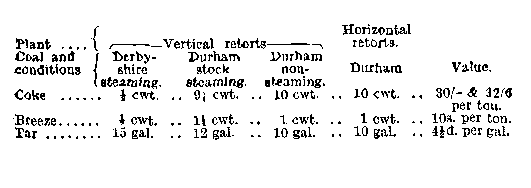
Mr. Thos. Carmichael, in the course of a paper before the Institution of Gas Engineers, summarised some recent experiences of the Portsmouth Gas Co., in the carbonisation of coal. He stated : The elimination of the dust and fines from the unscreened coal as received was commenced in December, 1922, and the anticipated results from the use of screened and partially screened Durham coal have been fully realised. In using the larger coal in the one installation of vertical retorts, improvement has been found in every direction, the actual increase in the thermal output of the coal being 10 per cent. and of the plant 20 per cent., and less sticking of the charge has been experienced. The production per ton of coal carbonised rose from about 62 therms with the Unscreened cdal to 69.1 With the screened cdal, while in the horizontal house the total therms evolved from the smaller grade of fuel dropped only to 68.8 per ton as compared with 70.2 from the unscreened variety. When the thermal output of the plant is also taken into consideration, the improvement is more marked. Thus the output of one bed of vertical retorts rose from 860 to 1,032 therms per day, while, owing to the large proportion of fines in the unscreened coal, the output of the horizontals was practically the same with the through coal. From the experience gained since 1922, it is unquestionably good carbonising practice, where continuous verticals and horizontals are in existence and where the principal supply of coal contains a large percentage of fines wholly or partially to screen the coal for use in the vertical retorts, and to carbonise the smalls in horizontal retorts. A further conclusion from these experiments is that, with the exception of coal — particularly swelling coal — containing a high proportion of dust, there are few coals, if any, that cannot be carbonised satisfactorily in vertical retorts. Coal dust is a bad conductor of heat; and this renders a dusty coal anything but the most suitable for vertical retorts and steaming. There is a falling-away in such cases from the high standard of efficiency realised with vertical retorts and steaming when using a coal comparatively free from fines. Screening of coal offers a further advantage, for as a general rule it is found that the coke resulting from the carbonisation of screened coal in vertical retorts has an appreciably lower ash content than that from the screenings treated in horizontals. The following figures illustrate this point :— (1) Screened Durham coal in vertical retorts: Ash in coal (dry basis) 9.2 per cent., ash in screened coke (dry basis) 11.6 per cent.; (2) Durham screening in horizontal retorts: Ash in coal (dry basis) 13.2 per cent., ash in screened coke (dry basis) 16.3 per cent. An average proximate analysis (wet basis) of Durham gas coal as received is : Moisture, 2.7 per cent. ; ash, 10.2 per cent. ; volatile matter, 30.1 per cent. ; sulphur, 2.3 per cent. The cost of coal, plus handing costs, is 31s. 6d. per ton for Derbyshire coal, and 25s. 3d. per ton for a good quality Durham, in each case into store. The yields and values of the residuals are as under :—
 |
 |
| Names mentioned in this article | |
 |
 |
| Name | Age | Occupation | Notes |
|---|---|---|---|
| Carmichael, Thomas |




 Contains public sector information licensed under the

