


| Newspaper Articles |

|
Newspaper Articles |
 |
 |
18th June 1927, Page: 378, Column: 1
Firedamp Detectors*
By Colin McLuckie, Dip.R.T.C., M.I.Min.E.
(Concluded from page 363.)
Electrical Devices.
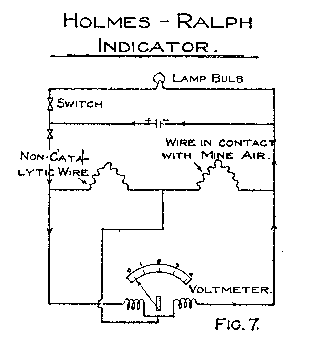
Ralph in 1910 invented an electrical device for the detection of CH4 in mine air, and had the same mounted on an electric hand lamp, the accumulator for the lamp serving to operate the indicator. Figure 7 is a diagram showing the connections. The chief drawback to an instrument of this description is the change that is liable to take place in the wire exposed to the air. It appears that the resistance of this wire is liable to change and to upset the calibration of the instrument.
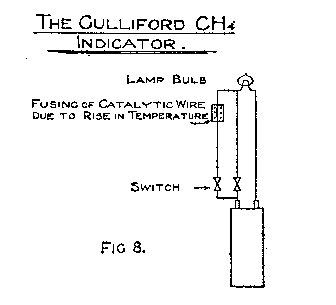
Recently Gulliford suggested placing a small piece of platinum wire in the circuit of a portable electric lamp, the wire being so proportioned that it fuses when brought into an atmosphere containing a dangerous quantity of firedamp. Figure 8 shows the arrangement suggested, which consists of the necessary switches, a fuse holder and fuse wire placed in the lamp circuit. The dimensions of the fuse wire are arranged so that the heating effect of the electric current passing through the wire plus the heat liberated by 3 per cent, of CH4 in air burning in the region of the wire, will raise the latter to its melting temperature. The dimensions of the platinum wire used for a 2 volt lamp are 3 mm. in length and 0.035 mm. in diameter. In the Gulliford arrangement, when the platinum wire fuses the light is extinguished. The light can be recovered by operating the second switch. An arrangement of this description will prove to be useful in pits where electric lamps are used. While the percentage of gas actually In the mine air cannot be ascertained, dangerous percentages can be indicated, namely, percentages greater than 2½ or 3.
Illuminating Power of Wire Tests.
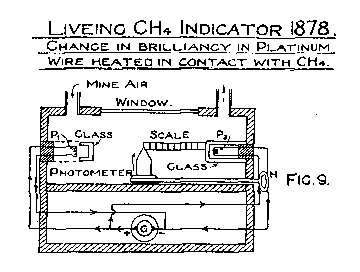
In 1878 Liveing constructed an apparatus for detecting CH4 which depended for its action upon the increase in the illuminating power of a wire heated electrically in the presence of methane. The general arrangement of the apparatus is shown in Figure 9. The chief disadvantage of this apparatus is due to the platinum wire, which is exposed to the air, changing its electrical resistance after a few tests have been made. The change produced is not permanent, and frequent adjustments have to be made.
Other indicators have been constructed making use of the change in appearance of catalytic wires heated electrically in contact with CH4 ; also attempts have been made to measure the increase in temperature produced in a glowing wire due to the heat evolved by CH4 burning in contact with it.
The Aitken indicator depends for its action upon the fact that platinum black induces the slow combustion of methane when present in air. The arrangement devised by Aitken consisted of two thermometers, one of the bulbs was naked and the other was coated with platinum black. The former served to register the temperature of the air. The bulb coated with the catalytic substance suffered a rise in temperature when CH4 was present in the air. The difference in reading between the two thermometers had a definite relation to the percentage of methane in the air. The arrangement was similar in some respects to a hygrometer. Unfortunately platinum black rapidly deteriorates and its "activity" cannot be relied upon. It is doubtful whether the apparatus is safe, because the catalytic substance in the presence of high percentages of CH4 may reach a high temperature and ignite the explosive mixture surrounding the bulb.
Limits of Inflammability.
Mallard and Le Chatelier in 1882 suggested that the percentage of methane in mine air could be ascertained by observing the quantity of pure methane that had to be added to a sample of mine air in order to make the latter inflammable. The application of this method may be carried out successfully in a laboratory, but it is useless for underground purposes.
Change in Volume, or Change in Pressure on Combustion.
Various inventors have devised appliances for estimating the quantity of firedamp present in the atmosphere of a mine by making use of the fact that a reduction in volume, or a reduction in pressure, is produced when the combustible gas is burned in the region of a glowing platinum spiral.
Mounier in 1881, Colquillon in 1887, Lewis and Maurice in 1887, Grehant in 1894, Burrell in 1912, and Williams in 1922 made use of the combustion equation as the principle underlying the action of their indicators.
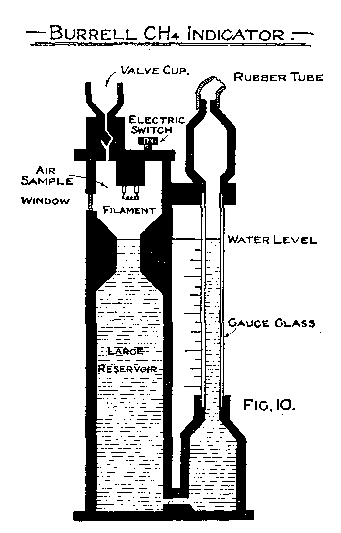
The Burrell indicator (Figure 10) is used extensively in America. As low as ¼ per cent. of methane is indicated by this appliance with an accuracy of plus or minus 0.15 per cent. in the hands of an average operator. The errors that arise in this apparatus are due to the following :—
(1) The use of water in the apparatus ; gases are soluble in water, especially CO2.
(2) Variations in the heat given out by the filament due to variation in the voltage of the accumulator.
(3) Water sometimes adheres to the filament, and the former has to be evaporated before the platinum wire begins to burn the CH4.
(4) Heat from the hands of the operator and the mine air will cause an increase in the temperature of the air inside the apparatus, and consequently an increase in pressure which will counteract some of the reduction in pressure due to the condensation of steam produced by the burning of CH4.
(5) Any change in ventilation pressure or atmospheric pressure while a test is being made will influence the gauge reading.
However, some of the errors are somewhat minimised when the apparatus is being calibrated. In spite of the many factors which may influence the action of the Burrell indicator, it is the best of its kind, and serves a useful purpose.
The Delbrouck firedamp tester has been recently introduced into the Belgian mines. The apparatus consists of a combustion chamber immersed in water ; the gas is burned off by a glowing platinum wire and the reduction in pressure is observed on a water gauge. In this arrangement the time required to burn off the methane is 10 minutes, then after combustion the apparatus is allowed to stand for 15 minutes before readings are taken, so that the complete time for one estimation is 25 minutes. It is claimed that the apparatus gives fairly accurate results.
* From a paper read before the Past and Present Mining Students' Association at the Wigan Mining and Technical College. Mr. McLuckie is Lecturer in the Mining Laboratory at the Wigan College
 |
 |
| Names mentioned in this article | |
 |
 |
| Name | Age | Occupation | Notes |
|---|---|---|---|
| Aitken, — | |||
| Burrell, — | |||
| Chatelier, Le | |||
| Colquillon, — | |||
| Delbrouck, — | |||
| Grehant, — | |||
| Gulliford, — | |||
| Lewis, — | |||
| Liveing, — | |||
| Mallard, — | |||
| Maurice, — | |||
| McLuckie, Colin | Lecturer | ||
| Mounier, — | |||
| Ralph, — | |||
| Williams, — |
 |
 |
| Related Articles | |
|
|
| Pub. Date | Article (Newspaper) |
|---|---|
| 07 May 1927 | Firedamp Detectors* (The Science and Art of Mining) |
| 21 May 1927 | Firedamp Detectors (The Science and Art of Mining) |
| 08 Jun 1927 | Firedamp Detectors* (The Science and Art of Mining) |
| 18 Jun 1927 | Firedamp Detectors* (The Science and Art of Mining) |



 Contains public sector information licensed under the

