


| Newspaper Articles |

|
Newspaper Articles |
 |
 |
8th June 1927, Page: 362, Column: 1
Firedamp Detectors*
By Colin McLuckie, Dip.R.T.C., M.I.Min.E.
(Continued from page 345.)
Diffusion of Gases.
Ansell, in 1868, constructed a firedamp indicator which depended for its action upon the law of diffusion of gases. McCutcheon, Turquand and Webster also devised apparatus based upon the same principle.
The principles underlying the diffusion of gases may be conveniently studied by means of arrangements shown in Figures 3 and 4. The arrangement shown in Figure 3 is the Ansell CH4 indicator.
From experimental work carried out in the Wigan College laboratory on the diffusion of gases it has been noted that the indications shown on the gauge are small when low percentages of CH4 are present in the air. For instance, 2½ per cent. of CH4 gave an indication of approximately 1/10 inch on the gauge shown in Figure 4. It would, therefore, appear that an apparatus which depends for its action upon diffusion will have a restricted field of practical usefulness until the gauge indications for small percentages of CH4 can be considerably magnified.
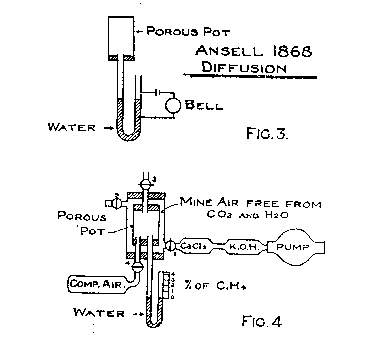
Further study of the experiments carried out also indicated that, before a CH4 detector (which depends for its action upon diffusion) can be relied upon to give consistent results, even for large percentages of CH4 in air, it is imperative that the mine air should be freed from moisture and C02 before it is brought into contact with the porous vessel. The reason for this is that if the humidity of air inside the pot is different from the atmosphere surrounding the vessel vapour will diffuse and influence the gauge reading.
In the course of the tests various mixtures of CH4, CO2 and air were brought into contact with the porous pot (Figure 4), and in every case the two gases CH4 and CO2 counteract each other, whilst even in the following mixtures they gave no indication : 40 per cent, air, 34 per cent. CO2, 26 per cent. CH4. Mixtures that could be exploded gave no indication on the gauge, but when the CO2 was extracted before the air was brought into contact with the porous vessel the presence of CH4 was indicated.
During my experience in working coal seams in the Ayrshire coalfield and in the Lancashire coalfield respectively, I have observed cases where in the same seam CH4 and CO2 were given off, and various mixtures of CH4, CO2 and air could be obtained in different parts of the workings.
The arrangement shown in Figure 4 is similar in some respects to the "Nelly" indicator that was awarded first place in a competition for CH4 indicators promoted in 1922 by the Prussian Minister of Trade and Commerce. This indicator is now being advertised for sale in this country as the "Dominit firedamp recorder." This recorder gives larger indications than that obtained in the experiments carried out in the Wigan College. For example, 1 per cent. of CH4 in the air gives a gauge reading of 1/10 inch. This difference is due to the fact that in the "Nelly" apparatus, the difference in pressure between the inside of the porous vessel and the atmosphere surrounding the latter is measured on the gauge. The porosity of the pot or vessel used also influences the results obtained.
The line diagram in Figure 4 shows how the mine air can be freed from coal dust, CO2 and H2O before it is brought into contact with the porous vessel. The compressed moisture-free air from the cylinder is used to flush out the apparatus before carrying out the test. By operating the pump and opening the cocks 1, 2, 3 and 4, the air inside the porous vessel will be pure air, and the air outside the vessel will be mine air free from CO2, H2O and coal dust. Then by closing the cocks 1, 2, 3 and 4, if CH4 is present; diffusion will take place and the pressure set up will be indicated on the gauge. The purifier contains a filter to remove coal dust, caustic potash to remove CO2, and calcium chloride to remove moisture.
The advantages claimed for apparatus based upon diffusion are as follows : (1) No glowing wires ; (2) the gauge reading is directly proportional to the amount of CH4 present in the air. This is not the case with indicators where the CH4 is burned. The latter arrangement will only give gauge readings directly proportional to the CH4 in the air up to approximately 10 per cent. of methane in air ; then with percentages greater than 10 per cent. the indication on the gauge decreases as the percentage of inflammable gas increases.
Low Density Tests.
Various attempts have been made to detect the presence of CH4 in mine air by making use of the fact that air containing CH4 is reduced in density. First suggested by Wilson in 1894, a patent was taken out in 1911 by E. A. Johnson. This arrangement is similar to Figure 5, and the specification was briefly as follows : "A hollow brass box A and a lead counterpoise W at the end of a bent brass tube are balanced on a knife-edge bearing F ; when the device tilts in either direction owing to abnormal density of the surrounding air, an electric circuit is completed and an alarm given."
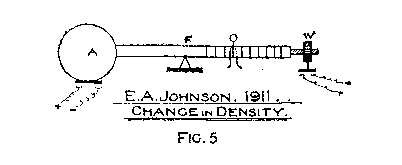
The diagram (Figure 5) shows a straight lever connecting the hollow vessel A and the weight W. A rider O could be conveniently mounted on the lever, and the relation determined between the percentage of CH4 in the air and the position of the rider on the scale to keep the lever horizontal. Unfortunately, there are numerous other factors that influence the density of air in addition to the presence or absence of CO2 and moisture, and variations in temperature and pressure.
Forbes in 1880 invented the "Damposcope," which consisted briefly of a tuning fork and a tube containing a piston. By means of this apparatus the length of the air column necessary to produce acoustic resonance to a musical note of standard pitch is ascertained. The length of the air column to produce acoustic resonance depends upon the density of the air. Just as it is impossible to detect the presence of CH4 in mine air by change in density, it is equally impossible to accomplish the determination by acoustic properties, unless all other variables can be eliminated, such as presence of CO2, etc.
Prof. Haber, in co-operation with the Zeiss optical works designed an apparatus for detecting the presence of methane and other gases in mine air. The principle underlying the apparatus depends upon the refractive index of the various gases. The apparatus, however, does not appear to be readily adaptable for underground use. In addition, it is complicated to manipulate and is expensive.
Thermal Conductivity.
Appliances making use of the thermal conductivity of gases have been constructed in this country and in other countries, with a view to determine the percentage of CH4 in mine air.
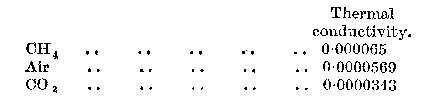
From the above table it will be seen that CH4 is a better conductor of heat than air, whilst air is a better conductor of heat than CO2.
The "Gnom" indicator was placed second to the "Nelly" indicator in the competition already mentioned. This apparatus consists of a heavy metal block, which has four circular holes. Four fine platinum wires, A, B, C, D are placed in the holes, as shown in Figure 6. The wires are arranged in the form of a Wheatstone bridge. The wires CD are sealed up and are surrounded by pure air, whilst the wires AB are contained in compartments into which the air to be tested is blown as shown by the arrows. The wires are heated by a current from the accumulator E. The temperature of the wires is not high enough to ignite CH4.
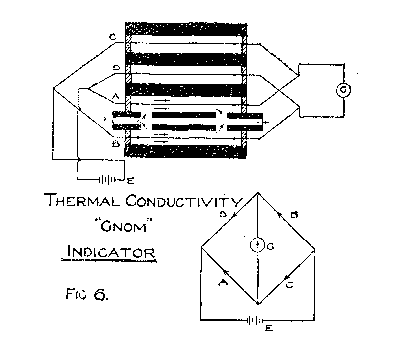
Provided the air blown into contact with the wires AB is of the same composition as the air in contact with the wires CD, the four wires will be cooled at the same rate and their resistances will be equal, so that no current will pass through the galvanometer G. If CH4 should be present in the air that is blown into the space containing the wires AB, the latter will be cooled at a greater rate than the wires CD, resulting in reduction in the resistance of the wires AB due to a drop in temperature. The change in resistance will cause an electric current to flow through the galvanometer and deflect the needle on the calibrated scale which reads direct the percentage of CH4 present. This instrument weighs 22½ lb. Even in this apparatus it would appear that the mine air should be purified before it is pumped into the instrument, because if CO2 is present in the air it will neutralise the effect of CH4 ; in fact it would appear to be possible to have fairly large percentages of CH4 and CO2 mixed in the air and yet the instrument would fail to indicate.
* From a paper read before the Past and Present Mining Students* Association at the Wigan Mining and Technical College. Mr. McLuckie is Lecturer in the Mining Laboratory at the Wigan College.
 |
 |
| Names mentioned in this article | |
 |
 |
| Name | Age | Occupation | Notes |
|---|---|---|---|
| Ansell, — | |||
| Forbes, — | |||
| Haber, —, Prof. | |||
| Johnson, E. A. | |||
| McCutcheon, — | |||
| McLuckie, Colin | Lecturer | ||
| Turquand, — | |||
| Webster, — | |||
| Wilson, — |
 |
 |
| Related Articles | |
|
|
| Pub. Date | Article (Newspaper) |
|---|---|
| 07 May 1927 | Firedamp Detectors* (The Science and Art of Mining) |
| 21 May 1927 | Firedamp Detectors (The Science and Art of Mining) |
| 08 Jun 1927 | Firedamp Detectors* (The Science and Art of Mining) |
| 18 Jun 1927 | Firedamp Detectors* (The Science and Art of Mining) |



 Contains public sector information licensed under the

