


| Newspaper Articles |

|
Newspaper Articles |
 |
 |
21st May 1927, Page: 344, Column: 2
Firedamp Detectors
By Colin McLuckie, Dip.R.T.C, M.I.Min.E.
(Continued from page 323.)
Explosion Meter.
The following apparatus was designed and constructed in the Wigan and District Mining and Technical College laboratory for the purpose of enabling the students to study some of the characteristics of firedamp and other combustible gases.
The details of the apparatus are shown in Figure 1. It consists of a measuring tube A, levelling bottle B, exploding chamber C (containing a spark gap), non-return valve V, by-pass E, accumulator and induction coil I, and a glass tube G, which acts as a manometer. The gas to be tested is drawn into the graduated tube A, and is mixed with air in the required proportions by raising and lowering the levelling bottle and operating the necessary cocks. When a mixture has been made up it is transferred to the chamber C and exploded by a "spark" through the medium of the induction coil. When an explosion takes place the water contained in the U-tube is forced up into the glass tube G. The non-return valve V holds the liquid in position until the head H is measured on the scale S. The water is then returned to the chamber C by opening the cock E ; then the products of combustion are brought into the tube A and the reduction in volume noted. If necessary the products of combustion can be analysed in a modified Hempel or similar apparatus. The curves shown in Figure 2 represent graphically the results obtained by exploding various mixtures of firedamp and air in the explosion meter.
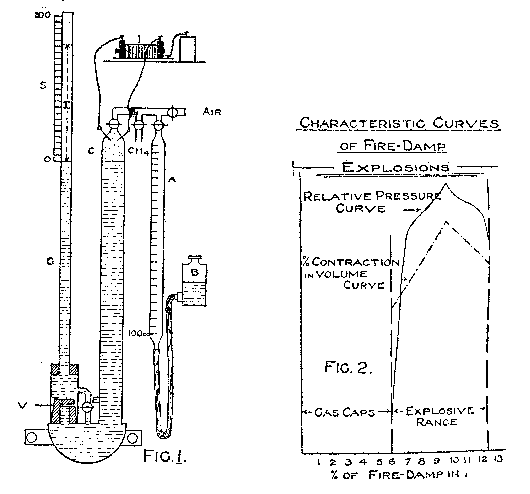
The relative pressure curve is obtained by "graphing" the values of H (the throw of the water column produced by exploding different mixtures) on a gas percentage base. It will be seen from the graph that there is a gradual rise in the pressure developed as the percentage of CH4 increases from 6 to 9.6 per cent. At the latter percentage the maximum pressure is produced. With percentages of CH4 in the air greater than 9.6 the pressure or force developed gradually decreases until the higher limit of inflammation is reached. The interval between the lower and higher limit is referred to as the "explosive range."
The percentage contraction in volume curve is obtained by plotting the values observed on a gas percentage base and is constructed similar to the relative pressure curve. From this curve it will be seen that the maximum reduction in volume is obtained with the same gas mixture that produces the maximum, violence. This curve also serves to show the relation between the contraction in volume and the percentage of CH4 in the explosive mixtures. The ratio between the CH4 in the mixture exploded and the contraction in volume produced is 1 : 2 until 9.6 per cent. is reached, after which the ratio does not hold good. This is a point that has to be taken into consideration in gas analysis as well as in OH4 indicators, where the combustible gas is burned in the region of a glowing wire.
Flame Tests.
Various methods have been devised to ascertain the percentage of methane in mine air, and they may be classified as (1) flame tests, (2) tests other than flame tests.
In 1876 Galloway made the first attempt to standardise the method of testing for firedamp by making use of the cap produced on the lower flame of a safety-lamp. The height of the "cap" produced is influenced by the following factors : (1) The percentage of gas present; (2) the height and width of the testing flame ; (3) the temperature of the testing flame ; (4) the kind of fuel used in the lamp ; (5) the temperature and pressure of the atmosphere; (6) the presence or absence of moisture or blackdamp in the air.
The research work carried out recently by the Mines Department has shown that the height of the cap is not influenced to any great extent by variations in atmospheric temperature, pressure, or humidity ; and even 10 per cent. of carbon dioxide in the air will not have any appreciable effect upon the caps produced. In a given mixture of methane and air the height of the cap produced on the lowered flame of a safety-lamp will depend upon the fuel used and the height and width of the testing flame adopted.
The relation between the height of cap and the percentage of methane for a particular lamp can be conveniently ascertained by testing the latter in known mixtures of methane and air under standard conditions as to height and width of testing flame.
Various devices have been introduced in order to facilitate the accurate determination of methane in mine air by means of the flame test, and they may be classified briefly as : (1) Alcohol flame of Pieler. (2) Hydrogen flame of Clowes. (3) Large testing flame including the "Beard-Mackie ladder" and the "Briggs loop." (4) Coloration of the flame as the "Cunynghame-Cadman" device. (5) Increase in the size of the flame embracing "the singing flame of Pleissner" and the "Cochrane lamp." (6) The Edmondson-Garton device (scale fixed to the lamp to measure per cent. of gas from the cap produced).
Alcohol Flame Test.
In 1883 Pieler devised a large gauze lamp similar in design to the Davy lamp in which alcohol was burned instead of oil. In the Pieler lamp there is always the danger of the alcohol boiling in the reservoir and producing a dangerous flame of burning alcohol vapour inside the lamp.
Stokes in 1892 suggested the use of a separate alcohol burner that could be introduced through an aperture into an ordinary safety-lamp, the flame of the latter to be used for illuminating purposes and for testing for large percentages of methane, the alcohol flame only to be used in testing for small percentages of methane. Ashworth in 1894 suggested a lamp with a double burner and a double reservoir, one-half for alcohol and the other half for oil.
The Hydrogen Flame Test.
Mallard and Le Chatelier in 1881 recommended the use of the hydrogen flame for gas testing, and the suggestion was adopted by Clowes in 1892. This lamp has the advantage of being able to give a cap of over ½ inch in height with 0.25 per cent. of methane in the air. Compared with the alcohol flame, the caps are more distinct and the observer has better control over the height of the testing flame. Both the hydrogen flame and the alcohol flame, if allowed to burn for any length of time, "fog" up the glass due to the deposition of moisture inside the lamp, and make the caps difficult to see.
Measuring Height of Caps.
Attempts have been made to ascertain the percentage of gas present in the air by measuring the height of the cap that envelops the full flame. The appliances may be classified as follows : (1) "Beard-Mackie" ladder (1903); (2) "Briggs" loop (1912); (3) hiding the flame from view — "Ashworth" (1890).
The following advantages would be obtained if a satisfactory device could be introduced whereby the percentage of methane in the air could be ascertained on a large testing flame : (a) There would not be the same danger of losing the light as compared with the test where the flame has to be made non-luminous by lowering the wick with a pricker, (b) It would obviate adjusting the non-luminous flame to a certain height and width, an operation which is sometimes rather difficult in the case of a flat wick, especially when the latter is charred and not properly trimmed.
In order to increase the visibility of the gas caps, Chesneau in 1892, in the modified Pieler alcohol lamp, used ethylene chloride and copper chloride in the alcohol. Briggs, in 1912, in conjunction with the copper loop, used carbon tetrachloride in the lamp oil, this combination making the large testing flame non-luminous whilst it tinged the caps a greenish-blue colour. The Cunynghame-Cadman device was introduced in 1909. It consisted of a slip of asbestos impregnated with carbonate of soda. When the slip was brought into contact with either a large or reduced flame, the caps produced were tinged a yellow colour.
Flame Elongation Tests.
The common practice adopted as a preliminary test for the presence of firedamp is to test with the large flame and to note if elongation is produced. If the latter takes place, the flame is reduced to the standard adopted for testing, and the percentage estimated by observing the height of the cap.
The Cochrane lamp placed on the market in 1910 is provided with a suitable scale which will measure any increase in the height of the normal flame produced by CH4. The difficulty in this arrangement sometimes is to set the flame at a standard height. The latter operation can only be accomplished in an atmosphere free from firedamp.
Maurice, in 1920, described the "Fleissner singing flame." This indicator depends for its action upon the elongation of the lamp flame due to the presence of CH4. The lengthening of the flame causes a musical note to be set up in a tube or hollow sphere fitted in the lamp.
In addition to the devices outlined, others have been suggested, and adopted in some cases, as for example, magnifying glasses, darkened background on the lamp glass, and modified forms of lamp, such as top feed and special "feeding" arrangements. However, the modified Davy lamp in the hands of a skilled observer is still looked upon as the most convenient form of indicator, and is the one almost universally adopted.
Principles Underlying Indicators.
Various inventors have devised apparatus for the detection and the determination of the percentage of methane in mine air by means other than the flame test. Up to date, however, none of the appliances have been adopted to any great extent in the mines in this country.
The principles underlying the action of the various appliances that have been devised are based chiefly upon the physical characteristics of methane such as : (1) Diffusion. (2) Density. (3) Acoustic properties. (4) Optical properties — refractive index. (5) Thermal conductivity. Also, a number of CH4 indicators have been designed to make use of the heat evolved when CH4 combines with oxygen in contact with catalytic wires. The latter are heated electrically in the majority of cases, and the arrangements may be classified as follows : (a) Change in electrical resistance of wires heated electrically in the presence of CH4 and air. (b) Fusing of platinum wires due to increase in temperature when in contact with CH4 and air. (c) Increased "brilliancy" of wires heated electrically in mixtures of CH4 and air. (d) Increase in temperature due to the heat evolved when a mixture of CH4 and air comes in contact with a catalytic substance such as platinum black.
Other indicators have been devised and depend for their action upon either the reduction in volume or the reduction in pressure when CH4 is burned.
* From a paper read before the Past and Present Mining Students' Association at the Wigan Mining and Technical College. Mr. McLuckie is Lecturer in the Mining Laboratory at the Wigan College.
 |
 |
| Names mentioned in this article | |
 |
 |
| Name | Age | Occupation | Notes |
|---|---|---|---|
| McLuckie, Colin | Lecturer |
 |
 |
| Related Articles | |
|
|
| Pub. Date | Article (Newspaper) |
|---|---|
| 07 May 1927 | Firedamp Detectors* (The Science and Art of Mining) |
| 21 May 1927 | Firedamp Detectors (The Science and Art of Mining) |
| 08 Jun 1927 | Firedamp Detectors* (The Science and Art of Mining) |
| 18 Jun 1927 | Firedamp Detectors* (The Science and Art of Mining) |



 Contains public sector information licensed under the

