


| Newspaper Articles |

|
Newspaper Articles |
 |
 |
26th March 1927, Page: 282, Column: 1
Winning Thin Seams*
By William Leebetter, Assoc.I.M.E.
There are only two ways of winning coal: (a) by hand, and {b) by machinery. We have learnt from past experience that seams from 1 foot 6 inches up to 3 feet are not paying concerns when got by hand. In my early days of mining, we had banks, or stalls, 60 yards in length and worked 30 yards each side of the gateway. This seam was 1 feet in thickness and known as the Deep Hard ; it was undercut by men and new starters 4 feet deep and 6 feet on the face. The men required to work this stall or gate were as follows :— Two fillers, two trammers and one topper up (meaning the man in the gateway), who emptied the small tubs from the face and loaded up into 15 cwt. tubs which were then sent to the shaft.
At these collieries conveyors and machines are being used which brings us to the great question of concentration to machine mining. If we were to allow some machine experts to have their way, they would install conveyors and tub loaders to fill the coal, but where men can get the tubs along the face, and can fill up to 10 tons per man, machines, etc., must take a back seat. To be successful in machine mining you must lay down a common-sense system of cutting canches and filling coal, and all concerned should be well versed with the system which must be carried out in its entirety. Where the coal is whole it is a much better proposition than brokens. If arc-wall machines are employed, with 7 feet jib, you will be able to cut 5-yard places with ease, and one machine will be able to cut ten places in an 8-hour shift; a seam 3 feet thick should produce from 6 to 7 tons per place, but if we say 6, we should be on the safe side. (10 X 6 = 60.) A stable-hole is necessary for the machine to be put out of the way. If you can divide your districts up so that you could cut for three shifts, then the plan for working is made simple, assuming that all places are squared up : (a) cutting ; (b) filling ; (c) canchwork. This applies to arc-wall machine cuts.
Should Siskol and Hardy machines be employed the work would have to be carried out as follows :—
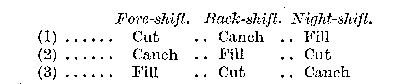
To make it clear you would say, cut your places first, canch men follow, the fillers could then get the coal out. If these places are cut 6 yards wide and 3 feet thick, they would produce 9 tons per Siskol Judd. These Siskol places require dividing up into three sections so that each class of labour follows on systematically. If we assume we have twelve places to cut, with good cutters, six men should be able to cut two judds each and drill the holes for firing. Taking a 3 feet seam with 18 cutters, 18 scrapers-out, and six machines, you would be able to produce at least 300 tons per day for three shifts. Provided the districts could be divided up, the flitting of these machines would be reduced to a minimum.
I can imagine that you will be wondering how this system works in brokens. That is a question requiring your close attention. It all depends upon the class of cover you have. If you take the road up at the "fast" side and build a pack wall every 6 feet, you will have a roadway that will stand all the pressure that may come. This will ensure ample room for tub ways and pipes that may be required. My chief reason for supporting the Siskol and Hardy for brokens is that all arc-wall machines must have the road in the centre, and when you have to do this you cannot obtain sufficient pack on the loose side to support the upper strata. Wherever possible machines of the Siskol type should be employed in the brokens. Of course, the other class of labour winch has to be put into the same must be done properly. A good idea is to have a reliable man for each class of work, namely, a master overman, master shifter, or master stoneman, and an overman who thoroughly understands the details of the whole system.
In addition to the points raised, where compressed air is used, a good system is to have a large range of pipes 6, 8 or 10 inches, to a receiver, and then lead pipes, if practicable, from the receiver to the machine so that there is less moisture in the air. At intervals of 300 yards a receiver should be placed, and at each district 6 feet receivers are placed in order that ample pressure may be available to work the machines. Valves should be placed so that only one machine or one district would be stopped in the event of any breakdowns with pipes or machines. These receivers should be attended to and water drawn off three times per week to ensure good results. A fitting shop should be arranged underground with a fitter in charge of each shift, and at least one complete machine in reserve in case of breakdown. This man should be held responsible for this department and should report to the manager and under-manager daily the state and condition of his department.
* From paper read before February meeting of the Students' branch of the North of England Institute of Mining and Mechanical Engineers.
 |
 |
| Names mentioned in this article | |
 |
 |
| Name | Age | Occupation | Notes |
|---|---|---|---|
| Leebetter, William |




 Contains public sector information licensed under the

