


| Newspaper Articles |

|
Newspaper Articles |
 |
 |
12th February 1927, Page: 235, Column: 1
Rules Governing Mining Examinations
From the Board for Mining Examinations we have received a copy of the new rules, signed by Sir R. A. S. Redmayne, chairman of the Board, and bearing the approval of the President of the Board of Trade, governing the qualifications for Certificates of Competency as follows :—
In pursuance of Section 9 (2) of the Coal Mines Act, 1911, the Board for Mining Examinations, with the approval of the Board of Trade, hereby make the following Rules for the qualifications of applicants for Certificates of Competency under the said Act :—
1. An applicant for a First-class or Second-class Certificate of Competency must be at least 23 years of age on the first day of examination, and must submit to the Board for Mining Examinations (hereinafter called the Examining Board) testimonials and certificates of his preliminary qualifications as follows :—
(i.) Satisfactory testimonials, on forms provided for the purpose, as to sobriety and general good conduct ;
(ii.) First-aid Certificate of the St. John Ambulance Association or of the St. Andrew's Ambulance Association or other Society or Body approved by the Board of Trade ; and
(iii.) Fireman's Certificate as required under Section 15 (1) (6) of the Coal Mines Act, 1911.
2. Save as is hereinafter expressly provided, an applicant must satisfy the Examining Board that he has had practical experience in mining at the working face and other parts of the underground workings for not less than 5 years (or not less than 3 years if he holds a Degree or Diploma which has been approved by the Board of Trade for the purposes of Section 9 (2) of the Coal Mines Act, 1911) ; provided that, for at least 2 years (or at least 1 year 6 months if he holds an approved Degree or Diploma), such experience shall have been obtained in the performance or responsible control of stonework, timbering, repairing, and of either the getting of minerals (by hand or machinery) or any work directly connected with such getting at the face of the mine.
The required experience shall have been obtained either in Great Britain in a mine or mines under the Coal Mines Act, 1911, or partly therein and partly elsewhere in such coal mine or coal mines, as may, in the opinion of the Examining Board, provide equivalent experience.
3. For a First-class Certificate, an applicant must satisfy the examiners in knowledge of fiery mines and must possess such a knowledge of arithmetic, mathematics, physics (including electricity), chemistry, geology, and engineering science as will enable him to pass a written examination on the subjects in the following syllabus :—
(i.) Winning and Working. — Systems of laying out and working under varying circumstances, of coal and other stratified deposits included under the Coal Mines Act. The geology of these deposits. Methods of supporting roof and sides. Boring and sinking. Blasting and general knowledge of explosives.
(ii.) Theory and Practice of Ventilation. — The properties, identification and practical estimation of gases met with in mines. Sources and effects of heat in mines. Natural ventilation, fans and other ventilators. The distribution and control of the air underground. Construction, use and testing of safety-lamps.
(iii.) Explosions in Mines, Underground Fires and Inundations, their Causes and Prevention. — Coal dust. Spontaneous heating. Rescue operations, apparatus and organisation. Recovery of mines after explosions, fires and inundations.
(iv.) Machinery. — Winding, hauling, pumping, mechanical coal-cutting and conveyors, &c. Methods of transmission of power. Strength of materials.
(v.) Surveying, Levelling and Drawing. — Determination of magnetic declination. Loose and fast needle dialling. Calculation of areas and volumes. Contour lines and levelling. Traversing with the theodolite underground and on the surface. Connecting of surface and underground surveys. Triangulation. Mine plans and sections. The use, care and testing of instruments. '
Each candidate must produce a plan of a Mine Survey and a section prepared from an underground levelling made and drawn by himself with the original plottings and the notes from which the plottings have been made, and the work must be certified by him as having been carried out by himself. The plan and section prepared from an underground levelling must have been made and drawn not more than twelve months before the date of the examination.
(vi.) General Management and Mining Legislation. — Organisation and surface arrangements under varying circumstances. Mines Acts. General and special regulations or orders and other legislation applicable to mines under the Coal Mines Act.
4. An applicant for a Second-class Certificate will be required to pass a written examination on the undermentioned subjects in which the questions set shall be of a nature suitable for practical working conditions :—
(i.) Systems of laying out and working, under varying circumstances, of coal and other stratified deposits included under the Coal Mines Act. Methods of supporting roof and sides. Boring against old workings. Shot-firing.
(ii.) Ventilation, the properties, identification and practical estimation of gases met with in mines. Natural ventilation, fans and other ventilators. The distribution and control of the air underground. Construction, use and testing of safety-lamps.
(iii.) Explosions in mines, underground fires and inundations, their causes and prevention. Coal dust. Spontaneous heating. Rescue operations, apparatus and organisation.
(iv.) Machinery and plant in common use in a colliery, including the use of electricity, and with special reference to safety.
(v.) Arithmetic (simple rules). Elementary surveying and levelling.
(vi.) Mines Acts. General and special regulations and orders. Writing of reports.
5. In addition to the written examination mentioned in the two last preceding Rules, an applicant for either class of Certificate will be required to pass an oral examination designed to test his detailed knowledge oil practical methods of mining in the district in which he is examined.
6. An applicant shall not be deemed to have passed the prescribed examination unless he shall obtain (a) at least 40 per cent. of the maximum marks for each paper (6 subjects), (b) at least 40 per cent. of the maximum marks for the oral examination, and (c) at least 60 per cent. of the maximum marks for the whole examination (written or oral).
The maximum marks for a First-class Certificate shall be as follows :—
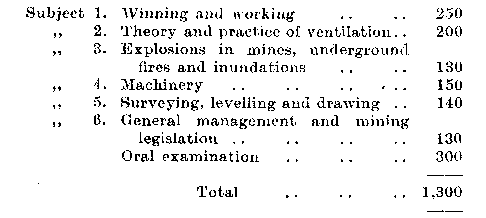
The maximum marks for a Second-class Certificate shall be as follows :—
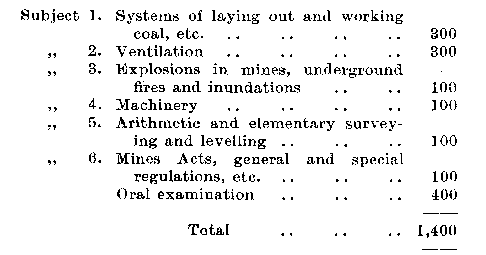
7. The Rules made by the Board for Mining Examinations on the 20th day of August, 1819, and approved on the 29th day of August, 1919, are hereby revoked, provided that any applicant who was qualified to sit and duly sat at any examination for First-class or Second-class Certificates of Competency held prior to the date of these Rules coming into force shall be deemed to have satisfied the requirements of Rule 2 of these Rules.
8. These Rules may be cited as the Mining Examinations (Qualifications for Certificates of Competency) Rules, 1926, and shall come into operation on the 1st day of March, 1927.
 |
 |
| Names mentioned in this article | |
 |
 |
| Name | Age | Occupation | Notes |
|---|---|---|---|
| Redmayne, Richard Augustine Studdart, Sir | Chairman | Whos Who Page |




 Contains public sector information licensed under the

