


| Newspaper Articles |

|
Newspaper Articles |
 |
 |
1st January 1927, Page: 188, Column: 1
Electrical Power At Mines
1925 Report of H.M.I.M.
The report of Mr. J. A. B. Horsley, H.M. Electrical Inspector of Mines, for 1925, contains much of interest to all electricians, managers, and others concerned with electrical equipment at mines. Readers of this Journal, particularly those who have to handle plant, would find it a good investment (6d. net, H.M. Stationery Office, obtainable through local booksellers, etc.).
Progress at mines under the C.M.A. is analysed in detail. The total horse-power of motors was 74,000 I.H.P. greater in 1925 than 1924, amounting to 1,556,235 H.P., and over 58 per cent. of the mines at work now use electricity, as compared with 52 per cent. in 1921.
In regard to, coal-cutting machines, electrical types are more than holding their own with compressed-air types. During the past ten years, in which the total number of machines of all types in use has nearly doubled, the proportion of electrical machines has increased from 67 to 70 per cent. In this connection the Inspector observes that the extent to which electricity is used for coal-cutting varies greatly as between the different coalfields, and he divides the whole country into three well-defined categories — Scotland, almost wholly electrical; England (excluding Lancashire), half "electrical" and half "compressed-air" ; South Wales and Lancashire, less than one-fifth of machine-got coal obtained electrically.
A detailed analysis of electrical accidents during the year and brief descriptions of the more important ones with the Inspector's comments are included. This portion will be of the greatest interest to those concerned with electricity in the mining industry, for in it will be found the Inspector's conclusions as to the most common sources of accident, and his suggestions as to the means whereby such accidents may be prevented in the future.
Appended are abstracts from the report.
During 1925 there were eight fatal accidents attributed directly or indirectly to the use of electricity. Seven of these were simple cases of electric shock, and in one instance two lives were lost, making a total of eight deaths. The remaining accident was concerned with an ignition of firedamp at a machine-cut coal face, which was attributed to open sparking at the plug connector of the electrically driven coal-cutting machine. The evidence was not entirely conclusive, but it was clear that sparking had occurred at the plug contacts within some recent period and no other possible explanation was forthcoming. Five lives were lost in this most regrettable accident, so that the total number of deaths for the year is 13. Of the fatalities due to electric shock, two accidents occurred below ground, involving three lives, and five above ground, each of these involving one life. All occurred in or about collieries.
During the year 39 notices were received of notifiable nonfatal electrical accidents and dangerous occurrences at the time of their occurrence, and 15 further notices were received later on requisition by H.M. Divisional Inspectors following scrutiny of the annual returns of accidents which had entailed disablement for more than three days — making a total of 54 accidents in 1925, which compares with 57 in 1924 and 70 in 1923. These numbers include ignitions of firedamp attributable to "open-sparking." Of the 54 accidents reported in 1925, 34 occurred below ground and 19 above ground at mines under the C.M.A. and one at a slate mine. In each instance some personal injury was caused, affecting in all 64 persons, to which number must be added six persons injured non-fatally in two of the fatal accidents previously recorded, making a total of 70 persons.
Commenting on the analysis of non-fatal accidents according to electrical equipment involved the Inspector says : Inadequate maintenance together with ignorant misuse and negligence are as usual the most important contributory causes. Maintenance is primarily a matter of organisation, and a reduction in the number of accidents which are fairly attributable to faults of maintenance lies in the hands of the management of the mines. Where the staff is insufficient not only will the number of accidents be relatively high under this heading, but there will be avoidable interruptions of the service and a progressive, if at first imperceptible, deterioration of the installation. Accidents due to deliberate misuse or to negligent operation of apparatus can be controlled to some extent by establishing a high standard of discipline, but their root cause lies in the ignorance of the individual.
Coal-cutting Machines.
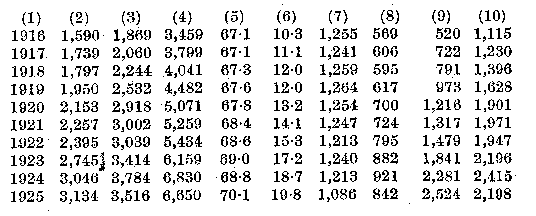
Approximately 30 million tons of coal were got by 3,134 electrical coal-cutting machines out of a total of slightly more than 48 million tons got by machine cutting in 1925. In view of the admittedly superior performance and economy of the electrical machine it is perhaps remarkable that the. proportion of machines driven by electricity has remained practically stationary. There are various reasons for this, but perhaps the most cogent is the wise reluctance of the management to introduce electricity into places where firedamp is a potential danger.
It is only within the last year or so that the problem of flameproof enclosure has been attacked on a scientific basis in this country, and although no novelty of principle has emerged, British designers and users now have for the first time definite and authoritative guidance as a result of the research which has been carried out by Dr. Wheeler and his Associates, under the auspices of the Safety in Mines Research Board and at the instance of the British Electrical and Allied Industries Research Association. There remains, however, the problem of ensuring that electrical equipment which is initially safe shall continue in that condition in use. This is essentially a matter of organisation within the control of the colliery management and the colliery manager is the person who is best placed to judge whether the standard of discipline and maintenance at the mine, under his charge, is adequate for this purpose, and whether the normal ventilation considered in relation to the physical conditions of the mine can reasonably be relied upon to eliminate the risk of a coincident accumulation of firedamp in dangerous quantity and a failure of the electrical equipment.
Assuming a satisfactory solution of the twin problems of design and maintenance of flame-proof apparatus there remains the risk of a defect in the cables, whether of the armoured type as used in the roadways or of the unarmoured type used with portable machinery. Here design and maintenance, especially the latter, are important. Little has been attempted so far in the evolution of a cable of either type that is proof against the risk of "open sparking" under fault conditions, but perhaps the crux of the matter lies in the automatic protection of the circuit. Mere overload protection cannot be depended upon to prevent "open sparking" on a cable of normal design under all fault conditions, but there is ground for hoping that leakage protection designed and applied to that end would prove effective, subject to the correlative provision in the cable of an earthed metal screen around or between the live conductors.
A table is given of the number of coal-cutting machines in use at mines under the C.M.A. during the last ten years from which we extract figures for reference. The first column gives the year to which the figures refer, (2) the electrical, (3) compressed air, (4) total of all types, (5) the percentage of electrical to total of all types of machine, excluding percussive drills, and (6) the percentage of total output got by machines. (7), (8), (9), (10) indicate the number of each type of E. and C.A. machine, i.e., disc, bar, chain, and percussive and rotary respectively.
 |
 |
| Names mentioned in this article | |
 |
 |
| Name | Age | Occupation | Notes |
|---|---|---|---|
| Horsley, James Arthur Bennett | H.M. Electrical Inspector of Mines | Whos Who Page | |
| Wheeler, Richard Vernon, Dr. | S.M.R.B. | Whos Who Page |




 Contains public sector information licensed under the

