


| Newspaper Articles |

|
Newspaper Articles |
 |
 |
6th November 1926, Page: 124, Column: 1
Spontaneous Combustion
The main cause of the spontaneous combustion of coal is most often direct action of the oxygen of the air on the coal substance. Coal is a conglomerate of widely differing compounds, as is shown by the readiness with which a bituminous coal can be divided by means of organic solvents into fractions that differ in general character. A paper by W. Francis and R. V. Wheeler, entitled "The spontaneous combustion of coal: the most readily oxidizable constituents of coal" (Safety in Mines Research Board Paper No. 28, H.M. Stationery Office, price 1s. net), gives an account of recent work designed to determine which constituents of the coal-conglomerate are most readily attacked by oxygen.
In the summary the authors say :—
In so far as their spontaneous combustion is, in the majority of instances, occasioned by the property possessed by coals, in varying degree, of absorbing oxygen and incorporating it within the molecules of the coal substance, it is important to determine which compounds, amongst the many that constitute the coal conglomerate, are mainly responsible for this attachment of oxygen. For it is known that coal is a conglomerate of widely differing compounds. This fact, deducible from our knowledge of the materials from which it is formed, is sufficiently evidenced by the readiness with which a bituminous coal can be divided, by means of organic solvents, into fractions that differ in general character.
It is known also, that one coal may differ in general properties from another, partly by reason of the proportions of the different ingredients that compound the conglomerate, exemplified in a striking manner by the vitrain, clarain and durain components of any banded bituminous coal; and partly by reason of modifications in the character of the ingredients, such as may determine the "rank" of a coal.
When attempting to determine the nature of the initial products of oxidation of coal, with a view to discover which ingredient is the most readily oxidizable, attention was therefore directed in the first place to the behaviour of the components of a banded bituminous coal. The coals used were from the Top Hard seam, Nottinghamshire (the vitrain, durain and fusain portions) and the Parkgate seam, South Yorkshire (clarain portion).
It was found that prolonged oxidation by air at 150° C. transformed nearly the whole of the bright coals, the vitrain portion of the Top Hard and the clarain portion of the Parkgate, into ulmin compounds soluble in alkaline solutions ; whilst the dull coals, the durain and fusain portions of the Top Hard, were only rendered partly soluble and further oxidation, even at a higher temperature, had but little effect on the residues.
An examination of the insoluble residues showed them to consist (apart from mineral matter) entirely of plant entities. The characteristic and only plant residues from a vitrain were resin rodlets, which were obtained in small quantity from several different coals. From a clarain or a durain the residues were chiefly spore exines and cuticles, whilst from a fusain they were carbonised woody tissues.
Earlier work had shown that the difference, chemically, between the vitrain, clarain, durain and fusain components of a bituminous coal lies in the proportion of relatively "inert" or unresponsive material with which a "reactive" portion is associated, the "reactive" portion being of the same chemical nature in each component. The present work specifies as the "reactive" group of compounds those that can be converted into alkali-soluble ulmins by mild oxidation ; and as the "inert" those that comprise the plant entities, whether resins, spore-exines, cuticles or woody tissues, that remain insoluble in alkalis after the ulmins have attained their maximum degree of solubility. The portion of the coal conglomerate that must be held responsible for its spontaneous combustion is, therefore, the ulmin portion.
A chemical examination has consequently been made of the ulmin portion of several bituminous coals. A vitrain consists almost entirely of ulmin compounds, the resin rodlets rarely amounting to more than 0.5 per cent. by weight,* so that it has been found convenient to use vitrains for the major part of the work. The mode of attack has been gradually to break down the complicated molecular structures of the ulmin compounds by the use of a mild oxidant such as hydrogen peroxide or dilute nitric acid. In this way there have been obtained recognisable products of known constitution and of sufficiently large molecular dimensions to enable the structure of the complicated ulmin molecule from which they have been derived to be visualised. Such products are aliphatic dibasic acids, aromatic acids and nitro-phenols, of which a number have been isolated in pure crystalline form. Evidence has also been obtained that the nitrogen in bituminous coal exists for the most part in stable ring formation.
It can therefore be concluded that the nuclei of the ulmin molecules, which form the bulk of all bituminous coals, consist of compact systems of six-membered annular groupings connected together by heterocyclic structures such as pyrrole and furan.
It is also shown that, although initial oxidation of a coal is confined almost entirely, if not exclusively, to the ulmin portion thereof, the plant entities, by reason of their presence as "inert" substances, or because they affect the physical character of the coal, may influence its spontaneous combustion. The general characters of the various plant entities that can be isolated from the four components of a banded bituminous coal are briefly described — other researches deal with their examination in detail — and an explanation is given of the fact that the bright portions of a seam are the most liable to spontaneous combustion, the fusain portion sometimes assisting.
Arising out of this research, it has been found possible to express the "analysis" of a coal in a form which indicates its properties more clearly than either the proximate or ultimate analysis. For example, the characters of the four components of the Hamstead banded bituminous coal are shown by the following analysis :—
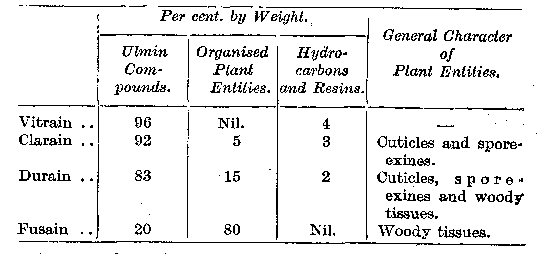
Amongst the majority of British bituminous coals the character of the ulmin compounds they contain does not vary very much, but with coals of higher carbon-content, in which the process of "coalification" has proceeded further, the external groupings of the molecules have suffered condensation and dehydration, with the result that the ulmins are more stable and less readily attacked by oxygen. The readiness with which a given coal will oxidise and self-heat depends, chemically, therefore : (1) on the proportion of ulmin compounds it contains and (2) on the degree of reactivity of those ulmin compounds as determined by the extent to which coalification has proceeded. The proportion of ulmins present in the coal can be determined, by difference, from the proportions of plant debris remaining after complete oxidation to form soluble ulmins has been effected ; whilst a measure of the degree of coalification of the ulmins can be obtained by determining the proportion of alkali-soluble ulmins formed under standard conditions of limited oxidation. Thus both properties upon which the liability of a coal, chemically, to spontaneous combustion mainly depends can be given quantitative expression.
* In addition, solid hydrocarbons (probably derived in part from waxes) and dispersed resinic compounds are present of which no account is taken in this examination.
 |
 |
| Names mentioned in this article | |
 |
 |
| Name | Age | Occupation | Notes |
|---|---|---|---|
| Francis, W. | S.M.R.B. | ||
| Wheeler, Richard Vernon | S.M.R.B. | Whos Who Page |




 Contains public sector information licensed under the

