


| Newspaper Articles |

|
Newspaper Articles |
 |
 |
6th November 1926, Page: 113, Column: 1
Miners' Welfare Fund And Education
Lord Chelmsford, distributing the prizes at the Wigan Mining and Technical College on Wednesday, October 20th, referred to the money that was being given by the Miners' Welfare Committee, and said that in addition to the £37,000 they were giving to Wigan for the extension of the college and for equipment, they were also contributing £5,000 to the Burnley Technical School, £6,000 to the St. Helens Mining College, and £1,500 to the Manchester Municipal College.
Speaking of education, Lord Chelmsford said we did not see the value of it unless it was measured in pounds shillings and pence, but to his mind that was an absolutely wrong view to take of the value of education. Education was meant to make us wiser and happier, and to make us enjoy our work, and not merely to get our reward for work in pounds shillings and pence, though that would come as often as not, and they all hoped it would come to those who had received prizes that night. A personal friend of his happened to be a member of Birmingham University, and he was speaking to his friend not so long ago, in connection with some mining inquiries, and he told him that he regarded it as his duty to take every opportunity to go out into the surrounding districts of Birmingham and preach the value of education, and what the University had to offer them. He was confident of this, that it was through that campaign, that deliberately instituted campaign, that the Midlands had become the one part of all the mining areas where a real response was given in respect of education, because they valued education for what it was going to give them.
Continuing, Lord Chelmsford said that some four years ago a very distinguished educationist, Sir Michael Sadler, who was now head of University College, Oxford, came to him, and said, "I am very anxious for you on the Miners' Welfare Committee to support a scheme which I have in my mind for lectures of a non-vocational type — that is, on art, and natural history, and literature, and other things that have nothing to do with mining, but concern the whole world — and the lectures to be given in the mining districts, about Leeds and Sheffield." Sir Michael Sadler was Vice-Chancellor of Leeds University at the time. He (Lord Chelmsford) said he would be very glad to support him, but that he wanted to know what the districts would say. So they asked the districts, and the districts said, "We should be delighted for these lectures to be given, provided you pay for them." "Well," he replied, "I think this is such a good thing that I am going to make you pay for it against your will, but only one-fifth against the four-fifths from the Welfare Fund." The lectures were started. The course was to be for three years, but at the end of three years the districts came and said "Will you allow us to continue these lectures ?" The reason why they wanted these lectures on art, and literature, and natural history, continuing, was because they found they were being attended by the most amazing audiences. He did not know whether there were any members of the Mining District Welfare Committee present that night, but if there were, he would like to impress upon them that in Lancashire also they could start the same sort of lectures, and if they did, he was confident they would have a real response on the part of the people.
It was because he firmly believed that it was through the means of education that we could make life more sweet for people, and make people happier, that he and his colleagues on the Central Miners' Welfare Committee had determined to spend a large amount of money on education and to support education for the welfare of the mining community. At Wigan they had started a series of studentships, and he wanted to say that the Miners' Welfare Committee were going to start a scheme of scholarships out of the Miners' Welfare Fund. "I believe that this nation requires that its best men should be given the opportunities to rise to the top," said Lord Chelmsford, "and I am confident that the best are to be found in every class of the community, and in this belief we are launching from the Miners' Welfare Fund a scheme of ten scholarships a year to last on an average for three or four years at the universities. It does not seem very much, but if we can get ten best men, or thirty-five in the course of a few years, out of the mining community, we shall be doing a great thing for England." His lordship explained that the scholarship holders would be given an initial outfit, have all their fees paid at the universities, and be given a maintenance grant which would enable them to mix on terms of equality with the other university students.
Might he give a personal illustration. He happened to belong to a great college at Oxford of which he had been a member for thirty years. It was a college, composed mostly of fellows, who got their fellowships after competition. Not long ago — he was not giving dates because he did not want to mention names — they had in for their fellowship a scholarship-student from another college who was a working miner's son from Cornwall, and had got a County Council scholarship, and from that had won a scholarship at one of the great colleges at Oxford. He went up for this Oxford fellowship, and he got it. That was an instance of a brilliant man rising from the humblest origin, but who had the good fortune to have won scholarships which enabled him to rise out of the humblest beginning to a position from which he might become anything, and might be of the greatest value to the community at large. Now he felt that if through the new Welfare Fund scholarship scheme they could get the mining community to throw up a man like that it would prove a good thing. But, of course, such men were very rare, and they did not expect to find them growing on every bush, and oftener than not they had to do the work of life with the second best men, and not with the best. The Welfare Fund Committee, Lord Chelmsford added, were not going to confine these scholarships to the mining side ; they were going to allow the students from the community holding the scholarships to take up those professions for which they felt they had a bent. If a student wanted to be a doctor, for instance, and had a bent and a natural instinct that way, he would be able by means of the scholarship to start upon a doctor's career. If, on the other hand, he felt a natural bent for the law, it was possible the nation might get a future Lord Chancellor out of the pit. A man who could rise to the highest position from a scholarship of that sort would be of great value not only to himself, but to the community at large. His lordship pointed out that the selection of students for the scholarships would probably take place early next year, so that the scholars might begin their University work in October, but, of course, there would be ample notice given throughout the mining districts. He might mention that it was no use anybody going in for these scholarships unless they were capable of passing the entrance examination to the university ; otherwise they would not be able to get into the university at all. There must be conditions attaching to the scholarships.
It was announced that in appreciation of the generosity of the Miners' Welfare Committee, the governors of the College had decided to provide six full-time day mining scholarships to be named after Lord Chelmsford, the chairman of the committee.
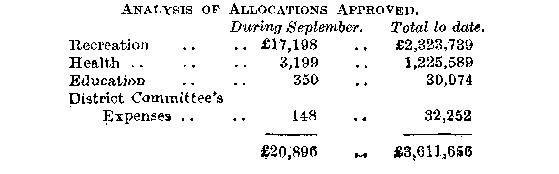
The monthly statement of the Mines Department on the position of the Welfare Fund, as at 30th September, 1926, shows that the contributions and interest amounted to £4,555,404, the total approved allocations to £3,011,656, and payments to £3,060,516.
 |
 |
| Names mentioned in this article | |
 |
 |
| Name | Age | Occupation | Notes |
|---|---|---|---|
| Chelmsford, The Viscount, Lord | Whos Who Page | ||
| Sadler, Michael, Sir |




 Contains public sector information licensed under the

