


| Newspaper Articles |

|
Newspaper Articles |
 |
 |
5th June 1926, Page: 360, Column: 1
Coal And Its Banded Constituents
From paper prepared for presentation at the April meeting of the Associates and Students' Section of the North of England Institute of Mining and Mechanical Engineers. Concluded from page 347.
By J. G. Taylor, M.C., M.A., M.Sc., Assoc.I.M.E.
Bituminous Coal. Banded Constituents. — In any enquiry into the constitution of a seam of coal it is important to consider it from the point of view of its banded constituents. These were first considered in detail by Stopes who named and described them as follows :—
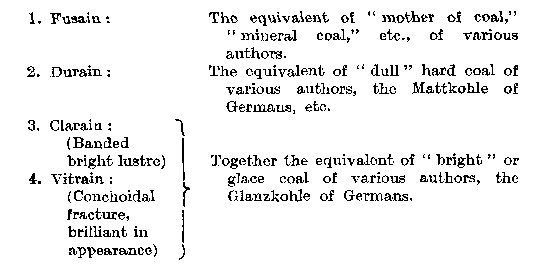
All bituminous coal seams are composed of these constituents in varying proportions with durain and clarain predominating.
Occurrence of Banded Constituents.
Fusain. — The occurrence of the constituents in relation to each other is interesting. For instance, the conjunction of fusain and vitrain is very frequent. A band, of vitrain occurring in a thicker section of clarain has usually a thin layer of fusain above it. This layer of fusain may be so thin that it does not show in a section of the coal at right angles to the bedding plane, but is visible when the specimen is fractured parallel to the bedding plane. This is so frequent that it appears to establish a relation between the formation of these two constituents. I have noticed that should a band of vitrain occur surrounded by durain the fusain may be absent.
Vitrain. — Vitrain, when found in conjunction with clarain, is often uniform in thickness over a considerable area. When in conjunction with durain it is more limited in extent and lenticular in section. It is rarely found to be more than half an inch in thickness. However. I have a specimen of a "seam" of vitrain 1½" thick. This seam occurs 4 feet above a seam of coal about 4 feet thick, the intervening strata being sandstone. It is composed entirely of vitrain, and although rather irregular it extends over a wide area.
Clarain. — Clarain is usually well stratified. It is possible, with care, to separate quite thin layers parallel to the bedding plane.
Durain. — Durain is coaser in structure and has an irregular fracture. Often the face of the fracture will show a very thin coating of brighter material, probably vitrain. Thus it is difficult to select a specimen entirely free from the other constituents.
Climatic Conditions. — The probable climatic conditions prevailing during the great coal-forming periods have been summarised by White as follows :—
1. General mildness of temperature, approaching in most cases tropical or sub-tropical.
2. Conspicuous equability or approximation to uniformity of climatic conditions, which with a few exceptions, appear to have lacked cold winters or severe frosts.
3. A generally high humidity, the rainfall being from moderately heavy to very heavy and fairly well distributed throughout the year, though in many cases there is evidence of the occurrence of dry periods, which, however, seem ordinarily to have been comparatively short and not severe.
4. An amazingly wide geographical distribution of these genial and equable climates.
Such climatic conditions are favourable for the rapid growth of vegetation. It is now generally agreed that the coal-forming vegetation was accumulated and transformed beneath a water surface. Now, there are three factors governing the rate of accumulation of vegetable material: (1) The rate of plant growth, (2) The rate and extent to which the decomposition of the plant material progresses. (3) The conservation of the products of decay.
It is obvious from the thickness of many coal seams that conditions have been favourable for the rapid growth of vegetation. The first step in the formation of coal is the decomposition of the accumulating vegetable material. This process is largely due to the activities of bacteria.
Microscopical Sections.
Vitrain. — An examination of microscopical sections is of great value. The outstanding feature of vitrain is that it is essentially homogeneous, showing no evidence of vegetable structure, in thin sections it is translucent, the colour varying from pale gold to brown according to the thickness of the section. There is no evidence of lamination within the vitrain itself, though it generally forms an extended band lying parallel to the bedding plane of the coal.
Clarain. — Clarain contains the greatest variety of recognisable vegetable tissues and structures. In thin sections it is translucent and the colour contrasts of the various minute structures present make the cellular tissue evident. After examination of microscopical sections of clarain Stopes says:—
"There may be in it clear bands and zones showing much disintegrated plant substance, also bands of clear cuticle, spore exines, "resin bodies" and other structures of various shades front pale yellow to a rich reddish-amber, . . . . and among this variety of material plant stem tissues, leaf tissues and so on may be preserved and may even fill the whole area of the sections."
Dawson (1866) was of the opinion that bright coal is composed of tree trunks of which only the bark remains. Thiessen considered the bright coal to be composed essentially of "wood," saying :—
"In some cases the 'woody' nature is readily discernible, especially where the sections are made across the grain . . . . The woody structure becomes particularly obvious where the 'wood' is very resinous, and especially where the resinous material is light and very refractive."
From these statements it is evident that clarain may contain a great variety of recognisable vegetable material. It differs from vitrain microscopically in being distinctly laminated within itself, the layers being parallel to the bedding plane of the seam.
Durain. — Durain is rather granular in structure, and it is difficult to finish sections finely. Describing sections of durain Stopes says :—
"Sections show a granular matrix of roundish or polyhedral fragments, the majority of which are blackish and opaque. The granules are closely packed and form a coherent mass, but mixed with them are the most characteristic spore exines . . . . . One may say that, on the whole, durain is essentially composed of a high proportion of opaque line granules with many macro-and microspore exines scattered through it."
Thiessen describes durain as consisting of macerated plant debris. Spore exines are the most conspicuous bodies in this part of the coal. Apparently the material forming durain is that which is most resistant to decay.
Fusain. — Fusain in thin sections is almost black, opaque, and when it shows the cellular structure of the wood from which it was formed, it reveals the walls as much thickened and the cell luminia as being generally empty.
Mineral Matter. — From the mode of formation of vitrain and clarain it is natural to expect that the mineral matter would consist of the inherent ash of the vegetable material and a portion of the dissolved mineral matter in the water. Thus the ash from vitrain and clarain should contain a substantial proportion of water soluble constituents. In durain ash there should be a proportion of mineral matter originally carried in suspension and generally only a small proportion of water soluble constituents. The percentage of ash in vitrain and clarain should also be lower than that in durain. Fusain ash should be more variable in quantity and quality. Being very porous it is easily permeated by solutions and consequently may contain a proportion of water soluble constituents. Also matter in suspension in water may be included subsequently to the formation of the fusain and therefore rather irregularly distributed throughout its mass.
In general one would expect the percentage of ash in vitrain and clarain to be smaller and consist largely of water soluble constituents, the percentage of ash in durain to be higher and to consist largely of insoluble constituents such as clay substance, the percentage of ash in fusain to be high, but rather variable both in amount and in the nature of its constituents.
Lessing has made analyses of the ash of the different banded constituents of Hamstead coal. The percentage of. ash in different samples of vitrain and clarain is almost constant. Durain varies slightly according to sample while fusain varies between wide limits. Average results of several samples are given as follows :—
| Vitrain. | Clarain. | Durain. | Fusain. | |
| Ash per cent. | 1.11 | 1.22 | 6.26 | 15.59 |
The banded constituents of a Nottinghamshire coal gave the following percentages (Baranov and Francis). :—
| Vitrain. | Clarain. | Durain. | Fusain. | |
| Ash per cent. | 0.90 | 1.30 | 7.80 | 13.80 |
The results from a Durham coal were (Taylor) :—
| Vitrain. | Clarain. | Durain. | Fusain. | |
| Ash per cent. | 0.75 | 1.20 | 3.75 | 9.30 |
In general it appears that in any seam the vitrain contains the least ash and the fusain the most, the order being vitrain, clarain, durain, fusain.
The analysis of the durain ash shows that it consists very largely (about 90 per cent.) of silica and alumina in the proportion in which these substances occur in "clay substance." It appears reasonable to conclude that this has been introduced into the mass of the durain by the action of water as "matter in suspension."
The ash of vitrain and clarain is made up of the inherent ash of the plant material together with a portion of mineral matter held in solution by water and remaining in the mass after evaporation. The small and nearly constant percentage of ash lends support to this view.
The fusain ash contains a large percentage of lime and soluble matter which is probably due to infiltration of lime salts, e.g., calcium hydrogen carbonate. This would explain the varying amounts of ash from different samples of fusain.
The amount and constitution of the ash from the banded constituents of widely separated seams lend confirmation to the opinion that similar conditions prevailed in each case during the accumulation of the material forming the separate banded constituents.
 |
 |
| Names mentioned in this article | |
 |
 |
| Name | Age | Occupation | Notes |
|---|---|---|---|
| Baranov, — | |||
| Dawson, — | |||
| Francis, — | |||
| Lessing, — | |||
| Stopes, Marie C., Dr. | |||
| Taylor, — | |||
| Taylor, J. G. | |||
| Thiessen, — | |||
| White, — |
 |
 |
| Related Articles | |
|
|
| Pub. Date | Article (Newspaper) |
|---|---|
| 22 May 1926 | Coal And Its Banded Constituents (The Science and Art of Mining) |
| 05 Jun 1926 | Coal And Its Banded Constituents (The Science and Art of Mining) |



 Contains public sector information licensed under the

