


| Newspaper Articles |

|
Newspaper Articles |
 |
 |
16th January 1926, Page: 196, Column: 1
Limits Of Inflammability Of Firedamp And Air
A paper on "The limits of inflammability of firedamp and air," by M. J. Burgess and R. V. Wheeler (Safety in Mines Research Board Paper No. 15, H.M. Stationery Office, price 6d. net), which has just been published, should be read in conjunction with Safety in Mines Research Board Paper No. S ("The ignition of firedamp," by H. F. Coward and R. V. Wheeler).
Conditions Favouring Explosion.
Since one of the chief dangers to be guarded against in coal mining practice is a firedamp explosion, it is of importance that the conditions under which a mixture of firedamp and air can become inflammable, and thus cause an explosion if ignited, should be fully known. There are two essential conditions for the production of an explosion of firedamp and air. In the first place, the composition of the mixture must be such that the continued propagation of flame can occur in it. In the second place, assuming the requisite composition of mixture, an explosion can only take place if an adequate source of ignition exists in contact with the mixture.
The mixture of firedamp and air which evolves on combustion the greatest amount of heat contains about 9.45 per cent. of firedamp, the firedamp and the oxygen in such a mixture being present in approximately the proportions necessary for complete chemical combination, and the mixture is highly explosive. If the percentage of methane is reduced below 9.45, the amount of heat generated when the mixture burns will be less, since the heat produced depends upon the amount of methane that can be burnt. Similarly, if the percentage of methane is increased above 9.45, there will be insufficient oxygen present to burn all the methane completely, and so there will be less heat produced when the mixture burns. Thus, as the amount of methane is gradually increased or decreased above or below 9.45 per cent. there is a gradual diminution in the amount of heat evolved when the mixture burns, until on either the lower or the upper scale a mixture is eventually reached which evolves only just sufficient heat to permit of self-propagation of flame. The limits of inflammability have then been reached, and the percentages of methane present in these two "limit mixtures" are termed the "lower" and "upper" limit of inflammability respectively.
The limits of inflammability of pure methane in air under normal conditions of temperature and pressure have been determined by a great many investigators since Davy first drew attention to their existence, the problem being one which is undoubtedly attractive to the experimentalist, though it presents more difficulties than are immediately apparent. In many instances the results recorded are significant only with respect to the particular experimental apparatus with which they were obtained, but such results often have a particular value for comparative purposes; for example, for comparison with other gases the limits of inflammability of which have been determined in the same apparatus.
Factors Affecting Results.
Of the four chief factors affecting experimental results two require only brief consideration so far as the propagation of flame in mine roadways is concerned, though they are of importance with respect to such matters as the construction of flame-proof electrical apparatus. These are, the effect of the diameter of the explosion vessel and the material of its construction.
It was shown that, whereas with tubes of small diameter great differences may be found in the limits, the narrower tubes giving narrower limits, with a tube having a greater diameter than 5 cm. there is hut little difference in the values obtained. When considering the propagation of flame in mine roadways the results of experiments made in tubes 5 cm, or more in diameter are sufficiently accurate. With regard to the effect of the material of the containing vessel, for the same reasons that the size of the tube is of little moment when a diameter of 5 cm. is exceeded, the material of construction of large tubes does not affect the limits.
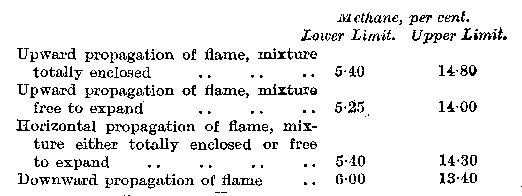
There are several points regarding the other two factors that must be considered. Although the condition of continued upward propagation of flame is not that most likely to occur on a large scale, it is no doubt wise to record the limits found under that condition, since they are of the widest. A uniform inflammable mixture of firedamp and air rarely occurs throughout any considerable area of a coal mine, but when it does the most dangerous lower-limit of methane is that which will allow of self-propagation of flame in all directions, namely, 6.0 per cent. With the lower limit mixture that can propagate flame horizontally but not vertically downwards, namely, 5.4 per cent., the flame would travel near the roof only and would in itself be comparatively harmless, the chief danger of such a mixture lies in its ability to convey flame some distance to richer mixtures.
It is also necessary to consider the practical importance of those experimental results which showed the effect of the mixture being totally enclosed or free to expand. Though there does not appear to be any appreciable difference in the results obtained for horizontal propagation, it has been shown that when the mixture is not free to expand during upward propagation of flame, both the lower and the upper limits have higher values than when release
pressure can occur. In mining practice the conditions under which a mixture of firedamp and air may be inflamed usually approximate to those of the experiments in a vessel partially open, the closeness of the approximation depending upon the rapidity with which the pressure produced by the burning gases can be released. It is possible, however, that in certain circumstances the release might be very slow, as when, for example, the mixture exists in a cavity. It is then necessary to consider the limits pertaining to totally closed vessels.
Presence of Incombustible Gases.
The Effect of Incombustible Gases. — The atmosphere of a coal mine, apart from any methane which it may contain, may differ from the normal air in the proportions of oxygen, nitrogen, and carbon dioxide it contains, as a result, for example, of the absorption of oxygen by the coal. This absorption of oxygen by the coal, in so far as it increases the proportion of nitrogen in the atmosphere, is equivalent to the addition of a certain amount of nitrogen. The combined effect of added nitrogen and carbon dioxide was studied by Haldane and Atkinson in their investigations of the effect of blackdamp on the inflammability of methane. Owing to the fact that the blackdamp they used contained many times more nitrogen than carbon dioxide, the amount of carbon dioxide present in their mixtures was always less than 5.0 per cent. This amount of carbon dioxide has very little effect on the lower limit of inflammability of methane, so that the inflammability of the mixtures tested by Haldane and Atkinson depended chiefly upon the amount of oxygen present in them.
The effect of nitrogen or carbon dioxide added to the air on the limits of inflammability of methane has also been determined by Coward and Hartwell, the addition of the incombustible gas being carried to the point at which no mixture of the prepared atmosphere with firedamp would propagate flame. Since the oxygen-content of the atmosphere is reduced by the addition of the incombustible gas, one would expect there to be a gradual narrowing of the limits until a point is reached at which the upper and lower limits coincide. This is found to be so, but the extent to which the oxygen can be reduced, and an inflammable mixture still be obtained, is not the same for different added incombustible gases. More nitrogen than carbon dioxide can be added to air before the point of non-inflammability is reached, owing no doubt to the much higher specific heat (molecular heat) of carbon dioxide. A certain amount of the heat produced by the inflammation is used in raising the temperature of the incombustible gases present, and since carbon dioxide requires more heat to raise it to a given temperature than does nitrogen, the point of non-inflammability is reached sooner when excess of carbon dioxide is present.
With both nitrogen and carbon dioxide a large proportion has to be added before much effect is produced upon the lower limit. As much as 10 per cent. of carbon dioxide only raises the lower limit by 0.35 per cent. and nearly 35.0 per cent. additional nitrogen must be present to raise the limit by the same amount. A comparatively large addition of carbon dioxide to a mine atmosphere, or the reduction of its oxygen content to a considerable extent, can therefore be made without materially affecting the minimum amount of firedamp required to render the atmosphere inflammable.
With carbon dioxide the limits coincide at a point corresponding with an atmosphere containing just under 25 per cent. of carbon dioxide, and the only inflammable mixture of firedamp with that atmosphere contains 7.3 per cent-, of methane. With nitrogen, just over 38 per cent. can be added before the limits coincide and the amount of methane in the only inflammable mixture with that atmosphere is 6.15 per cent. This difference has been explained as being probably due to the specific heat of carbon dioxide being higher than that of nitrogen. If this is the true explanation, the addition of air of an incombustible gas that has a lower specific heat than nitrogen (or than oxygen, which has a specific heat very similar to that of nitrogen) should cause a lowering of the lower limit of methane. Argon, of which there is normally a little under 1.0 per cent. in the atmosphere, is such a gas and it has been used by Coward and Hartwell to test the explanation of the effects of nitrogen and carbon dioxide.
Experiments with Argon.
By diluting air with 37 per cent. of added argon, and thus reducing the oxygen in the atmosphere to 13.13 per cent., the lower limit of methane is reduced from 5.24 to 4.48 per cent. This can only be because the lower-limit mixture with the normal atmosphere requires more heat to raise it to its ignition temperature than does the lower-limit mixture with the atmosphere consisting of 37 per cent. of argon and 63 per cent. of air, by reason of the low specific heat of argon.
At the upper limit different conditions hold, since the mixtures contain an excess of methane, and the slightest reduction in the oxygen content of the air, whatever the diluent gas that causes the reduction, restricts the amount of methane that can be burnt. As a consequence, the upper limit is narrowed when argon is added just as it is when nitrogen or carbon dioxide is the diluent gas.
These experiments with argon show clearly that the effect of an added incombustible gas on the lower-limit value is mainly due to its specific heat. There is, however, another attribute of a gas which affects its behaviour with respect to the propagation of flame, namely its thermal conductivity. A diluent gas of high thermal conductivity will the more readily help to dissipate the heat produced by combustion, and its presence should tend to raise the lower-limit of a combustible gas.
Since the dilution of mine air by incombustible gases is most often by blackdamp, which consists of nitrogen and carbon dioxide in varying proportions, it is important to be able to gauge the combined effect of these two gases on the limits of inflammability of methane. Determinations of the limits have been made in various atmospheres obtained by the addition of both nitrogen and carbon dioxide to air, and it has been found possible to construct a series of curves which show with considerable accuracy the limits for any mixture of air with carbon dioxide and nitrogen.
Combustible gases other than methane may occur in a coal mine as the result of a heating or fire due to the spontaneous combustion of coal, or in the afterdamp of an explosion. The gases that must chiefly be considered in this respect are hydrogen and carbon monoxide. Combustible gases produced by the heating of coal, such as the higher paraffins, may also occur in small quantities.
Hydrogen and carbon monoxide have wider ranges of inflammability than methane. The lower limit for carbon monoxide is higher and the lower limit for hydrogen (upward propagation of flame) is lower than that for methane. Under similar conditions the ranges of inflammability of the three gases in air are :—
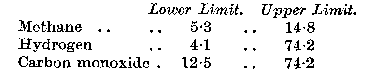
It is clearly difficult to gauge the possibilities of an explosion occurring behind a stopping, but the problem can be stated to be one of deciding whether, apart from the rapidity with which firedamp may accumulate, the greater inflammability of the hydrogen and carbon monoxide that may be present allows of explosive mixtures being formed in any quantity before the reduction in the amount of oxygen, or the production of carbon dioxide, prevent the propagation of flame.
Summary.
Our present knowledge regarding the limits of inflammability of firedamp can be summarised from the point of view of its application to coal-mining problems, as follows :—
The effect of the direction of flame propagation. — A marked effect on the limits is produced by the direction that the flame can take, an effect which can be explained as being that of convection currents. The widest range of inflammability occurs during upward propagation of flame and the narrowest during downward propagation, whilst for horizontal propagation the values are intermediate.
The effect of the manner in which the inflammable mixture is confined. — For horizontal propagation of flame there does not appear to be much difference in the limits whether the mixture is totally confined or is free to expand. For upward propagation, however, the lower-limit is least when the mixture is free to expand and the upper limit is greatest when the mixture is totally enclosed.
The effect of initial temperature and pressure. — Such variations in temperature and pressure as ordinarily occur in coal mines do not appreciably affect the limits of inflammability of firedamp.
The effect of movement of the gas mixture. — A mixture of firedamp and air containing about 5.0 per cent. of firedamp can propagate flame (a) under certain limiting conditions of turbulence of the mixture, or (b) when the mixture is travelling as a slow current.
Values for the limits. — The significant values for the limits, the mixtures being at ordinary mine temperatures, and pressures and consisting of air and firedamp only, are as follows :—
(A) Quiescent Mixtures.
(B) Turbulent Mixtures.
Lower limit, 5.00 per cent. methane. Upper limit not yet determined.
(C) Mixtures Travelling As Currents.
Lower limit, 5.05 per cent. methane, speed of current being not less than 69 and not more than 128 feet per minute. No observations with regard to the effect on the upper limit.
The effect of the composition of the atmosphere. — The presence of water-vapour in the atmosphere does not appreciably affect the lower limit of inflammability. The reduction of the oxygen content of the air narrows the limits, the upper limit being affected mere than the lower, until, when the air contains 13 per cent. of oxygen, they coincide and only one mixture, containing about 6 per cent. of methane, can propagate flame. If the reduction of the oxygen-content is brought about by the addition of carbon dioxide, the limits are narrowed more rapidly, owing to the specific heat of carbon dioxide being higher than that of nitrogen.
The effect of the presence of another combustible gas is dependent on the nature of that gas and can be calculated from the known values for its limits of inflammability with air alone.
 |
 |
| Names mentioned in this article | |
 |
 |
| Name | Age | Occupation | Notes |
|---|---|---|---|
| Atkinson, — | |||
| Burgess, M. J. | S.M.R.B. | ||
| Coward, — | |||
| Coward, H. F. | S.M.R.B. | ||
| Haldane, John Scott | Whos Who Page | ||
| Hartwell, — | |||
| Wheeler, Richard Vernon | S.M.R.B. | Whos Who Page |
 |
 |
| Related Articles | |
|
|
| Pub. Date | Article (Newspaper) |
|---|---|
| 15 Aug 1925 | Ignition Of Fire-Damp (The Science and Art of Mining) |
| 15 Aug 1925 | Research Board's Report (The Science and Art of Mining) |
| 21 Nov 1925 | Electrical Exploders For Shot-Firing (The Science and Art of Mining) |
| 21 Nov 1925 | Stone Dust (The Science and Art of Mining) |
| 06 Dec 1925 | Coal Dust Explosions (The Science and Art of Mining) |
| 02 Jan 1926 | Falls Of Ground, Support of Workings in Mines Committee Reports (The Science and Art of Mining) |
| 16 Jan 1926 | Limits Of Inflammability Of Firedamp And Air (The Science and Art of Mining) |
| 16 Jan 1926 | Gauge For Measuring Pressures (The Science and Art of Mining) |
| 30 Jan 1926 | The Composition Of Coal (The Science and Art of Mining) |
| 27 Mar 1926 | Pressure Wave Of Explosives (The Science and Art of Mining) |
| 10 Apr 1926 | Limits Of Inflammability (The Science and Art of Mining) |
| 24 Apr 1926 | Electric Ignition Of Firedamp (The Science and Art of Mining) |
| 31 Jul 1926 | Rock Drill Dust (The Science and Art of Mining) |
| 31 Jul 1926 | News (The Science and Art of Mining) |
| 04 Aug 1926 | Ignition Of Firedamp (The Science and Art of Mining) |
| 28 Aug 1926 | Coal Dust (The Science and Art of Mining) |
| 25 Sep 1926 | Firedamp Explosions (The Science and Art of Mining) |
| 09 Oct 1926 | Spontaneous Combustion (The Science and Art of Mining) |
| 12 Feb 1927 | News and Notes (The Science and Art of Mining) |
| 26 Feb 1927 | Safety In Mines Research Board (The Science and Art of Mining) |
| 12 Mar 1927 | Methods Of Working And Support (The Science and Art of Mining) |
| 23 Apr 1927 | Inflammability Of Coal Dusts (The Science and Art of Mining) |
| 23 Apr 1927 | News and Notes (The Science and Art of Mining) |
| 07 May 1927 | News and Notes (The Science and Art of Mining) |
| 18 Jun 1927 | Safety In Mines, Research Station at Buxton (The Science and Art of Mining) |
| 02 Jul 1927 | Buxton Research Station (The Science and Art of Mining) |
| 30 Jul 1927 | News and Notes (The Science and Art of Mining) |
| 13 Aug 1927 | Safety In Mines Research (The Science and Art of Mining) |
| 11 Feb 1928 | Flame Caps (The Science and Art of Mining) |
| 11 Feb 1928 | Lighting Power Of Safety-Lamps (The Science and Art of Mining) |
| 25 Feb 1928 | Mining Electrical Research (The Science and Art of Mining) |
| 19 Jun 1928 | Mine Explosions, Results Of Research Work (The Times) |
| 30 Jun 1928 | Safety In Mines Research Board, Report for 1927 (The Science and Art of Mining) |
| 30 Jun 1928 | Firedamp Explosions (The Science and Art of Mining) |
| 20 Oct 1928 | Safety In Mines Research (The Science and Art of Mining) |
| 01 Dec 1928 | "Sparks" And Ignition Of Firedamp (The Science and Art of Mining) |
| 15 Dec 1928 | Explosibility Of Coal Dusts (The Science and Art of Mining) |
| 29 Dec 1928 | Pyritic Oxidation (The Science and Art of Mining) |
| 26 Jan 1929 | Explosions Within Closed Vessels (The Science and Art of Mining) |
| 21 Sep 1929 | Popular Lectures For Miners (The Science and Art of Mining) |
| 31 May 1930 | Steel Pit Props (The Science and Art of Mining) |
| 06 Sep 1930 | Northern Engineers Meet (The Science and Art of Mining) |
| 20 Sep 1930 | Support Of Underground Workings (The Science and Art of Mining) |
| 05 Mar 1932 | The Combustion Of Coal Dust (The Science and Art of Mining) |
| 23 Dec 1933 | Preventing Ignitions Of Firedamp, Impact of Picks Against Rocks (The Science and Art of Mining) |
| 09 Jun 1934 | Firedamp Explosions: The Projection Of Flame, The Effect of Branch Galleries and of Bends (The Science and Art of Mining) |
| 21 Jul 1934 | Props — Lids — Bars, Research Committee's Pamphlet (The Science and Art of Mining) |
| 21 Jul 1934 | Simultaneous Shot-Firing (The Science and Art of Mining) |
| 08 Dec 1934 | Wave Sent Out By Explosives (The Science and Art of Mining) |
| 31 Aug 1935 | Safety In Mines Research, Board's Annual Report (The Science and Art of Mining) |
| 14 Sep 1935 | Ignition Of Firedamp By Compression (The Science and Art of Mining) |
| 29 Feb 1936 | Colliery Winding Ropes (The Science and Art of Mining) |
| 12 Sep 1936 | Safety In Mines Research, Board's Annual Report (The Science and Art of Mining) |
| 26 Sep 1936 | Research Work (The Science and Art of Mining) |
| 24 Oct 1936 | Roof Supports (The Science and Art of Mining) |
| 30 Jan 1937 | Pamphlet On Protective Equipment (The Science and Art of Mining) |
| 11 Sep 1937 | Safety In Mines Research, Board's Annual Report (The Science and Art of Mining) |
| 25 Sep 1937 | Protective Equipment (The Science and Art of Mining) |
| 25 Sep 1937 | Coal Measure Rocks (The Science and Art of Mining) |
| 15 Jan 1938 | Haulage Drawgear Failures (The Science and Art of Mining) |
| 15 Jan 1938 | Examination Of Colliery Ropes (The Science and Art of Mining) |
| 08 Oct 1938 | Safety In Mines Research, Board's Annual Report (The Science and Art of Mining) |
| 05 Nov 1938 | Wire Ropes, Careful Examination Emphasised (The Science and Art of Mining) |
| 03 Dec 1938 | Analysis Of Mine Dusts (The Science and Art of Mining) |
| 14 Jan 1939 | Fibre Cores For Winding Ropes (The Science and Art of Mining) |
| 12 Aug 1939 | Safety In Mines Research, Board's Annual Report (The Science and Art of Mining) |
| 26 Aug 1939 | Falls Of Ground, District Investigations (The Science and Art of Mining) |
| 26 Aug 1939 | Haulage Problems (The Science and Art of Mining) |
| 07 Oct 1939 | Noise In Coal Mines (The Science and Art of Mining) |
| 07 Oct 1939 | Wire Ropes, Examples of Deterioration (The Science and Art of Mining) |
| 07 Oct 1939 | Dust Production And Suppression (The Science and Art of Mining) |
| 21 Oct 1939 | Inflammability Of Coal Dusts (The Science and Art of Mining) |
| 21 Oct 1939 | Detection Of Heatings (The Science and Art of Mining) |
| 18 Nov 1939 | Ignition By Sparks From Picks (The Science and Art of Mining) |
| 16 Dec 1939 | Falls In Broken Workings (The Science and Art of Mining) |
| 16 Dec 1939 | Flameproof Releases (The Science and Art of Mining) |
| 13 Jan 1940 | Back-Stays In Mines (The Science and Art of Mining) |
| 09 Aug 1941 | Safety In Mines Research, Eighteenth Annual Report (The Science and Art of Mining) |
| 23 Aug 1941 | Safety In Mines Research — II, Eighteenth Annual Report (The Science and Art of Mining) |
| 06 Sep 1941 | Safety In Mines Research — III, Eighteenth Annual Report (The Science and Art of Mining) |
| 20 Sep 1941 | Research Pointers (The Science and Art of Mining) |
| 21 Feb 1942 | Safety In Mines Research, Nineteenth Annual Report (The Science and Art of Mining) |
| 30 May 1942 | Coal Dust Explosions (The Science and Art of Mining) |
| 06 Feb 1943 | Safety In Mines Research, Twentieth Annual Report (The Science and Art of Mining) |
| 20 Feb 1943 | Safety In Mines Research — II (The Science and Art of Mining) |
| 06 Mar 1943 | Safety In Mines Research — III (The Science and Art of Mining) |



 Contains public sector information licensed under the

