


| Newspaper Articles |

|
Newspaper Articles |
 |
 |
12th March 1910, Page: 2, Column: 5
Rhondda Dam Bursts
Raging Torrent Of Water
Sweeps Down The HillsideSchools Inundated
Five Drowned : Child Missing
Eleven Houses Wrecked
Scattered Like Skittles In All Directions
Plucky Rescues By Teachers & Miners
A catastrophe of an unprecedented character in the history of the Rhondda, and one which resulted, so far as was known at a late hour on Friday night, in the loss of five lives, occurred at Clydach Vale on Friday afternoon, an immense flood of water from a level gushing forth, and bringing death and destruction in its track.
The Death Roll.
The names of those known to have perished are as under:—
Enid Howells, aged six, of 64, Wern-road, daughter of Mr. John Howells, cashier at the colliery, died from shock after being rescued from the schoolyard and taken home.
Blodwen Davies, aged nine, of Howard's-terrace, daughter of Mr. Morgan Davies, overman at the colliery, drowned.
Mrs. Elizabeth Ann Williams, aged 34, wife of Evan Williams, of 9, Adam-terrace, and her infant child, aged four months.
Infant daughter of Mr. T. R. Brindle, collier, Adams-terrace, died from shock, after being rescued and temporarily resuscitated.
Missing
Gertrude Rees, aged four, daughter of Thomas Rees, Morien-street.
The disaster was as unexpected as it was terrible. The level had not been worked for some years, and it was known that a quantity of water had accumulated there. Messrs. Pugh and Thomas, contractors, were at work, it is said with the object of diverting it to an adjoining stream.
Without warning there was a terrific flood, appalling in its consequences. It swept along with terrifying rapidity, and undermined several houses in Adam-street, crumbling them like a pack of cards.
On the opposite side of the main road are the village schools, and there at the moment were no fewer than 900 children, boys and infants. Mr. R. R. Williams, the headmaster, saw the approaching danger, and at once did what he could to allay fear and prevent panic.
The lady teachers also kept cool under the circumstances, for in a moment the avalanche came and dealt destruction. The wall of the infants' school was swept away, and this, peculiarly enough, was a lucky happening, the stream thus being diverted to the colliery line.
Mr. D. Rees, senior assistant, succeeded in getting out all the elder children. The flood gained in velocity as it went down the Blaen-clydach hill, entirely stopping all traffic, and it is astounding how huge boulders were tossed about by the torrent.
In the infants' school the scene baffled description, the water being at least 4ft. deep, and desks and other furniture were actually floating about. The two mistresses acted with great presence of mind, carrying child after child to places of safety.
Numerous colliers were at the time returning from work, and, with the bravery and promptitude which characterises the Welsh miner, they put in heroic service.
Deputy-chief-constable Cole immediately drove to the scene of the occurrence and drafted a large number of constables under the charge of Inspector Hole so as to render assistance.
A feature of the happening was the remarkable pluck of the women of the village, who waded into the water to save life and belongings.
Miraculous escapes are recorded, and there were many acts of gallantry.
Cause Of The Disaster
Burst Dam Lets Loose a Torrent
The cause at the disaster was the bursting of an old disused level high up the hillside at Clydach Vale, owned by Messrs. Perch and Co., who, it may be remarked, were the founders of the Dinas Colliery, the oldest concern in the valleys. It is some years since there was any work at this level, with the result that it had become filled with water like a cistern, with a resulting huge accumulation of water. For some time past percolations of water gave rise to some apprehension, it being known that inside the old workings it must have formed a collecting ground for a huge reservoir. This ominous sign was taken note of, with the result that the residents in the immediate vicinity had been apprised of a possible bursting of the natural dam and an overflow of the water into the streets. Operations were, consequently, commenced with a view to averting any such calamitous contingency, and it was during the course of this work of tapping the reservoir that the wall of the cavity formed by the extraction of the seam of coal suddenly gave way.
Near the spot where the burst occurred building operations were in progress, and it was at the suggestion of the contractors, Messrs. Pugh and Thomas, that it was thought desirable that something should be done in the direction of emptying the accumulated water.
It was about four o'clock that the men realised the danger of the situation. The mountainside seemed to give way as though from a volcanic eruption, and, according to an eye-witness, a torrent of water, together with masses of earth and stone, swept down the hillside with fearful force, carrying everything before it in its mad and swift career. Along this precipitous declivity the terrible volume, which it is no exaggeration to say comprised millions and millions of gallons and thousands of tons of earth and stone, demolished every obstacle that stood up in its path. The inrush followed the natural conformation of the surface ground, aad its course was in the direction partially crossways to the residential portion of the village.
Fell Like Pack of Cards
Adams'-terrace, however, stood right in the track of the avalanche, and the very first house encountered was in a moment completely wrecked like a pack of cards, and the occupants, Mrs. Elizabeth Ann Williams and her infant child, perished.
Altogether eleven houses and a shoemaker's shop were wrecked, one being completely washed away. Furniture was scattered like skittles in all directions, and the streets were literally strewn with the belongings of the unfortunate inhabitants, who had rushed pell-mell for their lives to places of safety, all being thoroughly bewildered by the unexpected visitation.
A Heartrending Scene
The disaster was not confined to the immediate vicinity of Adams'-terrace, for the deluge dashed down the steep gradient into Clydach Vale Council Schools, where at the time some 900 children were congregated, and if the scene at Adams'-terrace was one never to be forgotten, that in the village schools was far more heartrending in its character, and equally as disastrous in its results.
The teachers had just been given a moment's warning, but ere anything could be done the flood was upon them, bursting through the windows and doorways, and completely swamping the various departments.
The two departments which, however, suffered most were the infants' and the girls'. Miss Hughes, the assistant-mistress in the infants' department, happened to be in the playground at the time, and directly she noticed the water flooding around her she dashed into the school, and told the children to get on the desks Mr. Rees, the assistant-master, giving a similar order.
Colliers to the Rescue
Meanwhile several colliers, who chanced to be returning from work, climbed upon the walls of the playground, and directed the rescue of the children through the windows of the school by placing baulks of timber and ladders from the wall to the windows. The children were then conveyed to a side room. Miss Hughes and the rest of the staff took part in this, and the colliers showed no little courage in wading waist-deep into the water. In this way many lives were saved. Naturally, the little ones were terror-stricken, and many of them cried piteously. Mr. Robert R. Williams, the headmaster, and Mrs. Colville, the mistress of the staff, did everything possible to calm their fears and prevent panic, but, despite the efforts of all, one of the children, Blodwen Davies, aged nine, was drowned, and another, Enid Howells, aged six, died from shock after being conveyed to her home. The former was carried away by the torrent after the collapse of the school boundary-wall.
A touching incident is related of the child Blodwen Davies. It is stated that she was particularly anxious to stay away from school on Friday afternoon, but was persuaded to go in order not to break her attendance. Mrs Davies, the mother, was in the village when the body was taken home, quite unconscious of her sudden bereavement, and a friend gently hinted to her that she was wanted at the house. The water had stripped the body of nearly all the clothing. The deceased was a niece of Mr. Frank James, Clydach Vale Hotel.
Children Floating Like Corks
But for the timely assistance rendered by the colliers coming from work it is very evident that the loss of life would have been considerably heavier. The mighty torrent of water swept down by the schools with such rapidity that, despite the heroic efforts made by the teachers to clear the school of the children, the latter were hurled in all directions, and were soon floating about the playground like so many corks.
The colliers dashed into the water and recovered child after child, handing each one over the boundary walls to the willing hands which were ready to receive them on the other side. Police-constable Thorburn himself rescued over six little girls from what was imminent death. Too much praise cannot be given to the teaching staff for the splendid presence of mind which they displayed when the disaster overcame them.
Mother and Babe Rescued
The experiences which befell Mrs. John, wife of the Rev. S. B. John, Baptist minister, Rhondda View, was of a most trying character. Mrs. John had given birth to a child on Friday, and the torrent dashed with frightful force against the house, causing it to be in imminent danger of collapse. To those who knew the circumstances it was exceedingly painful to think of what might momentarily happen, but, wading through the huge stream in a daring manner, Mr. D. W. Jones effected an entrance into the house, and, with assistance, succeeded in conveying the invalid and her babe to a place of safety.
Heroic Rescues
The Headmaster's Graphic Story
Mr. R. R. Williams, headmaster, discussing the accident, stated that shortly before four o'clock he happened to be in No. 1 Class-room, when he saw a rushing stream of water coming down between Saron Chapel and Dr. J. Jones's house. He immediately saw that the old level, of which they had been suspicious for some time, had burst. Without loss of time, he gave instructions to dismiss the boys, whilst he rushed out to open the gate leading from the girls' and infants' yards into the boys' yard. It was intended that this should be the means of escape for the whole of the children, but no sooner had 50 or 60 boys got away in this way than a tremendous volume of water presented itself, with the result that this means of escape was cut off.
In the meantime Mr. Williams had rushed towards the girls' and infants' departments, directing what should be done to get the children out of school in safety, but when he got into the girls' school he found that the water was rushing full strength through the main corridor of the school into the yard. The infants' department was even worse. This was completely inundated, and the children were being tossed about in all directions. Soon after this the top wall of the yard of the girls' school gave way with a tremendous crash owing to the force of water. Thus all possible means of escape were cut off, and the children were seen floating about in the water. One of the teaching staff in the girls' department, Mrs. Colville, was in such a helpless condition when the head master reached the girls' department that she had to be rescued.
Fortunately, by this time the colliers were coming home from work, and having seen what had happened, they immediately rushed into the school and rendered every possible assistance. They procured planks of wood and ladders, and managed to get into the children's playground. By this means they then clambered over the walls, dived into the water, and handed the children over as best they could.
Recovering the Bodies
Both Mrs. Williams and her infant were washed completely out of their house, and the two bodies were recovered about 200 yards away in a house in course of erection.
The body of the girl Blodwen Davies, who was drowned in the schoolyard, was washed away to a distance of about half-a-mile, being recovered near the Bush House.
The girl Enid Howell was rescued from the schoolyard, but died from shock after being conveyed home.
Houses Swept Away
It is difficult to estimate the extent of the damage by this terrible visitation, the like of which is unprecedented in the history of the Rhondda. It was really pitiful to watch the homeless people wandering about the scene of the accident late on Friday night. Several houses have been completely swept away with all their contents, and all the poor inhabitants had to do was to rely on the charity of neighbours in the low-lying district of Tonypandy for shelter for the night.
In Adams'-street six houses have been completely wrecked, one of them being absolutely washed away. The others are rendered utterly uninhabitable.
Five houses in Rhondda View were also wrecked, one being entirely washed away.
A shoemaker's shop in Wern-road was likewise washed away.
Considerable damage has also been done to other property in Wern-street and at the top of Clydach-road.
It is estimated that there was about 1½ mile of accumulated water in the old level at the time it burst, and up to midnight it had not stopped running, although workmen had been busy during the evening in digging new channels for the water to flow away.
It is rather fortunate that the disaster occurred during the daytime, otherwise it is difficult to estimate what damage might have been done. The scene of the calamity was visited by thousands of people during the evening, who were at a loss to understand why a new channel had not been made for the water previous to the disaster.
The force of the water having carried the boundary walls completely on to the Taff Vale Railway underneath, traffic for the time being has been rendered impracticable.
Gas Put Out
When darkness set in it was found that the gas mains had been affected, and lamps had to be procured. The council at once engaged a number of men to do what was possible.
The news was received by Mr. T. W. Berry, local director of education, whilst the school managers
Torn from Father's Grasp
Wiring at three a.m., one of our reporters states that it was impossible at that time to ascertain the number of victims of the Clydach Vale disaster, it being feared that, more bodies might be found under the huge masses of debris carried down from the mountain. The infant daughter of a collier, named T. R. Brindle, of Adams-terrace, who had been rescued and resuscitated, died later from shock, so that it was definitely known that the death roll had already reached five, while another little one was reported missing. This was Gertrude Rees, aged four, daughter of Thomas Rees, of Marian-street, Clydach Vale, and though search parties went out, they failed to find any trace of her.
Particularly pathetic was the experience of the man Brindle, especially as it was accompanied by a fatal sequel. Mr. Brindle had his infant daughter in his arms, but so powerful was the current that the little one was torn from the father's grasp and carried away to a considerable distance. She was rescued alive, but died at ten o'clock from shock.
The work of clearing the roads and the search for bodies was extremely difficult and arduous, for the street was placed in total darkness by the gas supply failing, this being probably due to the torrent tearing up the mains. For a long time the water rushed with very little abatement, it being computed that the workings which had been filled from the recent heavy rains covered an area of about four miles, so it will be realised what an enormous reservoir must have existed in the mountainside. The danger of a greater inrush was apparently over.
Scene of Devastation
The vicinity of the catastrophe presents a remarkable scene of devastation. Huge fissures indicating the course of the current are to be seen on the mountainside, whilst the road and the adjoining ground are strewn with tremendous boulders and stones torn from the walls of buildings. Hardly a stone remains of the house in which Mrs. Williams resided.
Men worked all through the night in the streets by the light of colliers' lamps.
The immensity of the released water might be further realised by the statement that the River Rhondda, into which the water eventually worked its way, presented the appearance of heavy floods, and its yellowish hue indicated the huge mass of subsoil it carried with it.
As a sad coincidence it may be re-called that the last disaster in the village was the terrible explosion at the Cambrian Colliery exactly five years ago.
Who Is Responsible?
At the time of the disaster a meeting of the Rhondda Council was being held, and the greatest consternation prevailed when Mr. W. T. Berry, director of education, announced that the children at the school were being imprisoned by the flood. The council meeting at once adjourned, and visited the scene, whilst later a special meeting was held, at which the following official report was handed to the press by Mr. W. P. Nicholas, the clerk:—
After inspecting the scene of the disaster the council passed a vote of condolence with the bereaved relatives, and instructed the clerk to retain the services of an expert to visit the scene of the disaster and report fully thereon to the council with the view of proceedings being taken for the recovery of damages. The clerk was instructed to take such steps as may be necessary for the council to be represented at the inquest.
Mr. Nicholas, in a conversation with an "Evening Express" representative, further wished to make it clear that his council have no jurisdiction over the levels, which, he stated, were private properties, the same as colliery undertakings, so far as the council was concerned. The council became acquainted with the fact that streams of water were coming out of the workings and causing a good deal of uneasiness, and they called upon the estate agents to take some steps in the matter. Some correspondence ensued, and as a result of the council's communication with them the agents afterwards took steps to have the accumulation of water removed.
So far as the colliery management are concerned, we have been asked to state that Mr. Leonard Llewelyn has deeply interested himself in the matter for the past four months, and that he had drawn the attention of the district council to the danger which threatened. Mr. Llewelyn had himself visited the spot and measured the depth of the water on different occasions.
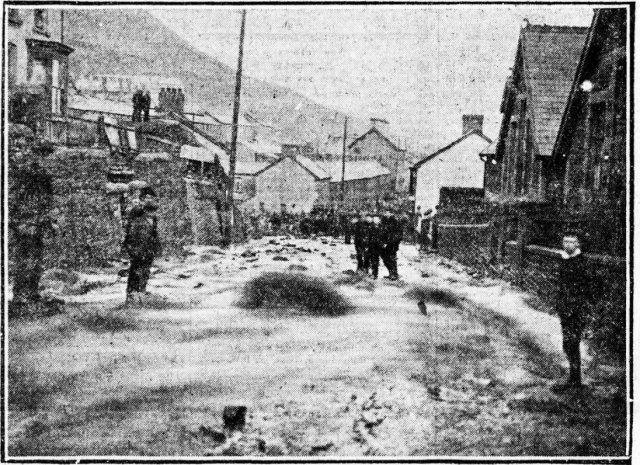
A View Of The Flooded Street
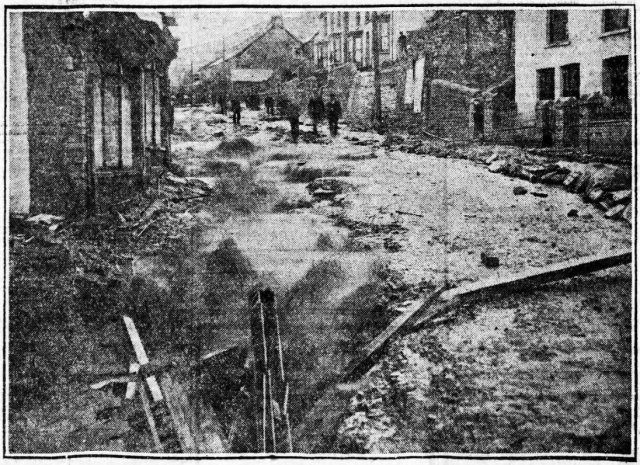
The Collapse Of A House. The Roof Is Seen In The Middle Of The Torrent
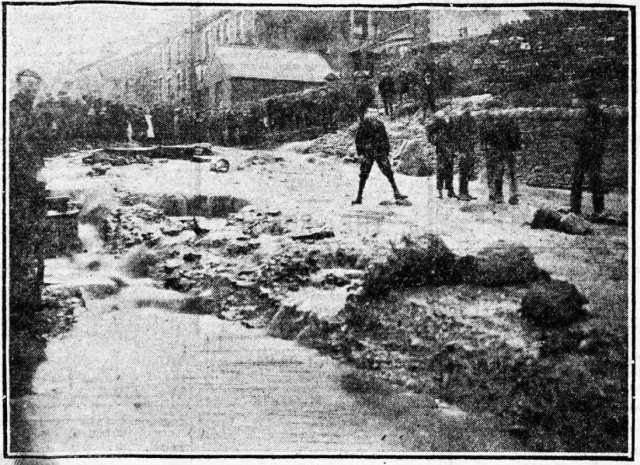
Crowds Watching The Torrent
 |
 |
| Names mentioned in this article | |
 |
 |
| Name | Age | Occupation | Notes |
|---|---|---|---|
| Berry, T. W. | |||
| Brimble, Haydn | Deceased, Individual Page | ||
| Brimble, T. R. | Collier | ||
| Brindle, T. R. | Director of Education | ||
| Cole, — | Deputy Chief Constable | ||
| Colville, —, Mrs. | Mistress | ||
| Davies, —, Mrs. | |||
| Davies, Blodwen | 9 | Deceased, Individual Page | |
| Davies, Morgan | Overman | ||
| Hole, — | Police Inspector | ||
| Howells, Enid | 6 | Deceased, Individual Page | |
| Howells, John | Colliery Cashier | ||
| Hughes, —, Miss | Assistant Mistress | ||
| James, Frank | Innkeeper | ||
| John, —, Mrs. | |||
| John, S. B., Rev. | Baptist Minister | ||
| Jones, D. W. | |||
| Jones, J., Dr. | |||
| Llewelyn, Leonard | |||
| Nicholas, W. P. | Clerk | ||
| Perch, — | Mine Owner | ||
| Pugh, — | Contractor | ||
| Rees, — | Assistant Master | ||
| Rees, D. | Senior Assistant | ||
| Rees, Gertrude | 5 | Missing, Individual Page | |
| Rees, Thomas | |||
| Rees, Thomas | |||
| Thomas, — | Contractor | ||
| Williams, Elizabeth, Mrs. | 34 | Deceased, Individual Page | |
| Williams, Evan | |||
| Williams, Myfanwy | Deceased, Individual Page | ||
| Williams, Robert R. | Headmaster |
|
|
| Links to Collieries/Mines mentioned in this article | |
|
|
 | Ffynnon Dwyn Colliery |
 |
 |
| Related Articles | |
|
|
| Pub. Date | Article (Newspaper) |
|---|---|
| 11 Mar 1910 | Rhonnda Disaster, Children Reported Drowned (The Cardiff Times) |
| 11 Mar 1910 | Old Level Dam Bursts at Clydach Vale, Rushing Torrent Overwhelms Two Children (Evening Express) |
| 12 Mar 1910 | Rhondda Dam Bursts, Raging Torrent Of Water, Sweeps Down The Hillside (Evening Express) |
|
|
| Links to related pages | |
|
|
 | Main page for Ffynnon Dwyn |
| Accident/Disaster Page |



 Contains public sector information licensed under the

