


| Newspaper Articles |

|
Newspaper Articles |
 |
 |
8th April 1869
Underground Life
We are mining people. At home we have an incalculable store of underground riches, and abroad not only have we colonies abounding in mineral wealth, but British capital is largely invested in mining enterprises in nearly every part of the globe. The subject, therefore, of M. Simonin‘s book is of national interest. Moreover, the book itself, in its French as well as its English garb, is externally attractive ; it is well printed in good legible type, and is illustrated with numerous woodcuts, chromolithographs of minerals, and coloured geological maps. The illustrations differ widely in character, and may be classified under three heads — the useful, the useless, and the sensational. The useful are exemplified by the woodcuts of the fossils of the coal formation, and of boring and mining implements, and especially by the maps ; the useless, by the chromolithographs of minerals, of which the species, with only a few exceptions, could not be recognized by a practised mineralogist ; and the sensational by the purely ideal representation of colliers tumbling down pits, blown to atoms by fire-damp, suffocated by after-damp, crushed to mummies by falls of the roof, or drowned wholesale by sudden inundation. It is proper the public should be informed respecting the dangers which, we fear, are necessarily attendant in a certain degree on a collier's occupation, in order that sympathy may be excited on his behalf, and every effort made to lessen his risks. That result, however, we think, is more likely to be attained by accurate descriptions of colliery accidents than by any ghastly pictorial display of shattered legs and arms, and putrescent corpses, some with heads and others with heels uppermost. (See fig. 87.) These accidents have often been so terrific and disastrous that the publication in the newspapers of a plain and simple narrative of their nature and of the number of their victims has stirred every heart, the Queen's as well as her poorest subject's ; and no sooner has an appeal been made through the Press for succour to the widows and orphans of the killed than money has flowed in copiously from every quarter. There may, indeed, be human beings who need such a stimulus as M. Simonin‘s woodcuts in order to excite them to deeds of benevolence ; but such persons, we fear, are not likely to become purchasers of his book. In an artistic point of view, some of these woodcuts have considerable merit, in grouping and chiaroscuro, as well as in execution ; they are eminently French in style, and any person practically acquainted with the various schools of engraving on wood would instantly detect their paternity. With regard to M. Simonin‘s attempts at pictorial mineralogical illustrations, it is only just to state that he has had predecessors in the same line who have failed equally with himself. As an instance, we may mention Mr. Philip Rashleigh, M.P., F.R.S., &c., of Cornwall, who in 1797 published a costly work on British minerals, embellished with numerous coloured engravings.
The author of the book is a French mining engineer, who tells us that he has long sojourned with the miner both in Europe and in America, and that his object is not only to amuse but to instruct us. The translator is one of the most experienced officers of the Geological Survey of Great Britain, and he has, to use his own language, "adapted" the book to our present requirements. He has suppressed portions of the original book, and has added new and, as we think, valuable material of his own. But, whether from modesty or other motive, he has not supplied the means to enable us to ascertain how far his adaptation extends. This is a growing practice among translators, and it is not altogether satisfactory, for, on reading the translation without carefully comparing it with the original, it is difficult — nay, impossible in many cases — to determine what belongs to the author and what to the translator.
The book is divided into three parts ; the first treats of coal mines, the second of metalliferous mines, and the third of mines of precious stones ; and in this order of sequence we shall present our observations. As, in the necessarily limited space at our command it is impossible even to touch upon many of the interesting subjects treated by the author, we shall select such as seem to be especially deserving of attention.
There is an interesting chapter on the distribution of coal throughout the world ; and it is gratifying to learn that for ages to come the known accumulation of that precious mineral will amply suffice for the wants of the human race. But there is reason to believe that many a coalfield remains to be discovered. China has excellent coal, which has been tried in our ships of war and found equal to the best steam coal of South Wales. All that is needed to render China a great coal-producing country is the introduction of the modern system of extraction, under the direction of skilful and energetic mining engineers. One great European Power has an eye on the coalfields of that vast empire. The Japanese work coal in the neighbourhood of Nagasaki, and the quality is said to be good. There is coal in Sumatra, in New Zealand, in New Caledonia, and in Australia. To enumerate, indeed, all the localities in which coal has been found would be wearisome to the general reader, and for such information M. Simonin‘s book may be consulted with profit. Here, however, a few words of caution to the public may be in season. The word "coal" is applied to mineral substances which, in respect of heat giving power, manner of burning, and, consequently, of pecuniary value, differ greatly from each other. Coal in a geological sense may be one thing, and in a commercial sense a very different thing. We have examined coal from nearly every recorded locality, and not unfrequently we have seen fallacious estimates of value formed on the supposition that coal is coal all the world over, just as gold is gold, or silver is silver.
The art of boring in search of coal or water has in recent years been carried to extraordinary perfection, and is described by M. Simonin in an agreeable and instructive manner. He gives an account of some of the most remarkable operations of this nature, especially those which have been conducted by French engineers. Boring for coal may in some cases yield an uncertain result, as the spot selected may be over what is termed "a fault" — that is, a natural dislocation of the strata, which has caused the local absence of the mineral. We have even seen coalpits sunk on "faults" of which the existence was not suspected. It is proposed that in certain districts in England the Government should be called upon to incur the expense of boring for coal, on the ground that the question is one of national concern. But who, it may be asked, would be the first and chief gainers by the discovery of coal ? Clearly the landed proprietors, who own the coal. The value of their estates might be thereby enormously increased ; and it is for them to make the trial, not the Government. The circumstances must, indeed, be exceptional to justify the appropriation of public money in such hazardous enterprises.
M. Simonin has a fling at geologists, though himself professedly one of the brethren. Thus, he says, in alluding to the discovery of coal in the department of the Pas-de-Calias, and the rapid acquisition of wealth in consequence :—
"Chance and geology have contributed to promote this happy change ; chance even has effected nearly all, for geology, having got on a wrong scent, has been searching to no purpose around Arras for the continuation of the Valenciennes basin. The normal prolongation of the strata was, in fact, in that direction ; but the geologists failed to perceive that there was, as it were, an underground ridge of the older rocks taking a sharp bend backwards from its former direction at Valenciennes in the direction of Douai." — P.73.
As this passage has received no comment from the translator, who is a practical geologist of great experience, we may fairly accept it as correct. Geologists, like all other men of science, have made mistakes ; but they have, nevertheless, rendered substantial service and prevented many a capitalist from wasting his money in a search after coal, where it was absolutely certain none could exist.
When Mr. Vivian addressed the House of Commons about two years ago in support of his motion for the issuing of a Royal Commission to inquire into the probable duration of our coal, he somewhat startled his audience by announcing the probable existence of coal under the very floor of the House. It was the well-known geologist, Mr. Godwin-Austen, who originated this speculation. The evidence he advances is of a purely technical character, and would be out of place here. It is sufficient to state that some eminent geologists differ from Mr. Austen on this point. There is an excellent article on the subject by the translator, in which all the data have been collected. He adds :—
"As the problem can only be solved by actual experiments, of too costly a nature to be made by private individuals, it is to be hoped that a few borings may be made in the most favourable places at the public expense ; for the question is a national one, and where the interests of the country at large are concerned, it is but fair that each member of the community should bear his share of the cost."
For reasons which we have previously stated, we hope the Government will do no such thing. Although each member of the community might contribute his share of the cost, yet it is certain that each member would not receive his proportionate share of the gain. Supposing coal to exist under London at a workable depth, it would be worthless, because it would not be possible to win it without causing damage to the buildings on the surface to an amount vastly exceeding the value of the coal when raised.
We are informed by M. Simonin, that, — "As regards artistic constructions, modes of working, internal management, and surface arrangements, everything is with them (i.e., the English) inferior to what is seen in many coal mines in France and Belgium"(p. 143). We are surprised that such a statement should have been allowed to pass unchallenged by the translator, who ought to have known that it was not true. While we admit that in some of the colliery districts in Great Britain, especially in former times, the winning of coal has been conducted in a slovenly and wasteful manner, owing to the ignorance of the persons entrusted with the management, we deny the universal inferiority of British collieries to those of France and Belgium, with regard to mechanical appliances, methods of winning, and other arrangements. In all these respects many of our collieries are unsurpassed, even by those of France, as every practical and unprejudiced mining engineer would admit, and as might easily be demonstrated to the satisfaction of the general reader, if space permitted. The author frequently obtrudes upon us his claim to be considered as a mining engineer of long and varied experience ; but he has certainly not yet given any proof that he ought to be accepted as an eminent authority in that capacity, and we know that he is not received as such either in his own country or in England. As an instance of his want of practical information, we refer to his representation of the workings of a thick-coal colliery in South Staffordshire (see fig. 58, p. 129). The roof is shown to be supported by pillars of coal of about 2ft. square, to judge from the size of the colliers near them. The fact is, that the actual pillars are from eight to ten yards square, as we ourselves have repeatedly observed, and such slender columns as those in the woodcut in question would be crushed to dust in a second under the circumstances.
The importance of correct underground plans is properly insisted on, and is now generally acknowledged. Without such plans no colliery can be economically and safely worked ; and they are, moreover, essential in order to prevent colliery proprietors from driving beyond their own boundaries and appropriating the coal of their neighbours. By transgressions of this kind coal has been stolen to an almost incredible extent. If the robbery be not detected and legal proceedings taken within six years, claim for compensation is barred by the Statute of Limitations. Now, it has often been impossible to obtain evidence of the crime — for crime it is — until after the lapse of six years, and nothing has arisen to excite even suspicion of the theft while in course of perpetration. There is no power to enable the proprietor of land adjoining other land on which a colliery is situate to survey the underground workings, unless evidence can be procured sufficient to justify an application to the Court of Chancery, on the subject ; and under any circumstances it would be exceedingly difficult, and in some impossible, to obtain such evidence. Only a short time ago we were informed by an eminent Chancery barrister that he had not fewer than three cases of colliery encroachment under his consideration at the time ; and in one the entire coal of an estate had been stolen, without hope of compensation, owing to the application of the Statute of Limitations. Again, encroachments, when not followed by theft of coal in a notable degree, may cause incalculable damage to an adjoining proprietor. Thus, as coal is extracted, water may and often does accumulate in its place, which ought to be restrained by a strong barrier or rib of coal ; and in the belief that such a rib has been left a neighbouring colliery proprietor may unwittingly inundate his own mine while working within his own boundary. We know from sad experience the mischief and hardship that have arisen as well from actual loss of coal as from the sudden influx of water caused by encroachment. In many a case it has been proved that encroachments and wholesale robbery have been wilful. The attention of Parliament should be directed to the injustice of applying the Statute of Limitations in the case of collieries.
Accidents, attended with loss of life or severe mutilation, are, unhappily, of too common occurrence in all collieries, foreign as well as British, and of these the author records many appalling examples. In Great Britain alone about a thousand colliers are annually killed. But it is only when there is wholesale destruction of life that the public mind is awakened on the subject. The announcement that one or two hundred men have been either roasted or suffocated by an explosion of fire-damp, or have been buried alive in a deep and dismal subterranean tomb, as in the awful catastrophe at the Hartley Colliery, thrills the heart of the nation. Yet more lives are sacrificed every year in our collieries to accidents comparatively insignificant, viewed in relation to the number of the subjects of each, than in such catastrophes, and the fact is unheeded. The causes of the loss of life are exceedingly numerous, and occasionally most extraordinary, as any one may satisfy himself by referring to the reports of the colliery inspectors yearly presented to the Home Secretary, and printed by order of the House of Commons.
Spontaneous combustion in coal mines is not uncommon in certain districts, of which South Staffordshire is, perhaps, the most notorious. This depends partly upon the quality of the coal and partly upon the mode of working the seam. It is certainly not wholly due, at least in many cases, to the slow combustion of iron pyrites, as is usually believed, but to the oxidation at ordinary temperatures of certain kinds of coal when in powder and accumulated. The first indication is afforded by what the South Staffordshire colliers designate "fire-stink," which we have had the opportunity of carefully observing several times ; it resembles the odour evolved from coal when subjected to distillation at the lowest temperature adequate to produce decomposition. The pecuniary loss which colliery proprietors in that district have suffered in consequence is very great ; but rarely has it occasioned destruction of life. We have ourselves descended pits when in a state of incipient combustion. The remedy is either damming up the part on fire or hermetically closing the whole pit for a season. M. Simonin recommends the use of what is called an "extincteur," which those who are practically acquainted with collieries know would be a mere childish toy under the circumstances.
Ignition of coal has occasionally proceeded from blasting with gunpowder and from ventilation furnaces ; but, under skilful management and with properly constructed furnaces, such accidents can very rarely happen. It is true that in fiery pits blasting has been carried on, an explosion of fire-damp followed, and the coal has been ignited in consequence. In such pits, however, blasting ought not to have been permitted ; for it is obvious that in such pits, especially those liable to sudden irruptions of inflammable gas in enormous volumes, danger from explosion cannot be avoided except by the absolute prohibition of any so-called naked light, which, like that evolved from gunpowder on ignition, may set fire to the gas. It is utterly impracticable by ventilation to counteract the danger of an escape of gas, which in some instances has rendered the atmosphere in every part of a pit explosive in the course only of a few minutes.
Accounts of the awful destruction of life caused by the ignition of firedamp in our collieries have so often appeared in our columns during recent years that it would be superfluous to dwell on the subject. The practical question of the day is — How may these accidents be prevented ? The answer is not far to seek. It is efficient ventilation, the compulsory use of the safety-lamp in all fiery mines ; the prohibition of Lucifer matches and smoking, with the severest penalties in case of disobedience ; education of the working colliers, and intelligent, constant, careful supervision. Government Inspection is beneficial, provided really qualified Inspectors be appointed in sufficient number ; but care should be taken not to relieve colliery proprietors of the responsibility which properly devolves upon them. The deaths which result from explosions in coal mines are chiefly caused by suffo
cation from what is called "the after-damp," — that is, the carbonic acid produced by the combustion of the carbon of the fire-damp and the fine dust of coal diffused through the air of the pit. It is, in fact, the same agent which has so frequently killed well-sinkers, workmen in breweries, and persons who have been exposed to the fumes of burning charcoal in close rooms. Now, in order to reduce this source of danger as far as practicable, the arrangements for colliery ventilation should be such as are least likely to be disturbed by the effect of an explosion. Flimsy wooden doors and damp canvas are blown instantly away, and they, accordingly, should be abandoned. Moreover, a colliery should be so laid out as to make each division of the workings, with respect to ventilation, as independent as possible of the other. A single bratticed shaft is always dangerous, and in every case there should be two independent shafts, as wisely determined by the Legislature not long ago.
Immediately after an explosion, it would be possible to save many a collier struck down insensible by after-damp, if means could be adopted for enabling an exploring party to carry with them an adequate supply of oxygen gas, or vital air. M. Simonin has given a description of an apparatus invented for this purpose by M. Rouquayrol, to which we invite attention. It consists of a vessel of sheet-iron, capable of resisting the pressure of from 25 to 40 atmospheres, similar to what was long ago adopted in this country by the Portable Gas Company for the conveyance of compressed gas intended for illumination. Air is forced into it by pumps, of which the pistons are fixed and the cylinders movable. The apparatus is fastened on the back like a soldier's knapsack, and an engraving of it is given at pp. 176. A bellows-like contrivance is placed above the vessel or reservoir, which allows the air, though so greatly compressed, to enter the lungs at the ordinary pressure of the atmosphere. A small external valve, formed of two leaves of indiarubber, which are kept in contact with each other by the pressure of the atmosphere, opens to allow the expired air to escape. It is asserted that a man thus provided can breathe with ease under water, as proved by experiments on rivers and at the bottom of the sea.
The author has given an account, illustrated by a woodcut (p. 177), of another apparatus contrived by M. Galibert with the same object. It is an airtight goatskin bag, distended with air by a bellows. The man carries it upon his back, where it is kept in its place by straps, which pass over his shoulder and round his waist. Two indiarubber tubes are fitted to the bag, connected together at their ends by a piece of horn or ivory, hollowed out round its circumference, and held between the teeth, which forms a mouthpiece. The nostrils are compressed by a small nose-pipe of wood closing with a spring. When necessary, as in a very hot atmosphere, or in case of fire, the eyes are protected by a pair of spectacles with glasses mounted in leather. The man is unfettered in all his movements, and breathes without difficulty. The expired air is returned into the bag, and it is necessary to renew the air in the latter in a quarter of an hour. The tube through which the air passes outward is attached to the top of the bag, and that by which it is returned to the bottom. This apparatus, we are told, is especially used by pump-men, well-sinkers, and sewer men. For mines the inventor constructs an air reservoir of tin-plate, which is not liable to burst like goatskin, and which allows the air to be forced in under a greater pressure. We are not informed whether either apparatus has been actually tried in coal mines. We have little doubt that if the inventive faculty of our mechanical engineers were exercised on the subject, an efficient and valuable life-preserving instrument would be the result. We should think that some substance, such as caustic soda or potash, might be used in order to absorb the carbon acid of the expired air.
It is computed that the total number of persons annually employed in getting coal in Europe is 700,000, — in Great Britain, 300,000 ; in Belgium and France, 120,000 ; in Prussia, 80,000 ; and the remaining 200,000 elsewhere. M. Simonin remarks that this number —
"Amounts to precisely the number of combatants that first-class Powers send into the field on momentous occasions ; but how much more valuable is the army armed with the pick than that which carries the musket ! The latter spreads ruin, fire, and blood in its path ; the former leads directly towards progress. The first keeps men nearly in idleness, or in costly and unremunerative activity ; the second comprises the most energetic of industries. Both make use of gunpowder ; but while the one destroys the other creates. Both are valiant beyond doubt ; but one exists only for war and destruction, the other is an army of peace." (P. 258.)
We are glad to find such sentiments expressed by a Frenchman, and we hope they are becoming more and more prevalent among his countrymen. We believe they will be cordially echoed on this side of the Channel.
The following statistics extracted from the author's book (page 259) may interest many of our readers :—
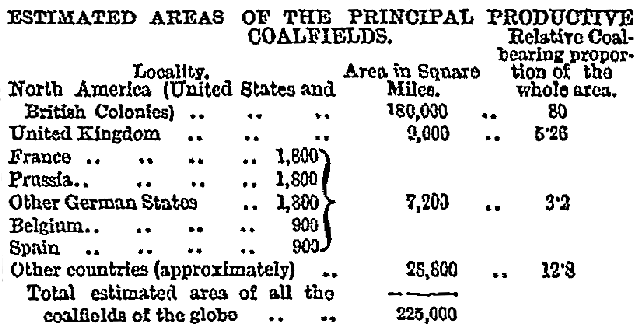
These figures must be received as more or less conjectural. The statement that France, Prussia, and other German States have exactly the same area each will necessarily excite the suspicion of inaccuracy.
With regard to the exhaustion of the coal-fields of Great Britain, the present generation has no ground for the least apprehension. Of course, the day of exhaustion will come, but the present Prime Minister, who expressed his opinion in the House of Commons, some years ago, that the probability of such exhaustion should enter into the financial considerations of British statesmen, need not trouble himself further about the matter. He and a long line of succeeding First Ministers of the Crown will have mouldered into dust before that day shall come. If rumour speaks truly, the labours of the Royal Commission on Coal will conclusively establish the fact that the quantity of workable coal remaining in Great Britain vastly exceeds what has hitherto been supposed. Speculations on the possible substitutes for coal are idle and useless under existing circumstances. Ages hence it will be time enough for the inhabitants of Great Britain to investigate that problem.
In the second part of M. Simonin‘s book the ancient history of metallurgy is despatched in a loose and summary fashion. By way of example we have selected the following statements :— "The three metals, lead, silver, and quicksilver, were doubtless found simultaneously with bronze, and perhaps prior to it" (p.283). Cinnabar, the ore of quicksilver, "possesses the property of parting with its sulphur when heated" (p. 284). It does not, unless there is access of atmospheric air or some solid reducing agent is present. "The waste gases (nitrogen and carbonic oxide — of the blast furnace), which under ordinary circumstances are allowed to escape from the furnace, are conducted to the steam boilers and there burnt, and so made to serve as fuel" (p. 288). It is only the carbonic oxide that burns, nitrogen being incombustible. "All these (metalliferous) ores possess a well-marked metallic lustre." Every tyro knows this to be inaccurate, as the lustre of many of these ores is not in the least degree metallic. At page 283 silver is reported to be "a metal of rare occurrence in the native state," and at page 302 to be one of the metals "most commonly found in a native state." "Arsenic, cobalt, nickel, and bismuth are met with native, but most frequently as sulphides in certain lodes." Cobalt and nickel do not occur native, except in meteoric iron, which cannot be regarded as an ore ; and they are most frequently found in association with arsenic. Bismuth is described as "silver white !" (p. 306). It has a decided yellowish red tinge, and may be immediately distinguished from silver by its colour. In a note antimony is stated to be an ingredient in German silver (p. 306). This is a gross blunder, as that alloy does not contain a particle of antimony.
We are presented with the history of an illusory goldmining venture, which may convey salutary instruction to enthusiastic searchers after that precious metal. The scene is an island of the East Indian Ocean, of which the name is suppressed :—
"About ten years ago some persons who had inhabited this island addressed a request to the French Government for the concession of the gold mines of Chrysonиse. Shareholders flocked together ; great personages interested themselves in the affair. Tons of sand were carried away, and gold was always found in it. With the produce of analyses it was proposed to make sleeve buttons for the members of the committee of management. Meanwhile the mines prospered and multiplied, silver and platinum being found associated with the gold, and in the interior of the island were discovered, not only placers, but true auriferous veins. An eyewitness, who had contributed to the discovery with naпve enthusiasm that 100,000 men, working for the same number of years, would scarcely exhaust even the surface of the mine, and that henceforth Chrysonиse would produce gold instead of sugar and coffee ; and this man spoke with good faith. The imaginary placers are the shingle and sand of the sea coast ; the veins are blueish volcanic clays, sprinkled with brilliant and crystallized iron pyrites, which might readily be mistaken for gold (i.e., by ignorant persons), but which do not contain an atom of that metal ; besides which they are situated in the midst of almost inaccessible mountains nearly 5,000 feet above the level of the sea. In spite of failures without number the mines of Chrysonиse still survive, and the shareholders have not lost their confidence. Although they have never received any other dividends than those paid out of capital — as is often the case in such undertakings — the greater part of them are still sanguine. Some months since it was said that the precious metals could not be worked, on account of their existing only in a microscopic state ; the company were about to change the character of their operations, and collect the magnetic iron ore from the sands. Unfortunately, the steel ore is not sufficiently valuable to be transported from the Indian Ocean to Europe. It is, therefore, necessary to smelt the ore on the spot. From whence are the coal and the smelters to be procured ? In the meanwhile, the Chrysonиse people laugh at the credulous Parisians. From the lowest of the blacks to the highest inhabitants of the island, no one has taken shares in the Gold Company. The country, prudent, economical, and industrious, continues to produce sugar, coffee, and spices. The cultivation of cotton has recently been tried with success, and everybody there laughs at the fabricators of lodes, who selected a remote spot for the theatre of their exploits." (P. 391.)
There is much interesting matter in this part of the book, and the article on gold-washing may be read with advantage by those who may be deluded with the fallacious hope of speedily acquiring wealth in that alluring occupation.
In the last part of M. Simonin‘s book, which is the shortest and is devoted to precious stones, the fair sex will find both amusement and information. They will revel in the descriptions of diamonds, sapphires, rubies, emeralds, and pearls ; of their modes of occurrence and of their localities ; and of the means of judging of their quality and estimating their pecuniary worth. The fortunate possessors of diamonds will be gratified to learn that during the last 20 years their value has much increased. Thus the price of polished diamonds at present is stated to be £12 per carat (i.e., a weight of 3 1-5th troy grains), the same weight of gold being 500 times less, or 6d., whereas 20 years ago the carat was only worth £8 The value increases in a rapid proportion with the weight of the diamond. Thus 15 carats of diamonds, weighing 1 carat each, will be worth about £180, while a single diamond weighing 15 carats, in perfect condition, would be worth from £2,000 to £2,800 We have inquired of an eminent jeweller as to the present price of diamonds in London, and we are assured that a good diamond weighing 1 carat is worth about £18, instead of £12, as stated by the author. Although the diamond is nothing more than crystallized charcoal, and а priori its artificial formation seems exceedingly probable, yet hitherto the efforts of chymists to produce it have utterly failed. Sapphires and rubies in minute crystals, identical in every respect with the natural gems, nave been made. Probably in any case, should it hereafter be found possible to crystallize carbon, a very long period might be necessary to produce a diamond of the first water and of large dimensions. The conditions under which Nature has manufactured her diamonds must be rare, seeing how infinitesimally minute is the total bulk of all the diamonds hitherto discovered, and yet carbon in one state or other is a chief constituent of the crust of the earth.
There is much that requires correction, as well by the author as the translator. Should the book reach a second edition the latter would do well thoroughly to revise his English, and to correct such mistakes as confounding centimetres with millimetres. (See p. 83.)
* Underground Life ; or, Mines and Miners. By L. Simonin. Translated, adapted to the present state of British mining, and edited by H. W. Bristow, F. R. S., of the Geological Survey. Illustrated with 160 engravings on wood, 20 maps geologically coloured, and 10 plates of metals and minerals in chromolithography. London : Chapman and Hall. 1869 (pp. 510).
 |
 |
| Names mentioned in this article | |
|
|
| Name | Age | Occupation | Notes |
|---|---|---|---|
| Bristow, H. W. | |||
| Galibert, M. | |||
| Godwin-Austen, Reade | Whos Who Page | ||
| Rashleigh, Philip | |||
| Rouquayrol, M. | |||
| Simonin, L. | |||
| Simonin, M. | |||
| Vivian, — |



 Contains public sector information licensed under the

