


| Newspaper Articles |

|
Newspaper Articles |
 |
 |
19th February 1853, Page: 148, Column: 1
Railway Between Seaham And Sunderland
The want of railway communication between the Important ports of Seaham and Sunderland has long been felt to be a serious inconvenience by the inhabitants of both these towns. On Tuesday (last week) the interesting ceremony of "cutting the first turf" of a railway intended to connect these two ports took place, in the pretence of a large assemblage of the inhabitants of the adjacent districts.
This Railway has been projected by the Marquis of Londonderry, and is to be executed throughout by his Lordship, at an estimated cost of £60,000. In addition to affording the means of speedy communication between the two towns, the project embraces the connecting and opening an easy way to the sea-board for many important colliery districts, hitherto compelled to send their mineral produce round by circuitous routes. The new line, which is seven miles in extent, will enjoy the remarkable distinction of being commenced and carried through without the obstruction of competing interests — the necessary buying off of opposing landholders, or the expense of an application to the Legislature. It will be made without an act of Parliament ; the whole of the land traversed belonging, with unimportant exceptions, to the noble Marquis. The ceremony was witnessed by a very large number of persons, including the leading inhabitants of Seaham and Sunderland, among whom we remarked the Mayor of the latter borough, James Hartley, Esq.; Hon. Thomas Liddell, Mr. W. Ord, Mr. Roland Burdon, Rev. Hart Dyke, Rev. H. Peters, rector of Sunderland; Sir William Eden, Mr. Nicholas Wood, &c. The scene was highly animated. A platform, occupying the site of the intended Seaham station, was erected in the centre of a field, commanding a fine sea view on one side, and upon the other the ancient church of Seaham, with the family mansion of Lord Londonderry in close proximity. The guests invited to be present assembled in the town of Seaham, at one o'clock ; and shortly afterwards moved in procession, headed by two excellent bands belonging to his Lordship’s collieries, to the scene of operation, where they were met by the Marquis of Londonderry, accompanied by the Mayor of Sunderland, and two or three other gentlemen, in a carriage and four. The noble Marquis was welcomed by the assembled multitude with loud cheers. His Lordship, together with his friends, having mounted the platform,
Mr. Joseph Wright, of Sunderland, then came forward, and addressed the company, expressing his admiration of the public spirit and liberality of Lord Londonderry, and the advantages which this railway would confer upon the district, and concluded by wishing success to the Londonderry and Seaham and Sunderland Railway, and long life and happiness to its noble and spirited projector. (Loud cheers.)
Mr. White, iron-master, of Seaham, next characterised the benefits to be derived from the proposed railway, and bore testimony to the great public works which Lord Londonderry has already carried out in this locality, as well as to the active benevolence of his Lordship and the Marchioness.
Mr. Christopher Bramwell (of Sunderland) spoke in support of the proposed railway, remarking that it could not fail to give a great impulse to the coal trade of the district.
Mr. George Elliott, C.E., then presented to Lord Londonderry a very handsome silver-mounted spade ; when his Lordship addressed the company in a speech, in the course of which he made the following observations :— "When I added the estate to this Wynyard family property, there was a notion a harbour might be made at this end of the estate, and I was introduced to a clever engineer of that day, named Chapman, who projected a small basin. The coal-trade at that time was in a sad state. The rivers of this wealthy district — Sunderland and the Tees especially — were frequently shut up, and there was not then the enterprise and vigour which has lately grown up in the flourishing town near us ('Hear, hear,' and laughter). In fact, our trade was imprisoned ; vessels loaded with coals frequently remained weeks and weeks without actually clearing for sea. Coals were sent down to the banks of the Wear, and shipped there into keels, and again from them into ships ; and I myself, at that period, was paying to the commissioner of the river Wear £8000 a year for permission to send my articles by this river to market (Hear, hear). Great discontent prevailed. Sunderland having a good thing, kept their own. And they were right. So would any of you have done the same ('Hear, hear,' and laughter). Such was the state of things, when it occurred to me that if I could get a harbour my trade would be in my own hands, and I should not have to go to sea for it. I embarked at once in the undertaking, against the opinions of those I valued, and ought to have looked up to, and engaging Chapman, and entering as rapidly as possible into other arrangements, I launched your little harbour. Urged on by the same principle which guided me in the case of Seaham harbour, viz. that I should not have to seek a trade, for that if I made the harbour the trade would come to me, I conceived the project of constructing the railway we are about to commence this day (Hear, hear). I knew that the trade of many of the collieries to the southward of us in this great county most pass, sooner or later, our little half-way house of Seaham on their way to Sunderland, and I thought if we could get them to stop on the road we should be safe to obtain a large addition to our present trade. (Hear, hear). Communicating these views to my able manager and engineer, the latter set about the matter in real earnest, and has already formed engagements with the South Hetton and Haswell Colliery Companies to carry their coals over the line as soon as completed, either to ships in the first instance at Seaham, or, if not, to send them on to Sunderland. The trade is, therefore, secured before the railway is commenced. There is my project, and that is the simple history of it." In conclusion, his Lordship said, "If I live to see this last prefect successfully accomplished, I shall cheerfully lay my head upon my pillow and resign life, conscious that, so far as concerns those whose interests Providence has committed to my care, I have to the fullest extent of my means discharged the duty which has devolved upon me." (Loud cheers).
The noble Marquis descended from the platform amidst the hearty cheers of the multitude assembled, and, advancing a few feet, cut a piece of the turf with his spade, and threw it into a handsome mahogany wheelbarrow in the most approved fashion. His Lordship next, amidst, if possible, still greater acclamations, wheeled the barrow across the field to his carriage, on the top of which, together with the spade, it was triumphantly elevated.
The noble Marquis then, together with about eighty gentlemen, returned to Seaham-hall, where a handsome dejeuner was served. The extraordinary spirit and energy displayed by Lord Londonderry, throughout the day, notwithstanding his advanced age, were the subject of general congratulation.
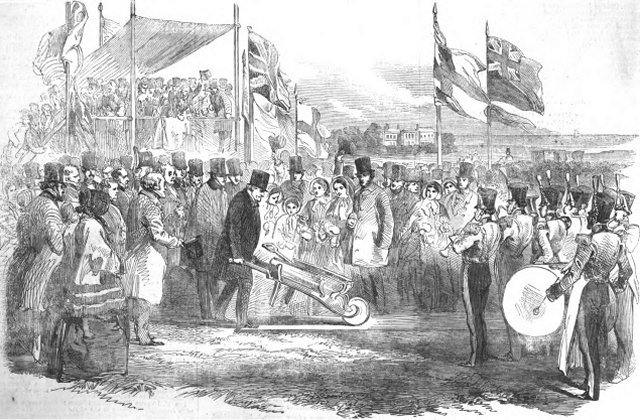
The Marquis of Londonderry commencing the Seaham and Sunderland Railway
 |
 |
| Names mentioned in this article | |
|
|
| Name | Age | Occupation | Notes |
|---|---|---|---|
| Bramwell, Christopher | |||
| Burdon, Roland | |||
| Chapman, — | |||
| Dyke, Hart, Rev. | |||
| Eden, William, Sir | |||
| Elliott, George | |||
| Hartley, James | |||
| Liddell, Thomas, Hon. | |||
| Londonderry, —, Lord | |||
| Londonderry, Marquis of | |||
| Ord, W. | |||
| Peters, H., Rev. | |||
| White, — | |||
| Wood, Nicholas | Whos Who Page | ||
| Wright, Joseph |



 Contains public sector information licensed under the

