


| Newspaper Articles |

|
Newspaper Articles |
 |
 |
10th July 1846
Gases and Explosions In Collieries
The following important and interesting document is the result of a commission addressed by Lord Lincoln to Sir H. De La Beche and Dr. Lyon Playfair, with the object of obtaining information as to the best means of preventing, or at least of mitigating, the fatal effects which are so frequently the result of the generation of noxious gases in coal mines :—
Museum of Economic Geology, June 1, 1846.
My Lord, — Having, in conformity with the instructions contained in the Earl of Lincoln's letter of the 27th of August, 1845, directed our attention to the composition of the gases evolved from coal beds, to the mode of ventilating collieries, and to the subject of explosions in them generally, we have the honour to submit the following statement for consideration.
With respect to the gases evolved from beds of coal, they may be viewed as the result of the continued decomposition of the vegetable matter from which coal is derived, a decomposition which may be regarded as still in progress under favourable conditions. Omitting the mineral substances, which when burnt, are known as ashes, coal is essentially composed of carbon, oxygen, hydrogen, and nitrogen ; and the quality of the coal depends upon the relative proportion of these ingredients. When the proportion of the carbon to the oxygen and hydrogen does not exceed about 75 per cent. the coal, in common terms, is called "bituminous ; when the carbon amounts to about 85 or 90 per cent. it is termed "anthracite," or stone coal ; or, in other words, the most advanced state of decomposition of the original vegetable matter bears the latter name.
During the decomposition a portion of the carbon is removed by its union with oxygen, forming carbonic acid, and another portion by combining with hydrogen, as carburetted hydrogen. Thus by continued decomposition the carbon gradually becomes a more important constituent in the remaining part of the original vegetable matter. The change from bituminous coal to anthracite can be produced artificially, and in a manner to illustrate the subject, considered geologically. *
Though carbonic acid is, no doubt, found in many of our collieries in such a manner as to show it to be derived not only from the lights, horses, and workmen employed, but also to be partly the result of the progressive decomposition of the coal, it is with the carburetted hydrogen, or firedamp, as it is termed, that the collier has chiefly to contend. This comes upon him in various ways. Some coals more readily emit it than others, and hence they are locally termed fiery seams, beds, or veins. From some coals it would appear to escape more generally from the mass of the bed than from others, the gas gradually accumulating from the discharge over a wide surface. Other beds, again, are more fiery in the softer than the harder portions, and where joints or fissures are common. When two or more seams of coal, having different qualities, make up a workable bed, one will sometimes be more fiery than the other. Again, much depends, all other circumstances being equal, upon the kind of roof or covering rock of a coal-bed. If this be sufficiently porous, as many sandstones are, the conditions for the escape of the firedamp upwards through superincumbent rocks are more favourable than where the roof is composed of clay or argillaceous shell.
The dislocations of the strata termed "faults" or "troubles" act frequently also as channels for the passage of the firedamp into the works, as they conduct the gas from coal seams beneath, which may be highly charged with it, although the seam under work may be free.
Although we may regard a large proportion of this gas as previously formed, and ready to escape when the necessary conditions, such as those of colliery workings, present themselves, we can scarcely suppose that carburetted hydrogen is not also formed during the time occupied by the progress of the same workings, much being evolved from the older portions of them. The manner in which splinters of coal are thrown off during the cutting of some beds has led to the hypothesis that the gas may be present in a liquid state, produced by condensation, so that when the needful pressure is removed during the progress of the work, the sudden expansion of the "fire-damp" from a liquid to a gaseous form throws off the fragments. The force also with which the gas bursts suddenly forth from clefts or joints in some beds of coal is so considerable as to prove much previous compression, particularly when those bursts or blowers last only a short time. When they continue for protracted periods, we may infer a more constant supply from continued decomposition of the coal, though the first sudden burst would point to compression. It has been inferred that the small cavities in which the fluid gas is confined can be detected by the microscope in some coals. It is probable that soft places, the sides of joints and fissures, and the walls or faults, are more favourable to the decomposition of the coal than its more solid portions.
The escape of fire-damp is generally influenced by the barometrical state of the atmosphere, especially when much of the gas has become accumulated in the wastes or goafs. This is more or less experienced in all pits ; but one striking case was pointed out to us by Mr. Jobling, of Jarrow Pit. In a pit of which he is the viewer the gas issues from cracks in the roof of the seam, and in low states of the barometer is evolved in considerable quantity. When the barometer is high, instead of this issue of gas, there is a sensible current of air which enters into the cracks. When this inward current takes place the pit is worked with naked candles, but when the evolution of fire-damp commences Davy's lamps are employed.
Assailed in this manner by a gas which, when mingled with atmospheric air in certain proportions, is highly explosive, a knowledge of its exact composition becomes a subject of great importance to the collier, since effective precautionary measures, more especially as regards the lights employed, must necessarily depend upon such knowledge.
Dr. Henry, Sir Humphry Davy, in this country, and Bischoff and others on the continent, have examined into the nature of the explosive gases of mines, but with results differing from each other ; for while the English chymists found them to consist of carburetted hydrogen, with little or no admixture, the continental chymists have described them as very complex mixtures of olefiant gas, carburetted hydrogen, carbonic oxide, hydrogen, nitrogen, oxygen, and carbonic acid. On such a point ignorance would be culpable ; and we were instructed to bring our knowledge up to the present advanced state of chymical analysis. Whilst we were engaged in this research, Professor Graham made a report to the Chymical Society on the same subject. The previous investigations of this chymist had rendered him well fitted for the task, and the results of his inquiries (according, as they do, with our own) amply guarantee that the subject, as far as relates to this country, may now be considered as decided, and show that the importance of an exact determination had simultaneously engaged the attention of the public.
It is unnecessary to describe in detail the methods which we pursued in the analysis ; it may be sufficient to state that we adopted the methods mentioned in a report to the British Association on the analysis of gases by Professor Bunsen, and one of us. We may, therefore, at once tabulate our results, merely stating that we have devoted much attention to this investigation, so as to remove doubt upon a subject so important to the interests of the public. The gases were collected in various ways, some from blowers, others from the freshly exposed surfaces of the coal while the gas issued out with a singing noise, others from the explosive atmosphere of pits.
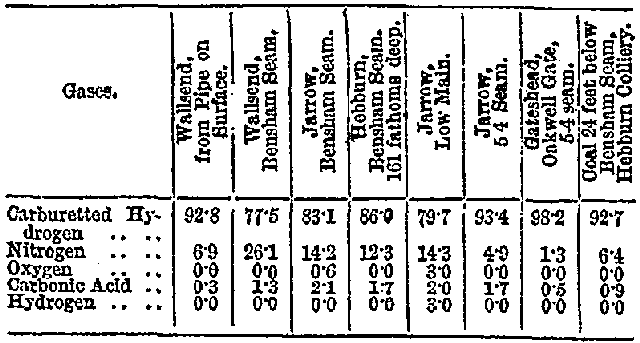
The general result of this examination is, that the only inflammable constituent present in the explosive gas of collieries is carburetted hydrogen or fire-damp ; there is not a trace of olefiant gas, and only in one out of the eight gases analyzed is there hydrogen. It follows from the previous analysis that the issue of fire-damp into the atmosphere of a mine must deteriorate the air, by adding an undue proportion of nitrogen gas ; in one case this gas amounts to 21 percent. During an explosion the oxygen necessary to the respiration of the workers is removed by uniting with the carbon of the fire-damp, and thus producing carbonic acid, a gas most fatal to animal life. This carbonic acid, mixed with the residual nitrogen of the atmosphere, and that present in the explosive gas itself, forms what is termed after-damp, which produces effects more fatal even than those arising from the explosion. It often happens, that after an explosion a sufficient quantity of oxygen remains to support the respiration of those who survive its effects, were it not for the presence of carbonic acid. This gas, when present in no greater proportion than one or two per cent., is capable of producing the most injurious effects. It has therefore been suggested, that cheap mixtures, made of substances capable of absorbing carbonic acid, such as glauber salts and lime, would prove useful to those who try to aid the sufferers after the explosion. Such a mixture placed in a coarse bag and applied to the mouth would effectually absorb the carbonic acid, and prevent it exercising an injurious effect on respiration. Certainly the want of some such precaution in the case of the Jarrow explosion caused the death of a very meritorious man, Jacob Difty, the overman of the pit.
An explosion is, however, generally attended with much more complex results than those described as attending the combustion of carburetted hydrogen. The amount of fire-damp which may be first ignited may be trivial, and yet produce the most disastrous effects. From its lightness it accumulates at the upper part of the passages, and diffuses with considerable difficulty, often acting as a train, and communicating the explosion to the pent-up reservoirs of gas in the goafs. It is thus that in almost all accounts of explosions two are generally described as taking place ; the first local, and at the seat of the explosion ; the second more general, and aided by any accumulation of foul gas in other parts of the pit. In the case of Jarrow, the heat attending the explosion was so intense as to have thoroughly coked to the depth of nearly one quarter of an inch the coal lining part of the walls of one of the passages ; an effect which could scarcely be conceived without supposing that the flame played for some time upon it with the intensity of a blow-pipe flame. The surface of the coal thus acted upon was so considerable that the amount of explosive gases evolved during this coking must have been far from insignificant, and may have aided the explosion itself. Add to this, that the first effect of the explosion is to blow up and ignite the immense quantity of coal dust lying about the pit, and not only produce from it an evolution of gas, but also occasion the production of much carbonic acid. And it cannot escape attention that the whole subject becomes involved in much complexity. It is known that a certain mixture of air with carburetted hydrogen prevents its ascendibility ; and, in the case of pure carburetted hydrogen, the proportion has been ascertained to be not less than 15 times its own bulk. But the variation in composition of the fire-damp of different mines, the uncertain modes of its issue, and the absence of any ready means of ascertaining its quantity, prevent any6 general rule being given as to the amount of air which should be thrown into mines to prevent the atmosphere ever attaining the explosive state. All this must be determined by practice to suit the varying conditions of different mines. It is certain that improvements might be made on the rude methods now in use for effecting the necessary mixture. The fire-damp being, from its lightness, at the top, is not quickly influenced by the current of cold heavy air descending the downcast shaft, and circulating through the passages. It is therefore not unfrequent to see colliers flapping their jackets among this light gas, so as to dilute it with the sufficient quantity of air, and thus disturb the train of communicating gas which, in a foul state, may connect two dangerous parts of a pit. Mechanical contrivances, such as fanners, would more efficaciously produce the result than the inefficient extemporaneous means referred to ; but, in general, such arrangements are only necessary when, from a defective ventilation, the current of air through the pit is not sufficiently strong.
Various artificial means had been proposed to facilitate the withdrawal of fire-damp from a pit. Suggestions have been made to take advantage of the lightness of the gas by favouring its ascent to the upper parts of the pits, and drawing it off by special air ways. Pipes let down into the wastes have been proposed for the same purpose, while other suggestions have been made of pipes to blow in air at the tops of the passages, so as to cause the dilution of the gases.
We do not stop to consider these plans, because, as we have already stated, the conditions under which coal is worked are so numerous, that a plan which might prove useful in one pit would be wholly inapplicable and sometimes positively injurious in another, and the legislative application of any one plan might prove highly prejudicial to this great branch of national industry.
In 1835, a Select Committee of the House of Commons was appointed to inquire "into the nature, cause, and extent of those lamentable catastrophes from explosions which have occurred in the mines of Great Britain, with the view of ascertaining and suggesting the means of preventing the recurrence of similar fatal accidents." Numerous witnesses were examined before this Committee, a body of important evidence collected, and a report published in the same year, — a report replete with valuable information, and to which we would wish to refer for ample details connected with the general mode of working collieries, especially in the north of England. The Committee observe, on the subject of colliery explosions, that while the loss of interrupted trade by these accidents is enormous, "it is nevertheless rather with reference to the cause and interest of humanity than in a pecuniary point of view that this inquiry has assumed its great importance." This Committee did not recommend any remedial measures.
The difficulty experienced of obtaining accurate information respecting the number of lives lost from colliery explosions within a limited period is nearly as great at the present time as it was in 1835. And it should be borne in mind that the number of lives lost by the great explosions, those which chiefly become known and arrest public attention, by ne means affords a correct view of the collective loss of life sustained by colliery explosions generally, including the minor accidents not commonly heard of beyond limited districts ; neither does it represent the injury sustained by these explosions, short of the loss of life, but from which many persons are more or less disabled.
The Committee were enabled to ascertain that during the 25 years preceding these inquiries 2,070 persons had perished from colliery explosions ; and they considered this number much underrated. During the last 10 years the rate of loss of life from this cause has certainly not diminished. The experience of the past year has shown that considerably more than 100 persons have been known to have thus perished.
It has so unfortunately happened that, during the few months we have been engaged upon this inquiry two explosions, one at Jarrow in Durham, and the other at Risca in Monmouthshire, have together deprived 76 persons of their lives, 41 having perished at the former and 35 at the latter.
By direction of Sir James Graham and the Earl of Lincoln, we were commissioned to ascertain the causes of both explosions. It so occurred that, being at that time in the south of Ireland, engaged on the duties of the geological survey, Sir Henry de la Beche could not reach Jarrow in time for the inquiry, and therefore the investigation into the cause of the explosion at that place devolved upon Dr. Playfair, who, under these circumstances, availed himself of the services of Mr. David Williams, at that time one of the geologists attached to the geological survey of Great Britain, and well skilled in coal mining, but now in the service of the East India Company, examining the coal resources of India. The results of this inquiry are given in the accompanying report by Dr. Playfair.
Immediately after the explosion at Risca on the 14th of January, 1846, instructions were again received to proceed without loss of time to that colliery. Dr. Playfair being, however, so engaged upon duties in London, that he could not readily proceed to Risca, the investigation was undertaken by Sir Henry de la Beche, aided by Mr. Warrington Smyth, mining geologist to the Geological Survey of the United Kingdom, who was in every respect qualified for such an inquiry. The accompanying report contains the results of this investigation.
During these inquiries it became very important carefully to consider the kinds of lights employed in collieries, and the usual regulations respecting them. The subject was not new to us, since for more than 25 years the mode of working collieries in different parts of the United Kingdom, as also on the continent of Europe, had engaged the attention of one of us. On the subject of safety lamps, of lighting generally, and of the regulations connected with it, the Committee of 1835 collected a large amount of evidence, more especially regarding our northern collieries. In the report of the South Shields Committee of 1843 there is also much information on this head. To these reports, therefore, we would wish to refer for sufficient information on the subject.
The Committee of 1835 pointed out that more persons had lost their lives from colliery explosions for the 18 years succeeding the introduction of the Davy safety lamp in 1816 than in the 18 years preceding the invention, and accounted for this fact by the working of numerous "fiery" seams of coal, which had, in consequence of the assumed security of that lamp, been undertaken, and by the abandonment of many precautions considered requisite when candles were commonly employed in collieries.
As much doubt has been thrown upon the real safety of the Davy lamp, it is but justice to the memory of Sir Humphrey Davy to state that he was perfectly aware that, if a proper mixture of fire-damp and common air were thrown against the lamp with sufficient force to project the flame upon the gauze cylinder, it might communicate with the flame, and cause explosion. Mr. Buddle, in his evidence (Report of Committee of 1835, Nos. 2,226 and 2,227), clearly shows this to have been the case. He mentions an experiment at Murton West Pit, where a very powerful blower from the shaft was tried with the lamp, when the flame passed and the blower was fired. Sir Humphrey Davy then, addressing Lord Durham, and many other persons who were present, said, "Now, gentlemen, you see the nature of the danger to which you are exposed in using the lamp, and I caution you to guard against it in the manner I have shown you. This is to show the only case in which the lamp will explode ; and I caution and warn you not to use it in any such case when you can avoid it without using the shield." The shield recommended was one of tin, inside the cylinder, to prevent a current of fire-damp from acting on the flame. Mr. Buddle stated before the Committee that in the lamps used in the collieries under his management the shield passed from one-half to two-thirds round the inside of the cylinder, and, being bright, reflected the light to such an extent as to be more advantageous than a glass cylinder inside that of wire gauze, a contrivance often recommended to obviate the risk of currents of fire-damp.
Dr. Pereira, at the request of the Committee of 1835, experimented upon many lamps before them, and passed the flame through all of those tested, except that of Messrs. Upton and Roberts. The experiments have been repeated at the Museum of Economic Geology, by Dr. Pereira and by ourselves, with the ordinary Davy lamp, and with the same results.
There can, therefore, be very little doubt that the flame can pass, and explode fire-damp adjacent, if the current be sufficiently strong, and no protection be afforded either by a metallic shield or by an internal glass cylinder. The question as to the amount of current required seems not so well ascertained. Mr. Buddle considered that blowers would rarely be found strong enough. Mr. Stephenson supposed that many accidents may have happened by the falling of the roof producing a sudden rush of explosive fire-damp. It will be obvious that the same effect might be produced by the careless swinging of the lamp with the required velocity through an explosive mixture of fire-damp and air, or from the lamp being so jerked out of a collier's hand, by an unlucky fall, that the cylinder presented the necessary front to the same compound.
Without desiring, in the slightest degree, to cast unnecessary doubt on the safety of the Davy lamp, since we consider its cautious use an immense boon to coal mining, and believe that much additional security is obtained by the proper use of the original Davy, or of its improvements, it can scarcely be denied that far more care in the use of safety lamps is needed than is commonly employed. Although shields or glass cylinders are used in some localities they are never employed in others ; and the bare single cylinder of wire gauze, not always properly manufactured, is the only form in which the Davy lamp is known. And it should be observed that, with a few local exceptions, the Davy lamp is that commonly employed. Numerous modifications, and in some cases improvements, of the safety lamp have been made, but, either from the expense, or want of simplicity in management, have never come generally into use.
The colliers, by their usual mode of carrying the common Davy lamp, certainly, under ordinary circumstances, guard against the passage of any current of fire-damp sufficiently strong to pass the flame, by placing the lamp within their jacket flaps, or carefully protected in some other manner. Abundant carelessness is often, apparent ; and, when the collieries are viewed as a whole, unnecessary risk is too common, especially when it is recollected that the foolhardiness or carelessness of one may destroy the lives of many.
To those who have, during many years, had occasion to visit collieries in different parts of Great Britain, the thoughtless daring of many of our colliers, and their frequent carelessness under danger, must be familiar. They will often, in an endeavour to execute more work in a given time, when paid by the ton or piece, remove the covers of their lamps, or employ a candle at a risk. Some even prefer a candle to ascertain the presence of fire-damp, since by it they more readily see the change in the flame. In many districts, though in some they are anxious to employ the safety lamp, it requires much trouble on the part of the managers to prevent the continual use of candles in suspected places before the danger becomes known to them. The less light afforded by lamps is considered a great drawback to their use when it can be avoided. Many most careful men, no doubt, anxiously watch over the common danger, and great precautions are taken by many coalowners and workers ; but, looking at the subject generally, and without reference to many exceptions, especially to be found in the north of England, the want of system in the management of lights, and in due precautions respecting the kinds employed, can scarcely escape the observation of those whose opportunities have been sufficiently extended.
When we consider that the safety lamps have now been in use for so many years, causing security in all cases where proper care is employed, although they may not be absolutely safe under unusual circumstances, their utility appears sufficiently sanctioned by experience to make them the subject of legislative enactment. The evils complained of in the modifications of the Davy lamp are, that, while they add to the security, they diminish so much the amount of light, as to render them practically useless. These are described in the report of the Select Committee referred to. A new modification of Dr. Clanny‘s lamp, invented since then, is not subject to this fault, and in principle is an elegant application of the safety lamp, and consists of a wire-gauze cylinder, having beneath a thick glass cover to the lamp, which only ascends till it meets with the gauze ; the thickness of this glass is supposed to free it from accidents, and, whilst strong enough to bear a considerable blow, it is sufficiently well annealed to resist sudden changes of temperature. But whether, in a manufacture so uncertain as glass, these conditions can always be attained, is questionable, and at all events has not been sufficiently tested by experience to induce the coalowners to employ this lamp in their mines.
It has been at various times proposed, during the last eight years, to employ electricity as a means of lighting collieries. The electricity, streaming between two charcoal points from a Grove's or Bunsen's battery, affords a light of much beauty, and perfectly safe, if completely surrounded by glass, but capable of igniting an explosive mixture if exposed. Professor Grove has constructed a lamp on this principle, which he kindly prepared for us, and which we have examined in action. It consisted of a box, containing four galvanic cells, and the light was obtained by the passage of electricity between two coils of platinum wire. These were surrounded with glass vessels ; the inner one for the purpose of isolation, the exterior one being filled with water, so as to destroy the light should the inner glass vessel be broken. The light given out was rather more than that of a miner's candle. This, certainly, is a safe lamp, but in its present state still unfitted for the purpose of the collier as at present arranged. The acids, sulphuric and nitric, render the lamp so inconveniently heavy, that both hands must be used in carrying it ; besides, from not being covered, the spilling of these corrosive liquids on the persons of the miners could scarcely be avoided. The water in the exterior vessel some becomes heated, and ultimately boils, and the light only lasts in proper strength for two or three hours. There must, therefore, be considerable modification in this lamp before it can be rendered available for ordinary purposes, which we may readily expect, from the acknowledged talent of its inventor.
The means of obtaining the needful lights in collieries, though most important, would still appear subordinate, as has, indeed, been before remarked, to such a system of ventilation as should not expose men in such large portions of a colliery as is now frequently the case to the risk of death from explosion (the greater proportion, and often all perishing from the carelessness of one man), or to unforeseen accidents under the greatest precautions in the use of lights. The too common use of single shafts in collieries, in cases where others might have been sunk, the single shaft divided into two or three portions by wooden partitions named brattices, a down current of pure air descending through one division, and the foul air from the colliery workings rising up through another, has often been reprobated. The Committee of the House of Commons of 1835, and many important witnesses examined, animadvert upon this practice ; and the bad effects of this system is pointed out by the South Shields Committee in their report of 1843.
In a single shaft, as has often been remarked, the ventilation may be cut off from the workings of a whole colliery in an instant by an explosion sufficient to destroy the doors or partitions directing the air-courses, the air merely going down one division of the shaft and rising through another, when the brattices may not be destroyed by the explosion, and a kind of draught kept up. Thus all not destroyed by the explosion perish in the mixture of nitrogen and carbonic acid, known as after-damp, to which no fresh air can reach. In the explosion at Jarrow Colliery there was only a single shaft communicating with the workings upon two beds of coal one above the other, and the lower part of the brattice in the shaft was so shattered by the late explosion in it, that Dr. Playfair and Mr. Williams, in their descent into the pit, then containing a large amount of fire-damp, had to be let down a considerable distance by a loop in a rope. In this explosion the upper portion of the brattice fortunately remained, and thus the lives of many of those engaged in the upper workings were saved, although several perished.
Even in a double shaft, or two shafts not far distant from each other, if the air be not made to course for a considerable distance amid the workings by a firm thick parting of coal, any needful perforation in the parting for the progress of the colliery being firmly built up, a whole mass of workings may, by an explosion, be suddenly cut off from ventilation, and numbers of persons, not killed by the explosion, perish by the after-damp. This was the case at the late explosion at Risca. It should, however, in this instance be observed, that the colliery was, as regards ventilation, in a transition state, a more perfect arrangement for ventilation being in progress.
Great improvements were introduced in the ventilation of collieries in many districts, when the course of air was quickened by means of a furnace established near the bottom of the upcast shaft, or that through which the foul air passes outwards, and more particularly when, in the north of England, instead of permitting the air introduced by the downcast shaft to pass slowly and imperfectly along a course of 20 or 30 miles of passages, it was split or divided into separate courses, from two to six miles in length. Those, however, who may possess an extended acquaintance with our collieries in different parts of the country cannot but be aware, that, as a whole, their general ventilation is very imperfect, good as it may be in some collieries, particularly in certain districts.
When it is considered that coals are worked in the United Kingdom under every variety of condition, — from levels driven into mountain sides to pits sunk to great depths through masses of superincumbent rocks, — in beds ranging from a vertical to a horizontal position, and even contorted and bent, — sometimes traversed by faults, at others free from them, — the beds near the surface in one place, and ranging beneath mountains in another, — in fact, under a great variety of geological conditions, it is not difficult to see that many plans which have been suggested for the working of collieries, good as they may be for some localities, would be inapplicable generally, and would indeed fail, except under the conditions fitted for them.
So various are the conditions under which collieries are or can be worked in the United Kingdom, that we would suggest for consideration, if legislative measures should be deemed advisable, and an extension of the principle which regulates the employment of women and children in our mines, and the labour in our factories, be thought good, that effective discretionary powers should be vested in properly qualified persons, appointed in convenient districts, so that the needful adjustments to conditions may be effected, and no single system be attempted inapplicable to our collieries as a whole.
Any general system of legislation for conditions so different could only be productive of failure or of injurious consequences, both to owners and workers ; but a local examination and inquiry, with power to adjust to special conditions would, we apprehend, remove the difficulties which the Legislature has felt in dealing with interests so important.
Jealous as the coalowners should properly be of any undue intermeddling with their collieries, it may nevertheless be true that a judicious system of superintendence in a district, by which the proper ventilation of collieries, efficient knowledge on the part of subordinate agents, and proper punishment for foolhardiness or carelessness on the part of the colliers may be secured, would be a great advantage to them individually and collectively, and be the saving not only of lives but of much capital securing them, in the case of accidents, from many an unjust accusation for neglect.
On the other hand, careful but not overmeddling supervision would afford confidence to the collier. Proper persons being appointed as superintendents (and, if improper, their deficiencies would soon become apparent, and their removal the consequence), he would feel that he has the advantage of the existing knowledge of the day brought to bear upon the particular conditions under which the colliery in which he labours is worked. In some districts the working collier is far better informed upon the general principles which should receive attention than may be commonly supposed, and he would feel far more secure from danger than he now does, if assured that the State was not neglectful of his safety.
Though several collieries in particular districts possess good plans and sections of their workings, and an inspection of such plans and sections affords a view of the system of ventilation and general mode of working adopted, this is far from being the case generally, and has been much regretted alike by the enlightened coalowners and by the public. The importance of correct plans and sections has been prominently pointed out, both by the Committee of the House of Commons of 1835, and in the report of the South Shields Committee of 1843 ; indeed, the necessity of them is sufficiently obvious.
Should the suggestion of a system of judicious inspection be considered worthy of consideration, the ready access to proper plans and sections of collieries, brought up to given times, would necessarily form a part of any general system of regulations. If correct (and power to ascertain that they were so would be essential), they would at once disclose the system of working and ventilation adopted, and, with information respecting the police regulations, and an account of the kind of lights employed, would at once afford a general view of the mode of conducting any particular colliery, and of the adjustment of the workings to conditions.
It being considered that safety lamps, properly used, do effect much security in the working of coal, and that in so many cases explosions do take place when they are not employed, it has often been suggested that the Legislature should compel the general use of safety lamps in coal mines. But, on the other hand, there are many collieries in which fire-damp never appears, and it would justly be considered a hardship in such cases to compel a precaution altogether unnecessary.
We would suggest that it could not be considered unjust for the Legislature to compel the use of safety lamps in all fiery collieries ; and, in the present state of the law of property, it might even be prudent to assume that all collieries in districts where explosions have been frequent are fiery, putting the onus probandi that they are not upon the owners of such collieries. If proved to the satisfaction of the inspectors that no reasonable danger was to be apprehended in their collieries, license might be given for them to work with naked candles, this license ceasing at short periods, but being renewable on ascertaining that the conditions of the mine had not altered.
Careful investigations into the causes of explosions in collieries, only part of which arrest public attention by their magnitude, appear to have led to the very general conclusion that the condition of our collieries is most unequal. While in some localities there is so little to improve that it becomes subject of regret that such examples should more generally be followed, in others it becomes a matter of surprise how the works can be permitted to remain in so defective a state, seeing that the owners themselves suffer much loss thereby. Under such a state of things, and considering the number of valuable lives annually lost by colliery explosions, the continued risk to which so many are daily exposed, the national injury sustained by the imprudent and careless mode of extracting coal in many localities — one often felt oppressively also by the parties engaged in colliery speculations — and that the workings for coal must be adjusted to local conditions, we are led to consider that these evils might be at least mitigated by the careful and judicious inspection of convenient districts by competent persons, the necessary funds to be raised from districts by a very slight impost, not even exceeding one farthing on each ton of coal raised in it ; and we believe that the cause of humanity and the interests of the coalowners would be alike benefited by a well considered legislative measure of this kind.
We have, &c.,
H. T. De La Beche
Lyon Playfair
*Specimens in illustration of this, made by coking coal in a very gradual manner, are deposited in the Museum of Economic Geology.
 |
 |
| Names mentioned in this article | |
|
|
| Name | Age | Occupation | Notes |
|---|---|---|---|
| Beche, H. De La, Sir | |||
| Bischoff, — | |||
| Buddle, John | Whos Who Page | ||
| Clanny, William Reid, Dr. | Whos Who Page | ||
| Davy, Humphry, Sir | |||
| Davy, Humphry, Sir | |||
| Difty, Jacob | |||
| Durham, Earl of | Whos Who Page | ||
| Graham, —, Professor | |||
| Graham, James, Sir | |||
| Grove, —, Professor | |||
| Henry, —, Dr. | |||
| Jobling, — | |||
| Lincoln, Earl of | |||
| Lincoln, Lord | |||
| Pereira, —, Dr. | |||
| Playfair, Lyon, Dr. | |||
| Roberts, — | |||
| Smyth, Warrington | |||
| Stephenson, George | Whos Who Page | ||
| Upton, — | |||
| Williams, David |



 Contains public sector information licensed under the

