


|
| |
Mineral Information |

|
Mineral Information |
|
 |

|
 |
Dolomite
|
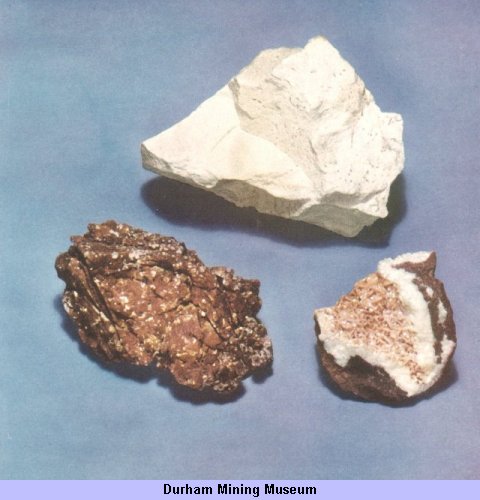
The specimens shown above came from Steetley, Worksop (top), Durham (right) and Cumberland (left).
|
Nomenclature and Synonyms
|
| |
 The mineral dolomite is named after Deodat Dolomieu (1750-1801), the Fench engineer and mineralogist who studied and described some of the properties of the mineral and some of its occurrences in nature. Pear spar, Rhomb spar, Bitter spar, Spath perlé (Fr.) ; Bitterspath (Germ.)
|
Composition
|
| |
Carbonate of calcium and magnesium; CaMg(CO3)2 or CaCO3,MgCO3. Theoretically, (a) CaO = 30.41 per cent., MgO = 21.86 per cent., CO2 = 47.93 per cent. or (b) CaCO3 = 54.35 per cent., MgCO3 = 45.65 per cent. Fe can replace Mg and when this is considerable the mineral is called Ankerite, which thus forms a link between calcite and siderite. Cobaltian, plumbian and manganoan varieties are also known. The CaCO3 : MgCO3 ratio, which is normally 1 : 1, may vary by the substitution of Ca for Mg or of Mg for Ca, the former of these two substitutions, thus producing the calcian variety, being the more common.
|
Crystallography
|
|
|
| |
Hexagonal class, rhombohedral division. a : c = 1 : 0.8332. The common form is the unit rhombohedron with r = {1011}, but M = {4041} is not infrequent. Faces often curved as in the saddle-shaped variety. Second and third order rhombohedra, as small modifying faces, are characteristic. Steep rhombohedra and prismatic forms are known. Also in massive, granular, columnar, porcellanous and other forms. Magnesian limestone is a crystalline granular form occurring as an important rock-forming mineral, especially in the Permian rocks of England.
|
Physical Properties
|
| |
Hardness, 3½-4. Specific gravity, 2.85 ± 0.01 increasing as Fe” or Mn” substitutes for Mg. Lustre, vitreous to pearly (as in pearl spar) dull and opaque in massive varieties. Colour, colourless or white in pure varieties but more often tinged with yellow or brown; red, pink, green and black varieties also occur. Fracture, conchoidal to subconchoidal or uneven. Cleavage, perfect parallel to the rhombohedron {1011}. Tenacity, brittle. Fusibility, infusible.
|
Optical Properties
|
| |
Transparent to translucent. Optically, uniaxial negative with ω = 1.679-1.716 and ε = 1.500-1.526. The indices of refraction and the birefringence increase with increase of iron or manganese for magnesium. Birefringence, 0.18-0.19; interference colours, pearl-grey to high-order white.
|
Tests and Diagnosis
|
| |
Infusible. Large fragments are less readily attacked by cold dilute hydrochloric acid than calcite; the powder is attacked quite readily; dissolved readily in warm acid. Various staining tests will distinguish between calcite and dolomite. Under the microscope, dolomite resembles calcite, but they can be differentiated by their refractive indices.
|
Occurrence
|
| |
A common mineral in veins and replacement deposits, in limestones and sedimentary rocks and in some metamorphic rocks. Stratified dolomite deposits are believed to have originated by the alteration of limestone.
|
Uses
|
| |
Large quantities of dolomite are used in industry, chiefly on account of its magnesia content, in making refractory linings for basic open-hearth furnaces and Bessemer converters. Dead-burned dolomite is produced by calcination at about 1,500° C. to drive off nearly all the CO2. Dolomite is also used in making heat-insulating materials, oxychloride cement, abrasives, and as a building stone.
|
Source: "Mine & Quarry Engineering", January 1955,
from a copy held in the National Mining Museum Scotland, Newtongrange, Midlothian.
|
|





 Contains public sector information licensed under the
Open Government Licence v3.0.

